
A teaching statement explains what you want learners to achieve, how your teaching helps them get there, and what evidence shows that your approach is developing. It is often requested for academic jobs, promotion or tenure review, teaching awards, education programs, school applications, professional portfolios, and reflective practice.
The two free Word templates below are designed for different teaching contexts. The first is a university teaching statement template for faculty members, lecturers, graduate instructors, and academic job candidates. The second is a classroom teaching statement template for school teachers, education candidates, tutors, and instructional coaches.
They are not cosmetic variations. The university version is organized around philosophy, disciplinary learning, inclusive course design, assessment evidence, and development. The classroom version focuses on learners, lesson planning, routines, differentiation, formative assessment, family communication, collaboration, and a concrete classroom example.
Download the Teaching Statement Templates
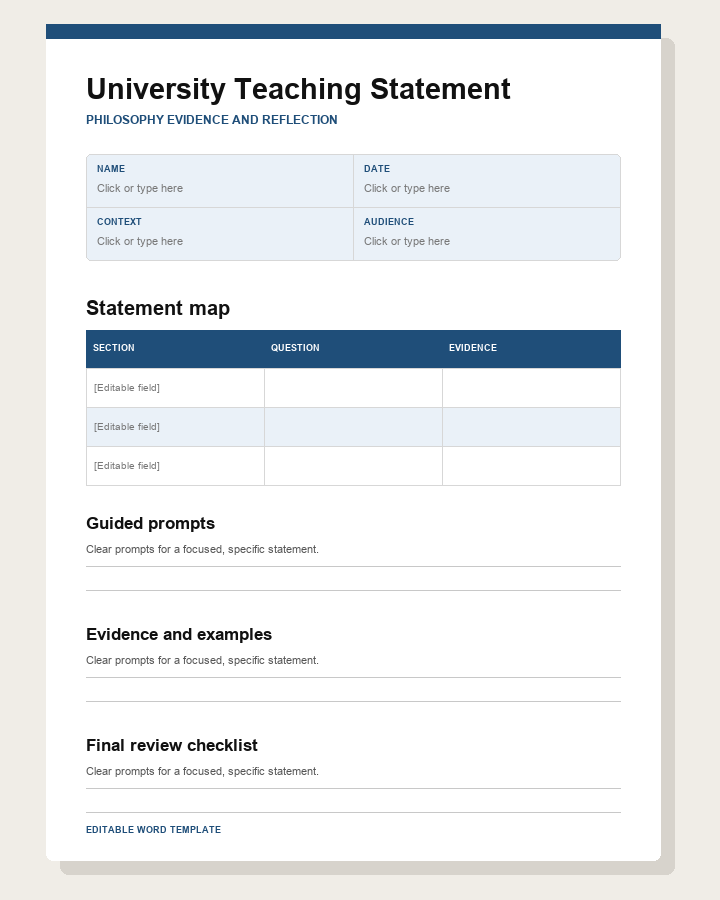
1. University Teaching Statement Template
This blue academic template helps you connect teaching commitments to specific practices and evidence. It includes a statement map, disciplinary and learner context, teaching methods, inclusive learning, assessment and feedback, evidence of effectiveness, reflection, future goals, and space to draft the final statement.
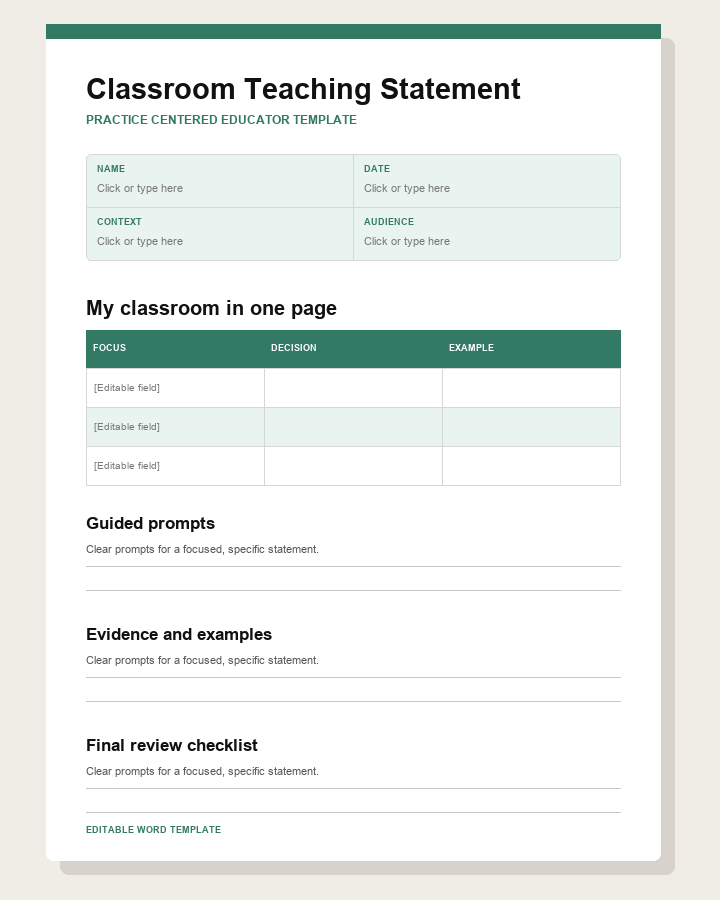
2. Classroom Teaching Statement Template
The green classroom version is a practice-centered educator template. It covers knowledge of learners, planning, instruction, classroom culture, access and differentiation, assessment, instructional response, family and colleague partnership, a classroom example, and a professional growth goal.
What Is a Teaching Statement?
A teaching statement is a concise, evidence-informed explanation of your approach to helping students learn. It may also be called a teaching philosophy statement, statement of teaching philosophy, educator statement, or teaching narrative. The name and expectations vary, so the institution’s current instructions should control the final length and content.
A strong statement does more than list values such as inclusion, engagement, rigor, curiosity, or student-centered learning. It explains what those ideas mean in a specific context and shows how they affect course design, classroom decisions, assessment, feedback, or relationships with learners.
Teaching Philosophy vs. Teaching Statement
The terms are often used interchangeably. In some settings, a teaching philosophy emphasizes the beliefs and principles that guide teaching. A teaching statement may be broader, combining those principles with methods, evidence, reflection, and goals.
If the prompt asks for a philosophy, you still need examples. If it asks for evidence of effectiveness, a purely philosophical essay will be incomplete. Read the criteria carefully and adjust the balance between principles, practices, evidence, and future development.
What to Include in a Teaching Statement
- Learning purpose: what students should understand, practice, or become able to do.
- Context: the discipline, grade, course level, learner group, or teaching environment.
- Teaching practices: concrete ways you structure learning, participation, examples, practice, feedback, and assessment.
- Inclusive learning: specific design and communication choices that improve access and meaningful participation.
- Evidence: student work, aligned assessments, observation, feedback, reflection, or other information that helps you evaluate teaching.
- Development: how experience and evidence changed your decisions.
- Future direction: a realistic teaching goal connected to the role or institution.
How to Start a Teaching Statement
Open with a clear learning purpose rather than a quotation or a broad claim that education changes lives. The reader should quickly understand what matters in your teaching and the context in which you teach.
One useful drafting structure is: “In [discipline or setting], I want learners to become able to [specific capability]. I support that development by [core approach], because [learning rationale].” Rewrite the sentence in your own voice and support it with a concrete example in the next paragraph.
Connect Every Claim to Practice
If you write that your teaching is active, explain what students do. They might analyze contrasting cases, solve a staged problem, annotate a model, rehearse a procedure, critique evidence, create a project, teach a concept to peers, or revise work after feedback.
If you write that your classroom is inclusive, identify the relevant choices. Examples may include transparent assignment instructions, accessible materials, varied ways to participate, structured group roles, early low-stakes practice, language support, multiple examples, predictable routines, or opportunities to demonstrate learning in an appropriate format.
Use Evidence Carefully
Evidence should match the teaching claim. Student ratings can describe perceptions but may not directly measure learning. A high exam average means little unless the assessment is aligned with the intended outcome and the standard is clear. A single positive comment can illustrate an experience but cannot represent every student.
Useful evidence may include samples or patterns in student work, performance on aligned assessments, changes after a course redesign, peer observation, curriculum review, reflective teaching notes, student feedback interpreted with context, retention or progression information, and outcomes from a supervised project. Explain what the evidence suggests and what it cannot prove.
Writing About Inclusive Teaching
Avoid claiming that you treat every student exactly the same or that one method reaches all learners. Inclusive teaching requires attention to access, prior knowledge, communication, representation, classroom climate, and the relationship between standards and support.
Choose one or two examples that show your decision-making. For instance, you might explain how you redesigned instructions after noticing that students misunderstood the purpose of an assignment, or how structured discussion roles improved participation while preserving academic challenge.
University Teaching Statement Structure
- Open with the central learning purpose and disciplinary context.
- Describe two or three teaching practices connected to that purpose.
- Explain how learners practice, receive feedback, and demonstrate learning.
- Give a concrete example from a course, laboratory, studio, clinic, or mentoring context.
- Interpret appropriate evidence of learning or effectiveness.
- Show one way your teaching changed through reflection or evidence.
- Close with a relevant future teaching goal.
Classroom Teaching Statement Structure
A school-focused statement normally benefits from a different emphasis. Establish who the learners are and what you want the classroom to feel and function like. Then show how planning, modeling, guided practice, independent application, formative checks, routines, differentiation, and relationships support meaningful learning.
Include one concise classroom example. Describe the learning goal, the teaching decision, what students did, what evidence you noticed, and what you changed next. This turns a general philosophy into a credible account of practice.
Teaching Statement vs. Personal Statement
A teaching statement focuses on how you support learning and how your practice develops. A Personal Statement is usually broader and may explain background, motivation, experience, or fit for a program or role. If an application requests both, avoid repeating the same story in each document.
For an academic application that also requests future scholarship plans, use a separate Research Statement. The documents should complement each other without becoming interchangeable.
Common Teaching Statement Mistakes
- Opening with a quotation instead of your own teaching purpose.
- Listing values without showing how they change practice.
- Using educational jargon that obscures the actual classroom decision.
- Describing only what the teacher does and not what students do.
- Claiming effectiveness without suitable evidence.
- Treating one student comment as proof for an entire course.
- Using “student-centered” as a label without explaining the learning design.
- Writing a generic statement that ignores the position or institution.
- Repeating the CV course list instead of interpreting experience.
- Describing inclusive teaching as a promise rather than a set of practices.
- Ignoring the stated page or word limit.
Final Review Checklist
- The opening identifies a specific learning purpose.
- The learner group, discipline, grade, or course context is clear.
- Each major principle is connected to an example.
- The statement explains what students do, not only what the teacher does.
- Assessment and feedback are connected to learning goals.
- Evidence is accurate and interpreted with appropriate caution.
- Inclusive teaching appears through concrete decisions.
- The statement shows reflection, change, and a realistic future goal.
- The final version is tailored to the current prompt and length limit.
Frequently Asked Questions
How long should a teaching statement be?
Follow the application or review instructions. Many statements are one or two pages, but requirements vary widely. A concise statement with well-chosen examples is stronger than a longer document that repeats general principles.
Should I include student evaluations?
You can refer to relevant patterns or evidence when appropriate, but interpret evaluations carefully and do not rely on them alone. Combine different sources when possible.
Can a new teacher write a strong statement?
Yes. Use examples from supervised teaching, tutoring, lesson planning, laboratories, workshops, mentoring, coaching, or other relevant learning environments. Be accurate about your role and focus on decisions and reflection.
Should I name teaching theories?
Only when the theory genuinely explains your approach and you can show how it affects practice. A clear classroom example is usually more useful than a list of theoretical labels.
Can I edit these templates in Word?
Yes. Both downloads are editable DOCX files. Replace the prompts, remove sections that do not apply, and adapt the final statement to the required audience and length.