
A cash flow statement explains why a business’s cash balance changed during a reporting period. It separates cash movement into operating activities (day-to-day business), investing activities (such as equipment or investments), and financing activities (such as loans, owner contributions, or distributions). This distinction makes the report more useful than a simple list of receipts and payments.
Cash flow should not be confused with profit. Revenue can be recorded before cash is collected, and expenses can be recognized at a different time from payment. A business may therefore report accounting profit while still experiencing a cash shortage. Reviewing both the income statement and cash flow statement provides a clearer financial picture. Our free cash flow statement templates provide a convenient starting point for preparing and organizing this information without having to create a financial statement from scratch.
These cash flow statement templates are designed to help you record cash receipts, cash payments, operating activities, investing activities, financing activities, and the resulting change in cash balance. You can use a suitable cash flow statement format to prepare monthly, quarterly, or annual reports depending on the needs of your business or organization.
What Is a Cash Flow Statement?
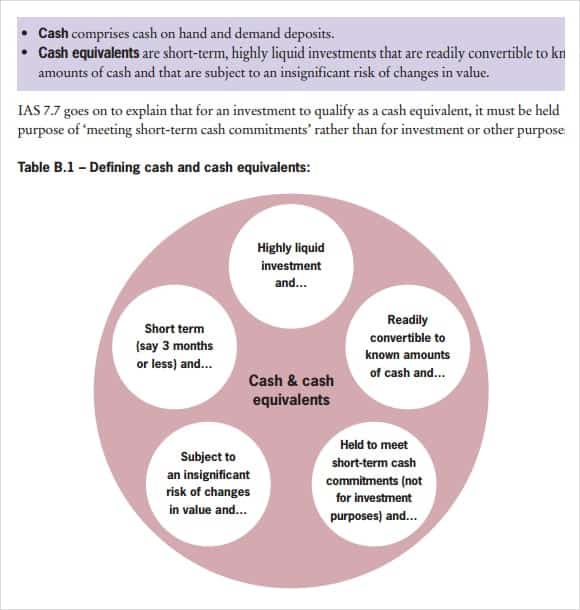
A cash flow statement, also called a statement of cash flows, is a financial report that shows the movement of cash and cash equivalents during a particular accounting period. Unlike an income statement, which focuses on revenue and expenses, a cash flow statement concentrates specifically on actual cash inflows and outflows.
A business may report a profit while still experiencing cash-flow problems. For example, a company may have significant sales on credit but not yet receive the money from customers. A cash flow statement helps identify situations like this by showing how much cash the business actually generated and where that cash was spent.
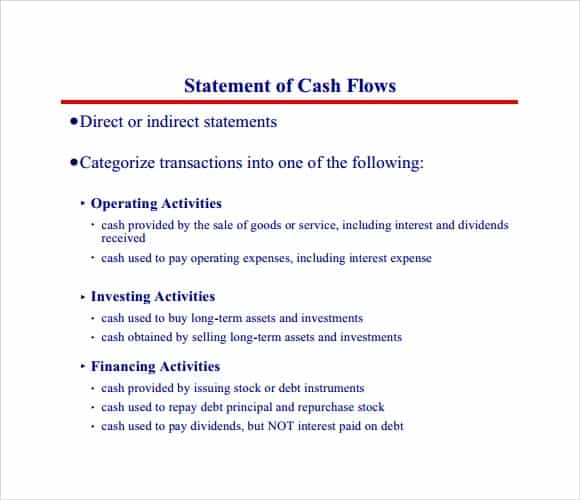
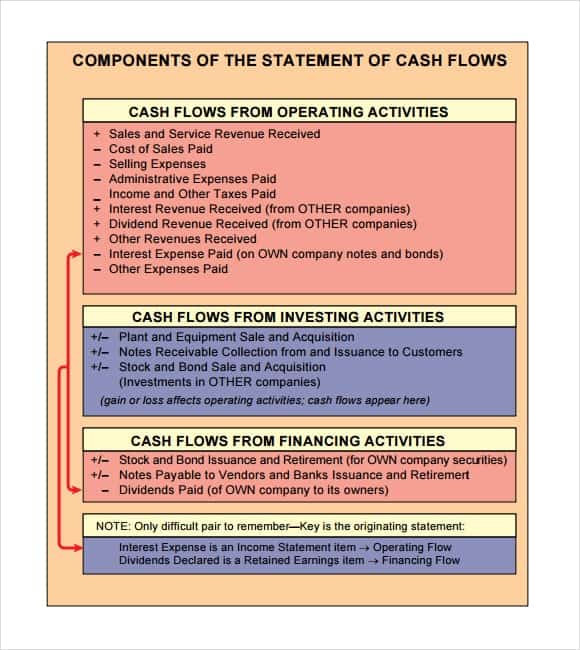
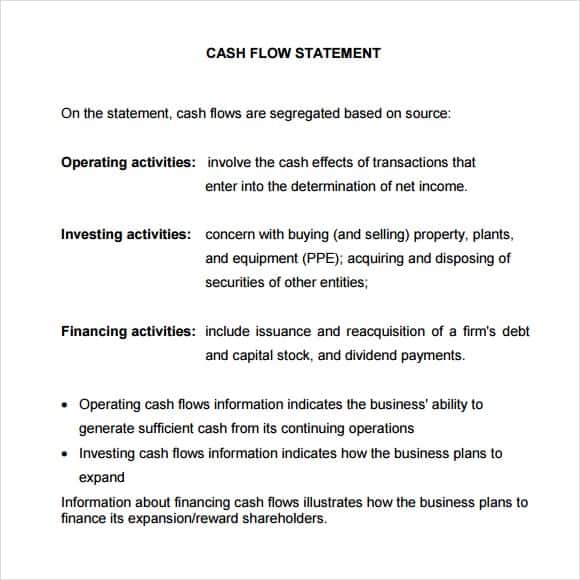
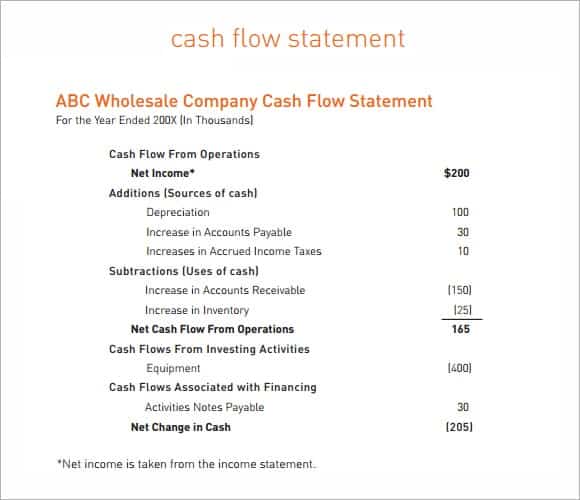
A typical cash flow statement example is divided into three major sections:
- Operating activities – Cash generated or used by the company’s normal business operations.
- Investing activities – Cash associated with buying or selling long-term assets and investments.
- Financing activities – Cash received from or paid to lenders, owners, shareholders, or other financing sources.
The three sections provide a clearer picture of where a company’s cash is coming from and how it is being used.
Free Cash Flow Statement Templates
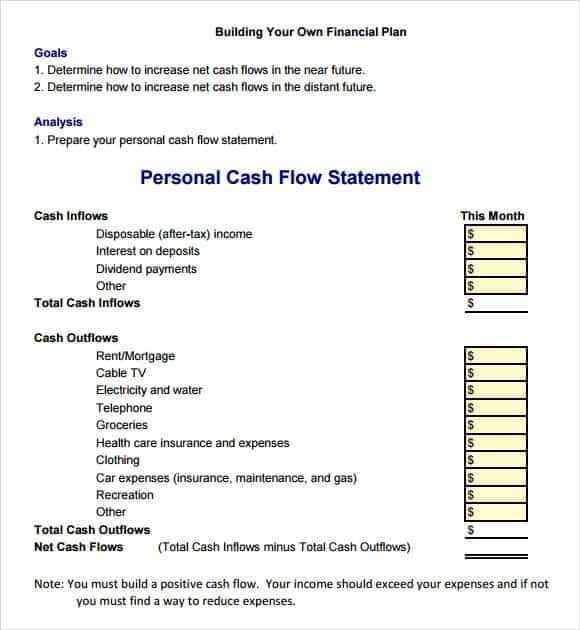
The templates available on this page can help simplify the process of preparing a statement of cash flows. Instead of designing columns, headings, categories, and calculations manually, you can start with an existing cash flow statement template and customize it according to your requirements.
A template can be particularly useful when preparing recurring financial reports. For example, a small business owner may use a monthly cash flow statement template to compare cash received and cash spent every month. A larger organization may use a quarterly or annual format as part of its financial reporting process.
Depending on the template you choose, you may find formats suitable for Word, Excel, or PDF use. Editable formats are especially helpful when you need to enter figures, change categories, add business information, or modify the reporting period.
What Should a Cash Flow Statement Include?
Although the exact layout can vary depending on the business and reporting requirements, a useful cash flow statement generally includes several important pieces of information.
The document should identify the business or organization name, the reporting period, and the currency being used. It should then organize cash inflows and outflows into appropriate categories.
Common items can include:
Cash from operating activities:
This section may include cash received from customers, payments to suppliers, employee payments, operating expenses, taxes, and other cash transactions associated with normal business activities.
Cash from investing activities:
This section can include the purchase or sale of property, equipment, machinery, investments, and other long-term assets.
Cash from financing activities:
This section may include loans received, loan repayments, owner contributions, dividends, share-related transactions, and other financing activities.
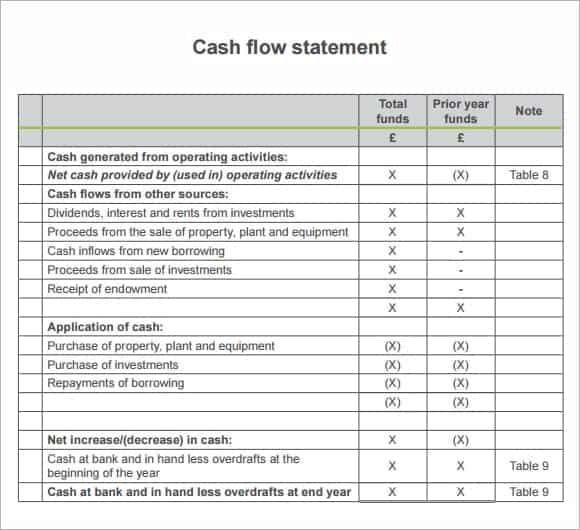
The statement may then show the net increase or decrease in cash, beginning cash balance, and ending cash balance.
Direct and Indirect Cash Flow Statement Formats
There are two commonly recognized approaches to presenting operating cash flows: the direct method and the indirect method.
The direct method lists major categories of actual cash receipts and payments. For example, it may show cash received from customers and cash paid to suppliers and employees.
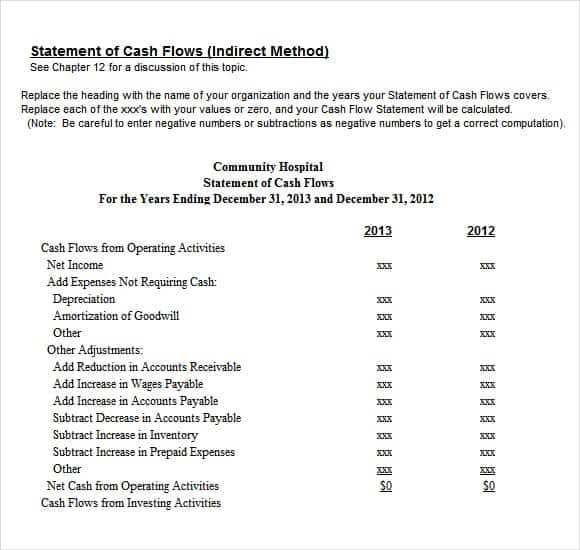
The indirect method starts with a profit-related figure and makes adjustments for non-cash items and changes in working capital to arrive at cash generated from operating activities.
When selecting a cash flow statement format, consider the purpose of the report, your accounting system, the information available to you, and any applicable reporting requirements. A simple template can be customized to match the method you need to use.
Why Use a Cash Flow Statement Template?
Creating a financial statement from a blank spreadsheet or document can take considerable time. A professionally organized template gives you a basic structure that you can adapt instead.
Using a free cash flow statement template can help you:
- Organize cash inflows and outflows clearly.
- Separate operating, investing, and financing activities.
- Track cash balances over a specific period.
- Prepare monthly or annual cash flow reports.
- Reduce the time required to design a financial statement.
- Maintain a consistent reporting format.
- Make financial information easier to review.
- Identify periods of positive or negative cash flow.
- Customize categories for your business.
- Create a professional-looking financial document.
Templates are also useful for students, accountants, business owners, managers, entrepreneurs, and anyone learning how cash flow statements work.
Cash Flow Statement Template in Excel
An Excel cash flow statement template can be especially useful when calculations are required. Spreadsheet-based templates allow you to enter figures into rows and columns and use formulas to calculate totals, net cash flow, and changes in cash balances.
Excel can also make it easier to compare different reporting periods. For example, you could create columns for January through December and monitor monthly cash-flow performance throughout the year.
When using an Excel template, always review formulas and totals carefully. A template provides a structure, but the accuracy of the final statement depends on the financial information entered into it.
Cash Flow Statement Template in Word
A cash flow statement template in Word can be useful when you need an editable document that can be printed, shared, or included with other business documents. Word templates are convenient when the primary objective is creating a clean and professional report rather than performing extensive calculations.
You can customize the company name, reporting period, headings, descriptions, amounts, and other information before saving or printing the completed document.
Cash Flow Statement PDF
A cash flow statement PDF template can be useful when you need a fixed-format document for printing, sharing, or reviewing. PDF files generally preserve the appearance of the document across different devices.
If you need to calculate or modify financial figures, however, an editable Word or Excel version may be more convenient. After completing the statement, you can save or export the final version as a PDF for distribution or recordkeeping.
How to Prepare a Cash Flow Statement
If you are creating a cash flow statement for your business, begin by selecting the reporting period. This might be a month, quarter, or financial year.
Next, gather the relevant financial records, including bank transactions, cash receipts, payments, loan activity, asset purchases, investment transactions, and other information affecting cash.
Organize the transactions into operating, investing, and financing activities. Calculate the net cash generated or used in each category and then determine the overall change in cash during the reporting period.
Finally, reconcile the result with the beginning and ending cash balances. Reviewing the figures carefully can help identify missing transactions, incorrect classifications, or calculation errors.
Monthly Cash Flow Statement
A monthly cash flow statement can be particularly valuable for small businesses and organizations that need to monitor their cash position regularly. Monthly reporting allows you to see whether cash receipts are keeping pace with expenses and other payments.
Regular cash-flow tracking can also help with budgeting and financial planning. If a business expects unusually high expenses in a particular month, reviewing previous cash-flow statements can help management prepare for those obligations.
A monthly template can therefore become part of a broader business cash flow management process.
Cash Flow Statement vs. Income Statement
A cash flow statement and an income statement provide different types of financial information.
An income statement generally reports revenue, expenses, and profit or loss for a specific period. A cash flow statement focuses on actual cash movement.
These reports should not be treated as interchangeable. A profitable company can have weak cash flow, while a company can experience temporary positive cash flow even when its overall profitability is poor.
Using both statements together provides a more complete view of business finances.
Who Can Use These Templates?
Cash flow templates are useful for a wide range of users. Small business owners can use them to monitor cash availability, while accountants and finance professionals can use them as a starting point for financial reporting.
Entrepreneurs can use a cash flow forecast template when planning future cash requirements, while students can use cash flow statement examples to understand the structure and purpose of financial statements.
They can also be useful for freelancers, consultants, nonprofit organizations, partnerships, and other organizations that need to track cash receipts and payments.
Choose a Cash Flow Statement Template
A good cash flow statement should make financial information easier to understand rather than more complicated. Choose a template that matches the type of reporting you need and customize the headings, dates, categories, and figures as necessary.
Our collection of free cash flow statement templates gives you a practical starting point for creating a structured statement of cash flows. Whether you need a simple cash flow statement example, a printable format, an editable Word document, or an Excel spreadsheet for calculations, select the format that best fits your purpose.
Before using a completed statement for formal accounting, tax, investment, lending, or regulatory purposes, make sure the information has been reviewed for accuracy and complies with the accounting standards and requirements applicable to your situation.
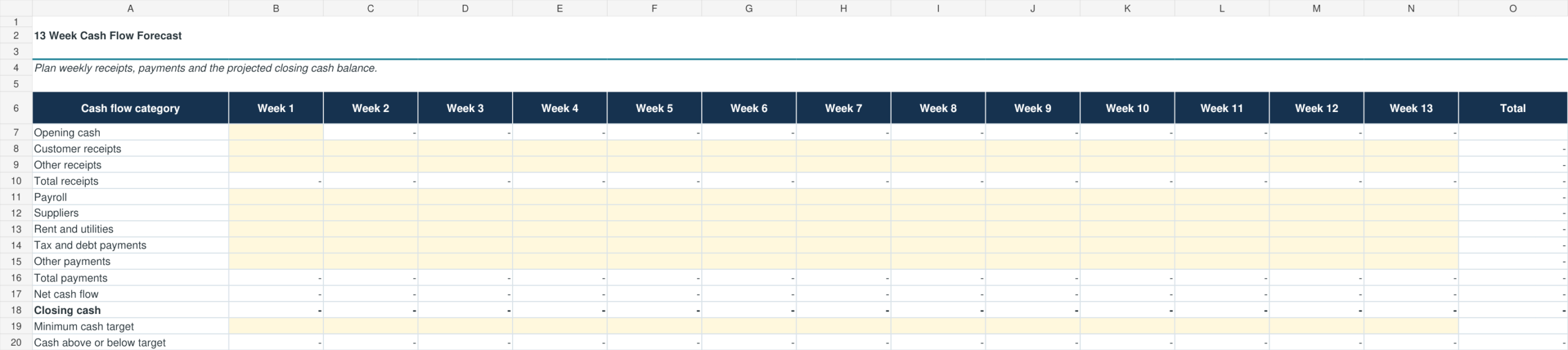
Download 13 Week Cash Flow Forecast Template
Use this Excel forecast to plan weekly receipts and payments, calculate net cash flow and closing cash, and compare available cash with a minimum target over 13 weeks.

FAQs
1. What is a cash flow statement template?
A cash flow statement template is a pre-formatted document or spreadsheet used to organize cash inflows, cash outflows, and changes in cash during a specific reporting period. It provides a structured starting point for preparing a statement of cash flows.
2. What are the three sections of a cash flow statement?
The three main sections are operating activities, investing activities, and financing activities. Together, these sections show how a business generates and uses cash.
3. Can I use a cash flow statement template for a small business?
Yes. A cash flow statement template can be useful for small businesses, freelancers, startups, and entrepreneurs who want to monitor cash receipts, expenses, investments, financing, and their overall cash position.
4. Is there a cash flow statement template in Excel?
Yes. An Excel cash flow statement template can be used to enter financial figures, calculate totals, compare reporting periods, and organize cash-flow information in a spreadsheet format.
5. What is the difference between a cash flow statement and an income statement?
An income statement focuses primarily on revenue, expenses, and profit or loss, while a cash flow statement focuses on the actual movement of cash into and out of the business.
6. Can I create a monthly cash flow statement?
Yes. A monthly cash flow statement can help you monitor cash activity throughout the year. You can use a template to record monthly cash receipts, payments, and changes in cash.
7. Should I use Word or Excel for a cash flow statement?
Excel is generally more convenient when you need calculations and formulas, while Word can be useful for an editable, printable document. The best format depends on how you intend to prepare and use the statement.
8. What information is needed to prepare a cash flow statement?
You generally need information about cash receipts, payments, operating expenses, asset purchases and sales, investments, loans, owner or shareholder transactions, and beginning and ending cash balances.
You must be logged in to post a comment.