
A confidentiality statement communicates that information is sensitive and explains expectations for its use, disclosure, storage, or distribution. Depending on the context, it may identify the intended recipient, describe the information covered, limit permitted use, request secure handling, and provide instructions if the document reaches someone unintentionally.
A confidentiality notice is not automatically equivalent to a negotiated non-disclosure agreement (NDA). An NDA typically creates contractual obligations between parties and may define exclusions, duration, remedies, and governing terms. Choose the document type according to the actual legal and business purpose.
Our free confidentiality statement templates provide a convenient starting point for creating a clear and professional confidentiality notice. Instead of writing a statement from scratch, you can customize a template with information appropriate for your company, project, document, or intended audience.
A confidentiality statement can help communicate expectations about the handling of sensitive information. Depending on its purpose, it may identify information as confidential, restrict unauthorized disclosure, explain permitted use, or direct the recipient to handle the document carefully.
These templates can be adapted for businesses, consultants, freelancers, organizations, project teams, employees, clients, vendors, and other professional situations.
What Is a Confidentiality Statement?
A confidentiality statement is a written declaration indicating that certain information is confidential or should be treated as private.
It is commonly placed in documents containing sensitive business information, proprietary material, financial information, customer data, project details, research, internal communications, or other information that the sender does not want distributed without authorization.
A simple confidentiality statement example might tell the recipient that the document contains confidential information and should not be copied, disclosed, or distributed to unauthorized individuals.
The wording should be appropriate for the specific situation. A short notice on a business report may be very different from detailed confidentiality provisions contained in a legally binding agreement.
Free Confidentiality Statement Templates
Using a free confidentiality statement template can save time and provide a professional structure for your document.
A template can be customized to include the name of a company or organization, the type of information being protected, the intended recipients, permitted uses, and any other relevant instructions.
You can also adjust the wording depending on where the statement will appear. A confidentiality notice attached to a business report may require only a few sentences, while a project involving highly sensitive information may require more comprehensive documentation.
The templates on this page should be treated as starting points. Review and customize the wording so that it accurately reflects your circumstances.
What Should a Confidentiality Statement Include?
There is no single format that applies to every confidentiality statement. However, a professional confidentiality statement format may include several useful elements.
Confidentiality Notice:
Clearly indicate that the document or information contains confidential material.
Description of Information:
Where appropriate, identify the general type of information that should be treated as confidential.
Intended Recipients:
Specify who is authorized to receive or access the information when this is relevant.
Restrictions on Disclosure:
Explain that confidential information should not be disclosed, copied, reproduced, forwarded, or distributed without appropriate authorization.
Permitted Use:
If applicable, state that the information may only be used for the specific purpose for which it was provided.
Ownership:
A statement may identify the organization or person who owns the information or document.
Contact Information:
Some notices provide a contact person or department for questions concerning access or permitted use.
Not every confidentiality notice needs every element. The appropriate content depends on the type of information, document, and relationship between the parties.
Confidentiality Statement Example
A confidentiality statement example can help you understand the type of language commonly used in a professional notice.
For example, a company preparing an internal business report might include a notice stating that the report contains confidential company information and is intended only for authorized recipients. The notice could request that recipients do not reproduce, forward, or distribute the document without permission.
A consultant preparing a report for a client might similarly indicate that the report contains information provided for the client’s specific business purposes and should not be shared with unauthorized parties.
The exact wording should be adapted to the circumstances rather than copied without review.
Business Confidentiality Statement
A business confidentiality statement can be useful when a company shares sensitive information with employees, consultants, contractors, customers, vendors, or business partners.
Businesses may need to protect information such as:
- Financial information
- Business plans
- Customer information
- Pricing information
- Marketing strategies
- Product plans
- Research and development information
- Internal processes
- Supplier information
- Proprietary methods
- Trade secrets
- Technical information
- Strategic plans
A confidentiality notice can communicate that such information should be handled responsibly.
However, simply placing a confidentiality statement on a document does not automatically create every legal protection a business might need. Important proprietary information may require contractual protections and appropriate security controls.
Confidentiality Statement for Documents
A confidentiality statement for documents is often placed near the beginning or end of a report, proposal, presentation, manual, or other business document.
The notice can alert readers that the document should not be distributed beyond its intended audience.
For example, a consulting report might contain confidential information about a client’s operations, finances, customers, or future plans. A confidentiality notice can make the intended handling of that information clear to people who receive the report.
The notice should be visible without interfering with the readability of the document.
Confidentiality Notice
The terms confidentiality statement and confidentiality notice are sometimes used interchangeably in everyday business communication.
A confidentiality notice generally serves as a warning or instruction to recipients that certain information should be treated as confidential.
It may appear in an email, report, proposal, presentation, document footer, employee handbook, or other communication.
A short notice can be appropriate when the primary objective is simply to alert recipients to the sensitive nature of the information.
Confidentiality Statement for Business Reports
Business reports can contain information that is not intended for public distribution. A confidentiality statement can therefore be included in reports prepared for management, clients, investors, consultants, or internal teams.
For example, a financial analysis may contain non-public business information, while a market research report may contain confidential research findings.
A report confidentiality notice can clarify that the document is intended for a specific audience and should not be distributed without authorization.
Confidentiality Statement for Proposals
Companies and consultants may include a confidentiality statement in business proposals when the proposal contains proprietary methods, pricing information, strategic recommendations, technical concepts, or other sensitive material.
A notice can remind the recipient that the proposal was prepared for a particular purpose and should be handled appropriately.
If the information is especially sensitive, the parties may need a separate confidentiality agreement rather than relying solely on a notice printed on the proposal.
Confidentiality Statement for Employees
Organizations may also use confidentiality statements or confidentiality policies to communicate expectations to employees.
Employees may have access to customer records, financial information, internal processes, business strategies, technical data, or other non-public information.
An employee confidentiality statement can reinforce the organization’s expectations concerning the use and disclosure of such information.
For important employment-related confidentiality obligations, however, the applicable employment agreement, company policy, and local legal requirements should also be considered.
Confidentiality Statement for Freelancers and Consultants
Freelancers and consultants frequently receive confidential information from clients. A confidentiality statement can be included in project documentation to indicate that client information should be treated as private.
For example, a marketing consultant may receive customer data and campaign plans, while a software developer may receive source code, technical specifications, or product plans.
A confidentiality notice can help communicate expectations, but freelancers and clients may also use a separate non-disclosure agreement (NDA) when formal contractual confidentiality obligations are needed.
Confidentiality Statement vs. Non-Disclosure Agreement
A confidentiality statement and an NDA, or non-disclosure agreement, are not necessarily the same thing.
A confidentiality statement or notice may simply inform a recipient that information is confidential and explain how it should be handled.
A non-disclosure agreement is generally a contractual document in which parties agree to specific confidentiality obligations. Depending on its wording and applicable law, an NDA may establish enforceable obligations concerning the use and disclosure of confidential information.
For this reason, a simple confidentiality statement should not automatically be treated as a substitute for a properly drafted NDA or other contractual agreement.
Confidentiality Statement vs. Privacy Statement
A privacy statement and a confidentiality statement address different concepts.
A privacy statement commonly explains how an organization collects, uses, stores, shares, or otherwise processes personal information.
A confidentiality statement generally focuses on restricting the disclosure or use of particular information.
For example, a company website may have a privacy notice explaining how visitor information is processed, while an internal report may contain a confidentiality notice explaining that the report should not be distributed outside an authorized group.
The appropriate document depends on the type of information and the purpose of the notice.
Why Use a Confidentiality Statement Template?
Creating a confidentiality notice from scratch can be unnecessary when a suitable structure is already available.
A confidentiality statement template can help you:
- Save time when preparing documents
- Create a consistent confidentiality notice
- Clearly identify sensitive information
- Communicate handling expectations
- Customize wording for different documents
- Create a professional-looking notice
- Add company or project information
- Provide a clear reminder to authorized recipients
- Use consistent language across business documents
Templates can be particularly useful for organizations that regularly prepare reports, proposals, presentations, project documents, and other materials containing sensitive information.
Where Can a Confidentiality Statement Be Used?
A confidentiality statement may be appropriate in many professional situations.
Common examples include:
- Business reports
- Financial reports
- Consulting reports
- Project documentation
- Business proposals
- Research reports
- Employee documents
- Internal company communications
- Client deliverables
- Technical documents
- Marketing plans
- Strategic plans
- Presentations
- Business plans
- Vendor documentation
The wording should always match the purpose and sensitivity of the information involved.
How to Write a Confidentiality Statement
Begin by identifying what information needs to be protected and who is expected to receive it.
Next, decide what you want the notice to communicate. You may need to state that the information is confidential, identify restrictions on copying or distribution, explain permitted use, or provide instructions for handling the document.
Keep the wording clear and specific. Avoid unnecessary legal terminology if the notice is intended simply as a professional communication.
If the information is highly sensitive or the parties need legally enforceable confidentiality obligations, consider whether a formal agreement prepared or reviewed by an appropriately qualified legal professional is more appropriate.
Finally, place the statement where recipients are likely to see it, such as near the beginning of the document, on a title page, or in a footer where appropriate.
Tips for Creating an Effective Confidentiality Notice
A useful confidentiality statement should be easy to understand.
Avoid writing a long paragraph that recipients are unlikely to read. Clearly identify the confidential nature of the information and explain the most important restrictions or expectations.
Use terminology consistently throughout the document. If you refer to certain information as “Confidential Information,” make sure that term has a clear meaning in the context of the document.
Also consider who will read the statement. A notice intended for employees may use different wording from one intended for external clients or business partners.
Choose the Right Confidentiality Statement Template
The right confidentiality statement template depends on what you are trying to protect and how the document will be used.
A simple business report may need only a short confidentiality notice. A project involving proprietary technology, customer information, financial information, or trade secrets may require more comprehensive confidentiality provisions.
Choose a template that provides an appropriate starting structure, then customize the wording to fit your specific document and circumstances.
Our free confidentiality statement templates can help you create a clear and professional notice for business documents, reports, proposals, projects, and other communications containing sensitive information.
Before relying on a confidentiality statement for important legal or commercial purposes, make sure the language is appropriate for your situation and consider obtaining professional legal advice where necessary.
Download and See Confidentiality Statement Templates:
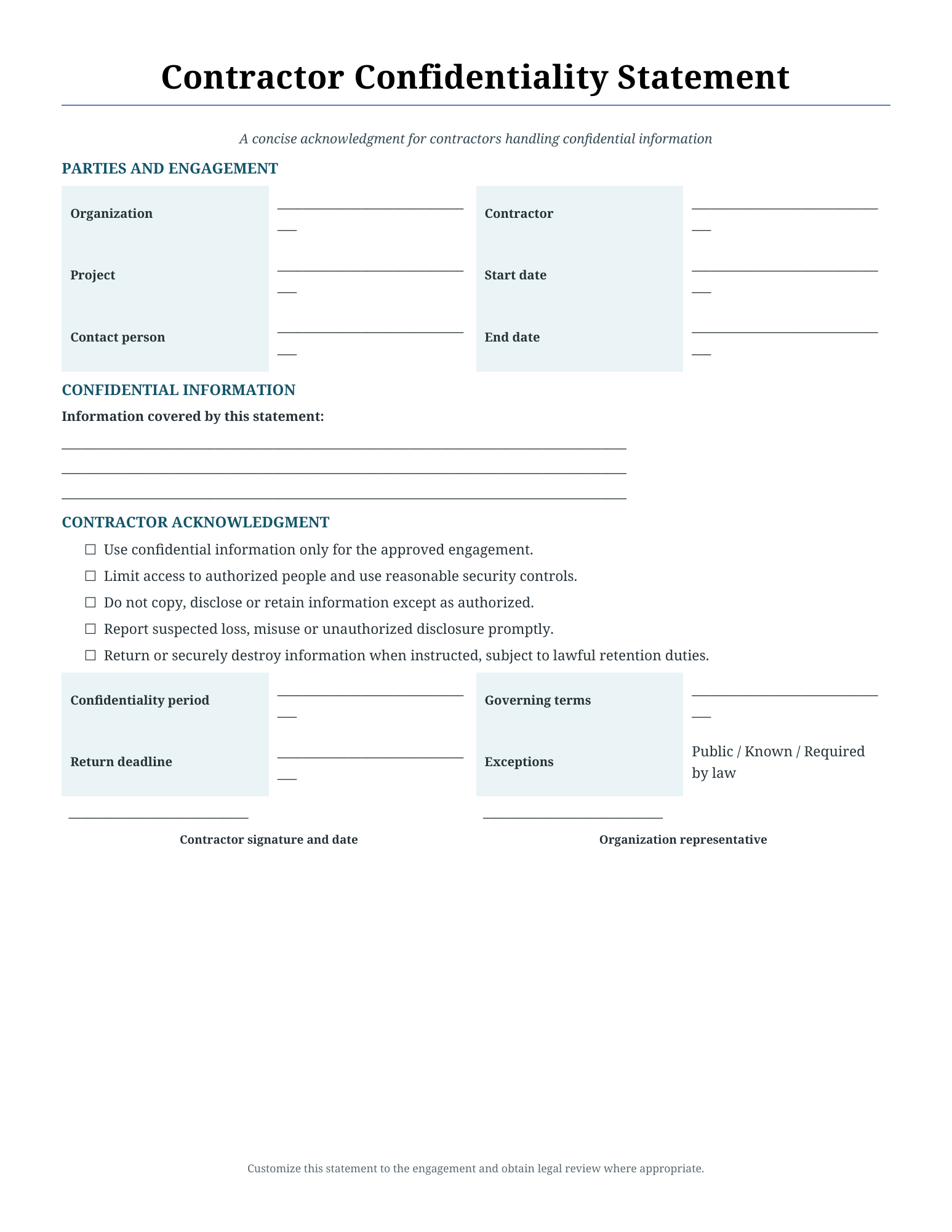
Download Contractor Confidentiality Statement
Use this editable Word statement to define confidential information, contractor duties, permitted exceptions, return deadlines, and signed acknowledgment.

FAQs
1. What is a confidentiality statement?
A confidentiality statement is a written notice explaining that certain information is private or confidential and should not be disclosed, copied, or distributed without appropriate authorization.
2. What is a confidentiality notice?
A confidentiality notice alerts recipients that a document or information contains confidential material and may provide instructions or restrictions concerning its use and distribution.
3. What should a confidentiality statement include?
Depending on its purpose, it may identify confidential information, intended recipients, permitted uses, restrictions on disclosure, ownership, and instructions for handling the document.
4. Can I use a confidentiality statement for a business report?
Yes. A confidentiality statement can be included in business reports containing sensitive financial, operational, customer, strategic, technical, or proprietary information.
5. Is a confidentiality statement the same as an NDA?
No. A simple confidentiality statement or notice is not necessarily the same as a non-disclosure agreement. An NDA is generally a contractual document containing specific confidentiality obligations.
6. Can a freelancer use a confidentiality statement?
Yes. Freelancers and consultants can use confidentiality notices in project documents, although a formal NDA may be more appropriate when legally binding confidentiality obligations are required.
7. Where should a confidentiality statement appear?
It can appear on a title page, near the beginning or end of a document, in a footer, or in another visible location appropriate for the document’s format.
8. What is the difference between confidentiality and privacy?
Confidentiality generally concerns restricting disclosure or use of information, while privacy commonly concerns how personal information is collected, used, stored, and shared.
9. Can I edit a confidentiality statement template in Word?
Yes. An editable Word template can be customized with company information, document details, confidentiality requirements, and other relevant wording.
10. Does a confidentiality statement legally protect information?
The legal effect of a confidentiality notice depends on its wording, circumstances, applicable law, and other agreements between the parties. A notice should not automatically be assumed to provide the same protection as a properly drafted confidentiality agreement.
You must be logged in to post a comment.