
Every loan comes down to a few questions: how much is still owed, how much of each payment goes to interest, and when will it be paid off? A loan statement answers all three. Whether you are a borrower checking your lender’s figures, a family member lending money informally or a small lender servicing a handful of borrowers, a clear loan statement template keeps the record accurate and avoids arguments about what has been paid.
This guide explains what a loan statement contains and how amortization works. It covers the statements you’ll need for tax and accounting and shows how to use each of the five free templates.
What Is a Loan Statement?
A loan statement is a record of a loan account over a period: the opening balance, payments received, interest charged, fees and the closing balance. Banks and lenders typically send one monthly, quarterly or annually. Like a statement of account, it tells both parties exactly where the balance stands on a given date.
There are a few common types:
- Periodic borrower statement: the monthly or quarterly statement a lender sends, showing recent activity and the next payment due.
- Amortization statement or schedule: a full table of every scheduled payment over the life of the loan, split into interest and principal.
- Annual interest statement: a year-end summary of interest paid, often used for tax returns or business accounts.
- Loan payoff statement: a quote for the exact amount needed to settle the loan on a specific date, including accrued interest and any fees.
- Informal repayment record: a simple log of repayments on a loan between friends, family or business partners.
Key Information on a Loan Statement
- Lender and borrower names, the loan or account number and the statement date
- Original loan amount, interest rate (fixed or variable) and term
- Opening principal balance for the period
- Payments received, with dates and amounts
- How each payment was split between interest, principal, fees and any escrow
- Interest charged or accrued for the period
- Closing principal balance
- Year-to-date totals for interest and principal
- Next payment amount and due date
- Late fees, arrears or payment holiday information, where relevant
How Loan Amortization Works
Most instalment loans, including car loans, personal loans, equipment finance and mortgages, use a fixed payment calculated so the loan is fully repaid by the end of the term. In Excel that payment comes from the PMT function:
Payment = PMT(annual rate ÷ 12, number of months, −loan amount)
Each month, interest is worked out on the outstanding balance (balance × annual rate ÷ 12). The rest of the payment reduces the principal. Early in the loan the balance is high, so most of each payment is interest. As the balance falls, more of each payment goes to principal. That is why extra payments early on save so much interest: every extra dollar comes straight off the balance that interest is charged on.
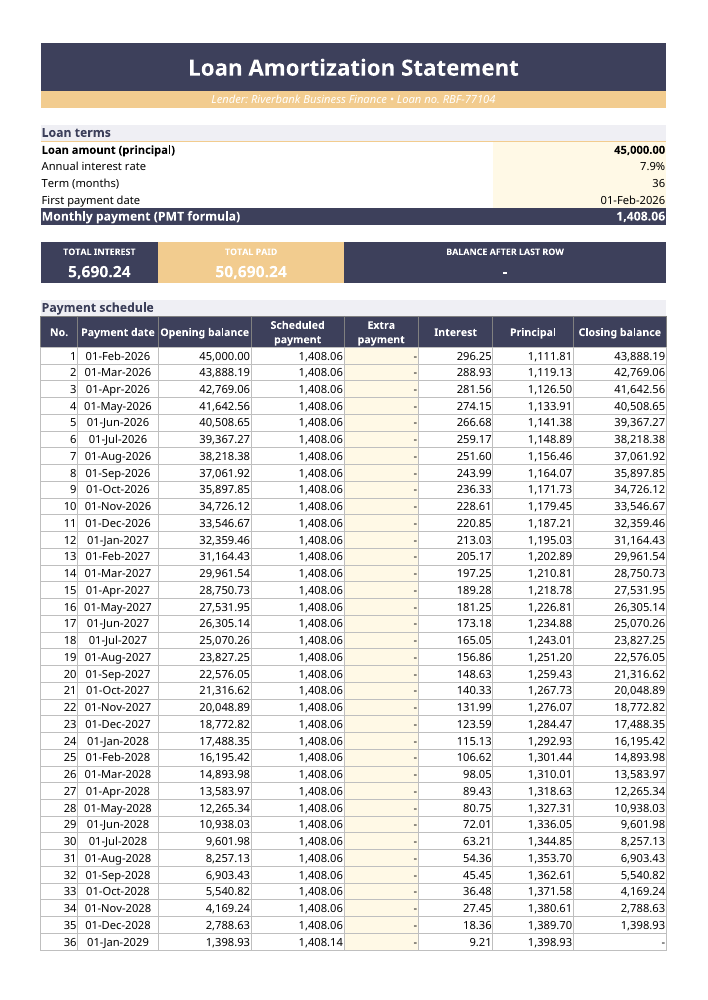
The amortization template on this page builds that schedule for you. Change the loan amount, rate, term or start date and all 36 rows recalculate. Type an amount in the “Extra payment” column for any month and you’ll see the balance fall faster. The final row is adjusted so the loan closes at exactly zero.
Download 5 Free Loan Statement Templates
Pick the template that matches your role. Borrowers can track a loan, private lenders can send statements, and businesses can summarise all their debt. The Excel files use PMT and running-balance formulas, and each template also comes as a PDF.
1. Loan Amortization Statement Template
Enter the amount, rate, term and first payment date. The PMT formula builds a 36-month schedule with interest, principal, an extra-payment column and the running balance.
2. Personal Loan Repayment Statement
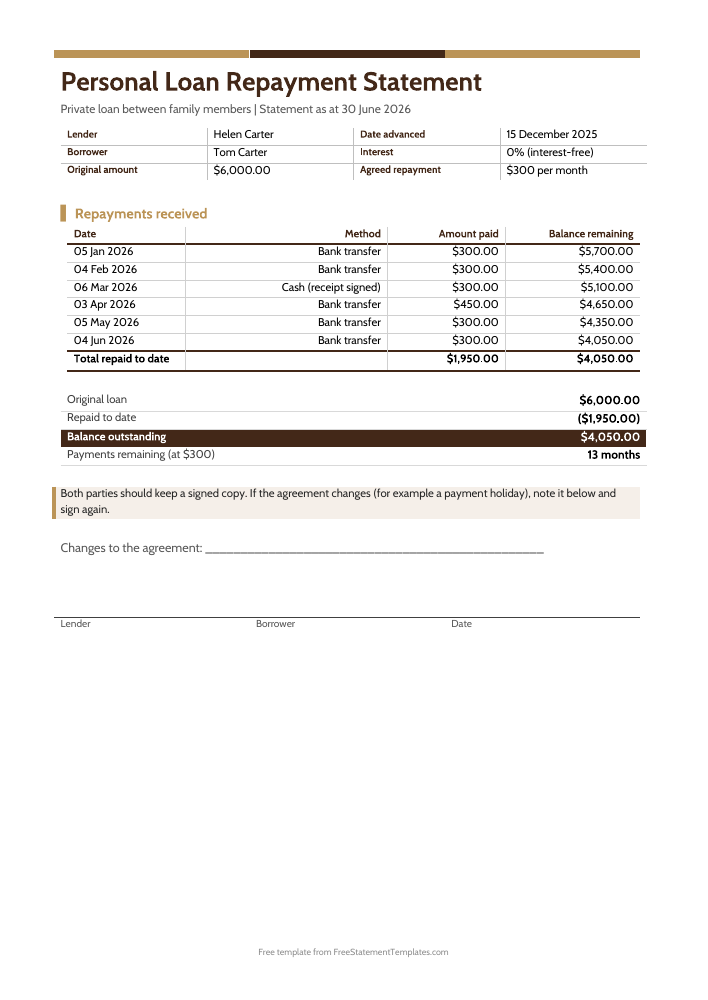
A simple Word record for loans between friends or family. It lists each repayment, the balance left and the months remaining, with space for both signatures.
3. Annual Loan Interest Statement
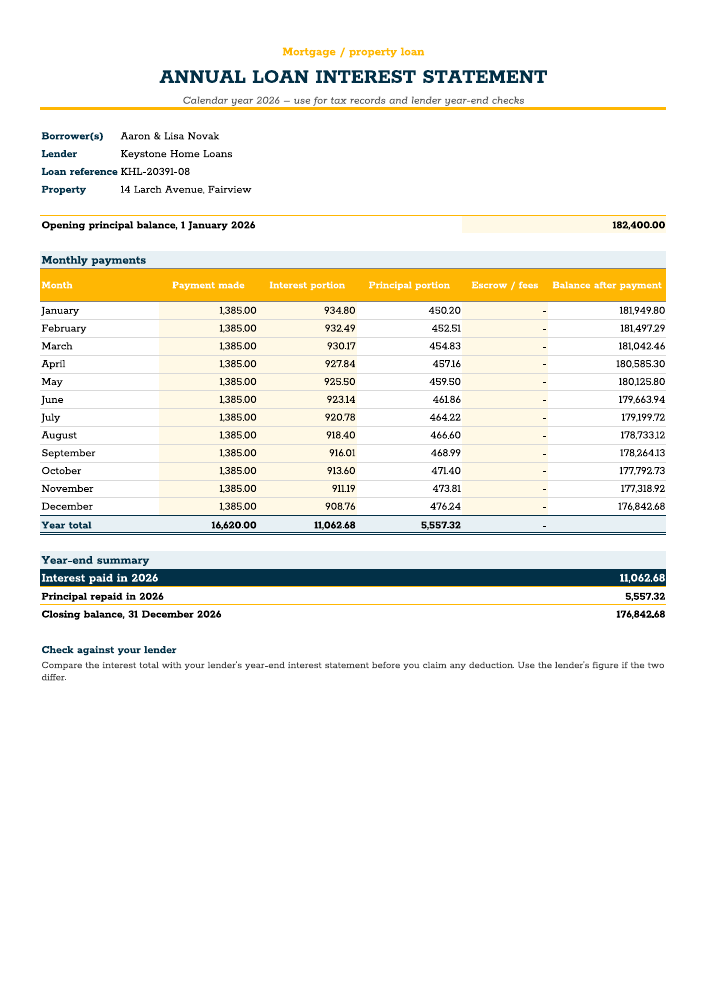
Splits each monthly payment into interest and principal for the calendar year and totals the interest paid. Useful for tax records and year-end checks.
4. Monthly Borrower Statement (Lender Version)
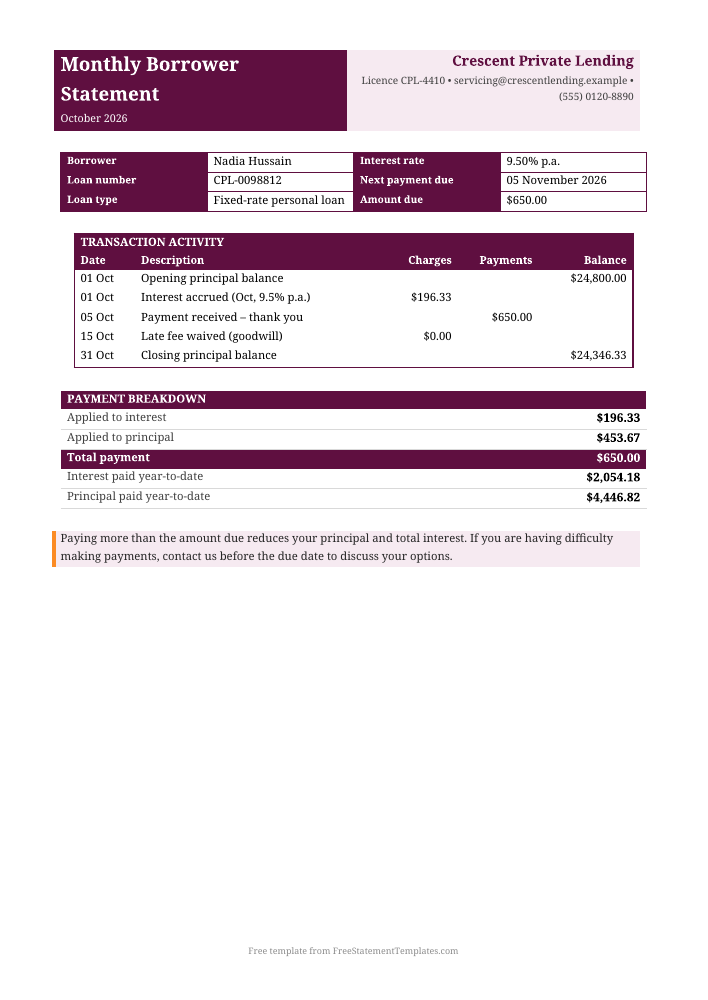
For private lenders and small finance firms that send borrowers a monthly statement with activity, payment breakdown, year-to-date totals and the next due date.
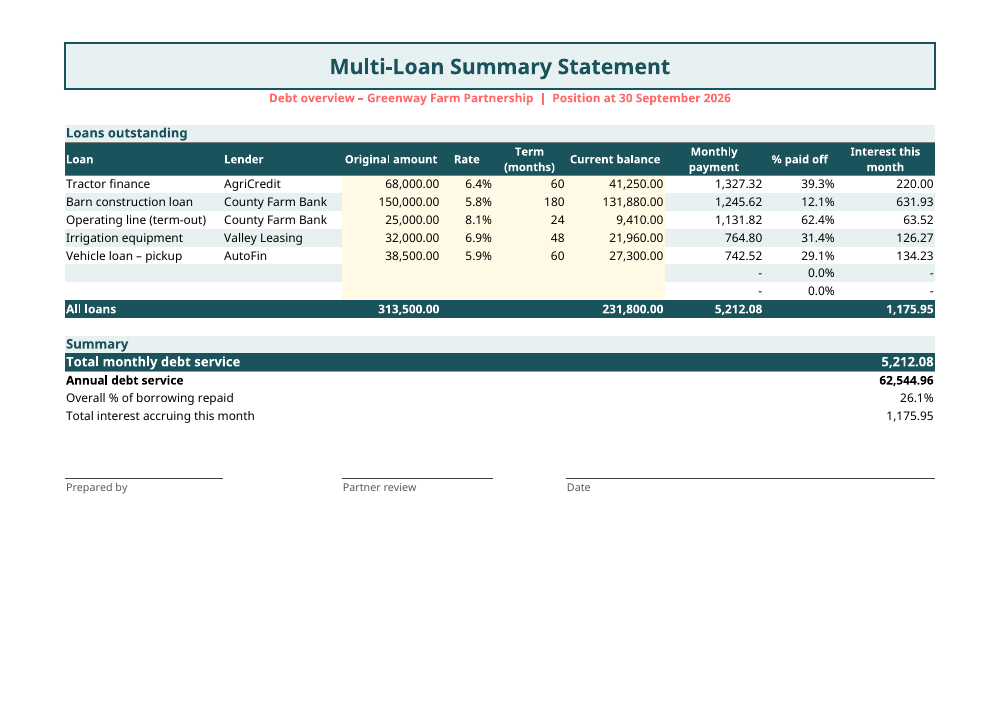
5. Multi-Loan Summary Statement
Every loan on one landscape sheet, with PMT-based monthly payments, % paid off, this month’s interest and total debt service.
How to Prepare a Loan Statement
- Gather the loan agreement. Note the principal, rate, compounding basis, term, payment date and any fees or penalties.
- Set the statement period and the opening balance, which is the closing balance from the previous statement.
- Record every payment with its date, method and amount. For informal loans, write down how each payment was made (bank transfer, cash with a signed receipt) so there is evidence later.
- Calculate interest for the period using the method in the agreement. Most simple monthly statements use balance × rate ÷ 12. Some lenders use daily interest, which gives slightly different figures.
- Allocate each payment. Normally fees and interest are covered first, and the remainder reduces principal.
- Work out the closing balance and the year-to-date totals.
- Show the next payment amount and due date, and add any messages about arrears or changes in rate.
- Share and keep a copy. Both parties should keep the statement. For family loans, sign it as well.
Loans Between Family and Friends
Informal loans cause more arguments than almost any other money matter, usually because nobody wrote anything down. The personal loan repayment statement keeps it simple: record the original amount, the agreed repayment, each payment received and the balance left. Both of you sign it, and if the arrangement changes, such as a skipped month or a new payment amount, write the change in the space provided and sign again. In many countries loans above certain amounts, or interest-free loans, can have tax consequences, so check local rules for large sums. A sworn statement can also help formally record that a sum was a loan rather than a gift.
Annual Interest Statements and Taxes
Interest on some loans may be tax deductible: business loans, many mortgages in certain countries and some student loans. The annual loan interest statement splits each monthly payment into interest and principal and totals the year’s interest. Lenders send an official year-end interest figure, such as Form 1098 for US mortgage interest, so use this template to check that figure, not replace it. If the two differ, ask the lender why before you file.
Multi-Loan Summaries for Businesses
Farms, contractors, clinics and other small businesses often carry several loans at once, for equipment, vehicles, buildings and working capital. The multi-loan summary puts them on one sheet with each loan’s original amount, rate, term, current balance, calculated monthly payment, percentage repaid and this month’s interest. The totals give you monthly and annual debt service, which lenders use to judge whether you can take on more borrowing. Copy the current balances into your balance sheet, splitting each loan into the part due within a year and the rest, and include the interest in your profit and loss statement.
Common Mistakes With Loan Statements
- Applying the payment to principal before interest. Unless the agreement says otherwise, interest and fees are paid first.
- Using the wrong rate period. An annual rate must be divided by 12 for monthly interest. Using the annual rate in a monthly formula inflates interest twelvefold.
- Ignoring extra payments. Record prepayments separately so the reduced balance is used for future interest.
- Not reconciling to the lender. Compare your schedule with the lender’s statement every few months. Small differences are normal rounding. Large ones need a phone call.
- Losing evidence of informal payments. Cash repayments without a receipt are the most common source of family loan disputes.
For other account-style records, browse our Bank & Account Statements category.
Frequently Asked Questions
What is the difference between a loan statement and an amortization schedule?
A loan statement records actual activity over a period, such as payments received, interest charged and the closing balance. An amortization schedule projects every scheduled payment over the whole term. Statements show what happened, while schedules show what should happen. The amortization template on this page combines both: it projects the schedule and lets you record extra payments as they happen.
How do I calculate the monthly payment on a loan?
Use Excel’s PMT function: =PMT(annual rate/12, term in months, −loan amount). A $45,000 loan at 7.9% over 36 months, for example, needs a payment of about $1,408. The amortization template calculates this automatically from your inputs.
Can I create a loan statement for a loan to a family member?
Yes. The personal loan repayment statement is designed for exactly that. Record the original amount, agreed repayments and each payment received. Both of you should sign it so there is a clear record if anything is questioned later.
What is a loan payoff statement?
A payoff statement, or payoff letter, shows the exact amount needed to close a loan on a specific date. It includes the outstanding principal, interest accrued up to that date and any fees. It differs from your current balance because interest keeps accruing daily. Always ask the lender for an official payoff figure before you send final payment.
Why is my loan balance going down so slowly?
At the start of an amortizing loan, most of each payment covers interest because the balance is at its highest. More goes to principal over time. Making extra principal payments, even small ones, speeds up repayment and cuts total interest.
Are these loan templates suitable for lenders?
Yes, for private lenders and small finance businesses. The monthly borrower statement shows activity, the split between interest and principal, year-to-date totals and the next payment. Licensed lenders must also include any disclosures their regulator requires, so add those to the template before using it.
Final Thoughts
A loan is a long relationship between lender and borrower, and good records keep it a friendly one. Use the amortization template to understand the loan, the repayment or borrower statement to record what actually happens, and the annual and multi-loan statements for taxes and planning. Review the figures regularly and the final payment will hold no surprises.