
A profit and loss statement (P&L), also called an income statement, explains how revenue becomes profit or loss over a reporting period. A well-structured P&L separates sales from direct costs to calculate gross profit, then deducts operating expenses and other items to arrive at net profit. This structure helps reveal whether changes in results come from sales volume, pricing, direct costs, overhead, or non-operating items.
For management use, comparing actual results with the previous period or budget can be more informative than viewing one statement in isolation. Consistent categories also make gross margin and operating expense trends easier to monitor.
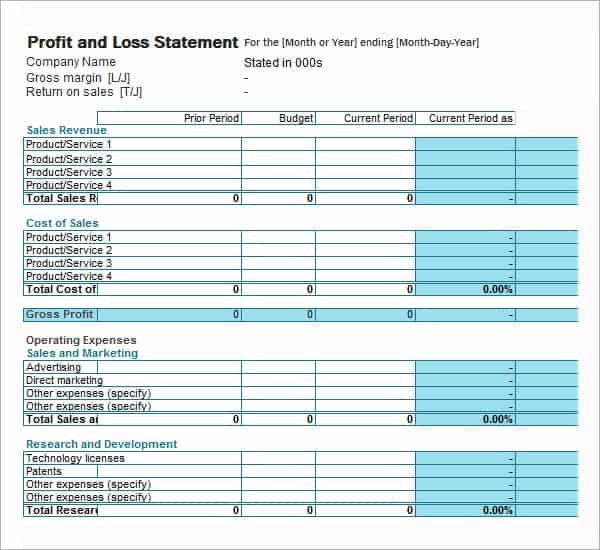
Our free profit and loss statement templates provide an easy starting point for creating a structured financial report. Instead of designing a P&L statement from a blank document, you can use a ready-made format and customize it with your business information, reporting period, revenue, expenses, and other financial figures.
A profit and loss statement can be prepared for a month, quarter, financial year, or another accounting period. Regularly reviewing this information can help a business understand its financial performance, identify significant expenses, compare revenue over time, and make more informed financial decisions.
What Is a Profit and Loss Statement?
A profit and loss statement is a financial report that summarizes income and expenses during a defined period and calculates the resulting profit or loss.
The basic concept is straightforward: a business earns revenue and incurs various costs and expenses. After the applicable expenses are deducted from revenue, the resulting amount represents the business’s profit or loss for the reporting period.
The P&L statement is also commonly referred to as an income statement. In many business contexts, these terms describe essentially the same type of financial report, although presentation and terminology can vary according to the organization and applicable accounting framework.
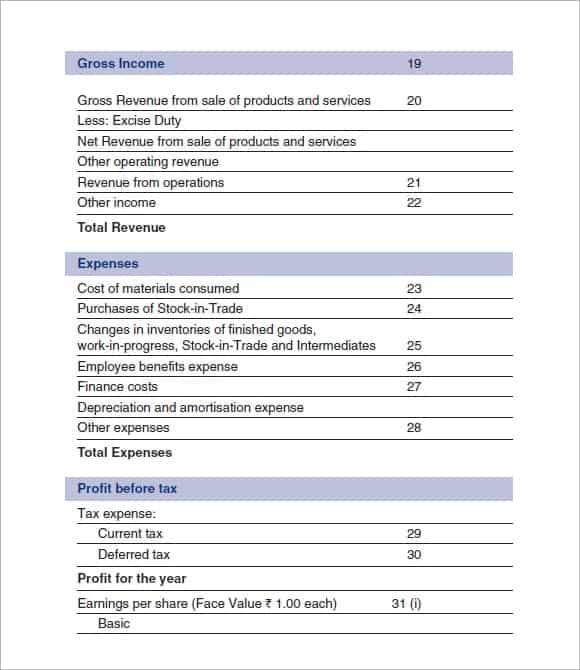
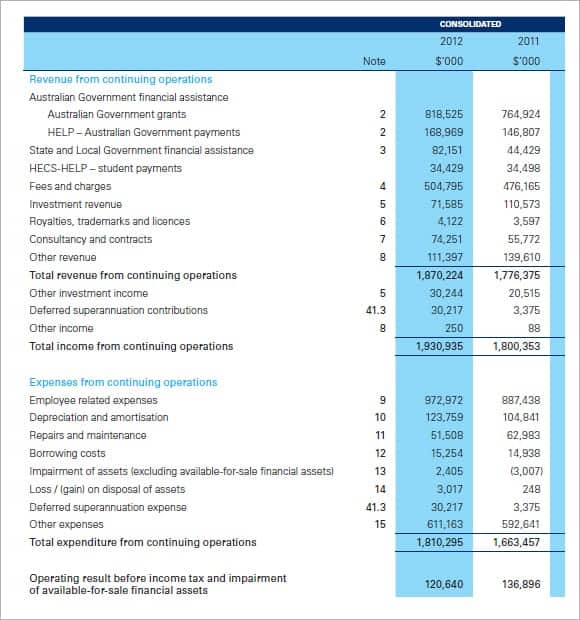
A typical profit and loss statement format may include sales revenue, cost of goods sold, gross profit, operating expenses, other income or expenses, taxes, and net profit or loss.
Free Profit and Loss Statement Templates
Using a free P&L template can save time and make financial reporting easier to organize. A template provides predefined sections and headings that you can modify according to the needs of your business.
You can use a profit and loss template for a small business, startup, freelance operation, consulting practice, retail business, service company, or other organization that needs to monitor income and expenses.
Depending on the format available, an editable template can be customized in Word or Excel, while a PDF version can be useful for printing, sharing, or maintaining a fixed-format copy of a completed report.
The most appropriate format depends on how you plan to prepare, calculate, edit, and use the statement.
What Does a Profit and Loss Statement Include?
The exact structure of a P&L statement varies between businesses, but several categories are commonly found in a profit and loss statement example.
Revenue:
Revenue represents money earned from the company’s primary business activities. A company may have one source of revenue or several categories of sales or service income.
Cost of Goods Sold:
For businesses that sell products, cost of goods sold represents costs directly associated with the products sold during the reporting period.
Gross Profit:
Gross profit is generally calculated by subtracting the applicable cost of goods sold from revenue.
Operating Expenses:
Operating expenses are the costs associated with running the business. Depending on the organization, these may include salaries, rent, utilities, advertising, insurance, office expenses, software, transportation, depreciation, and professional services.
Operating Income:
Operating income reflects the result of the company’s normal business operations after relevant operating expenses are deducted.
Other Income and Expenses:
A P&L may also include items such as interest income, interest expense, gains, losses, or other income and expenses that are not part of ordinary operating activities.
Taxes:
Applicable tax expenses may be presented before determining the final profit or loss.
Net Profit or Net Loss:
The final result shows whether the business earned a profit or incurred a loss during the reporting period.
Profit and Loss Statement Format
A clear P&L statement format should present financial information in a logical order so that the reader can easily understand the company’s performance.
A simple format might look like this:
Revenue / Sales
Less: Cost of Goods Sold
Gross Profit
Less: Operating Expenses
Operating Income
Add/Less: Other Income and Expenses
Less: Taxes
Net Profit or Net Loss
Not every business will require all of these categories. A service-based business, for example, may have little or no traditional cost of goods sold, while a retail or manufacturing business may require more detailed cost categories.
The template should therefore be customized to accurately represent the business’s actual financial activities.
Profit and Loss Statement Example
A profit and loss statement example can make it easier to understand how the different sections work together.
Imagine that a small business generates $150,000 in sales during a financial year. If the business incurs $60,000 in costs directly associated with the goods it sells, its gross profit would be $90,000.
The business may then have operating expenses such as employee salaries, rent, marketing, insurance, utilities, and administrative expenses. After those expenses and any applicable other income, expenses, and taxes are considered, the remaining amount represents the net profit or net loss for the period.
The example demonstrates why a P&L statement is more than simply a list of sales. It provides a structured way to understand how revenue is affected by different categories of costs and expenses.
Actual financial statements should always be based on accurate accounting records rather than estimated or copied figures from a generic example.
Monthly Profit and Loss Statement
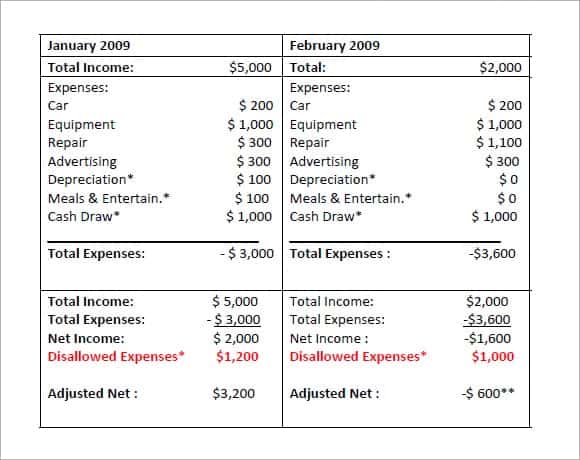
A monthly profit and loss statement can help business owners monitor financial performance throughout the year.
Instead of reviewing profitability only once a year, monthly P&L reporting allows management to identify changes in revenue and expenses more quickly.
A monthly report can help answer questions such as:
- Did sales increase or decrease this month?
- Which expenses increased?
- Is gross profit improving?
- Are operating costs under control?
- Did the business generate a monthly profit or loss?
- How does the current month compare with previous months?
Businesses can also compare monthly P&L statements to identify seasonal trends and recurring expenses.
Annual Profit and Loss Statement
An annual profit and loss statement summarizes financial performance over a complete financial year.
Annual P&L reporting can be useful for reviewing business performance, preparing management reports, supporting financial planning, and comparing results with previous years.
For example, a business might compare annual revenue and net profit over several years to determine whether it is growing and becoming more profitable.
The reporting period should always be clearly identified on the statement so that readers understand which financial period the figures represent.
Profit and Loss Statement Template in Excel
A profit and loss statement template in Excel is particularly useful when calculations are required.
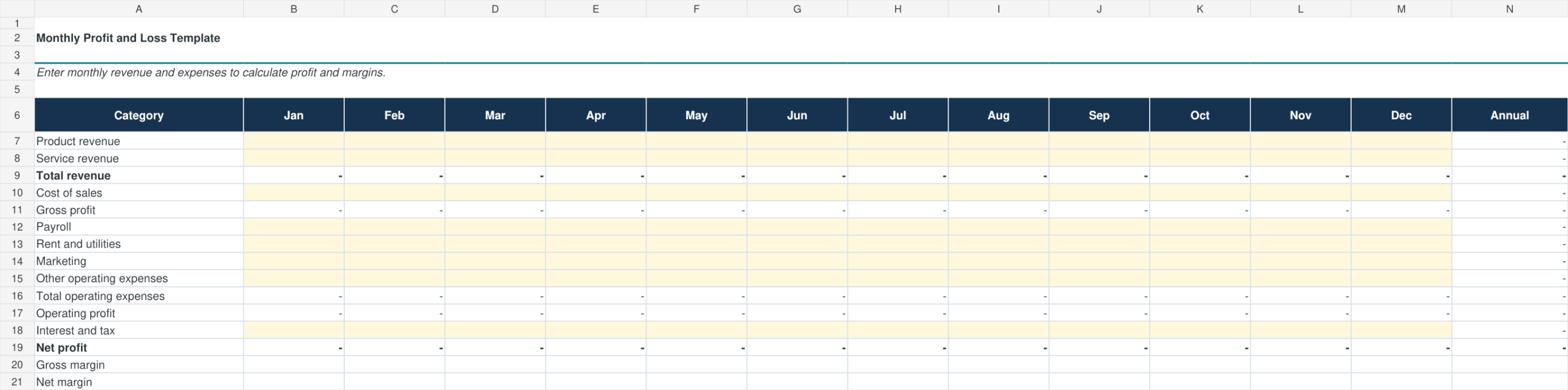
Excel allows you to enter revenue and expense amounts into cells and use formulas to calculate subtotals, gross profit, operating income, and net profit. It can also make it easier to compare multiple periods.
For example, a spreadsheet might contain columns for January through December, allowing you to track monthly revenue and expenses throughout the year.
Excel can also be useful for creating simple charts or comparing actual results with budgets. However, formulas should always be reviewed carefully before relying on a template for important financial reporting.
Profit and Loss Statement Template in Word
A profit and loss statement template in Word is useful when you want an editable, printable financial document.
Word allows you to modify headings, add company information, insert a logo, adjust tables, and customize the appearance of the report.
A Word P&L template can work particularly well for a straightforward statement where extensive calculations are not required. If the document contains many calculations or multiple reporting periods, an Excel format may be more practical.
Profit and Loss Statement PDF
A profit and loss statement PDF is useful when you need to share or print a completed financial report while preserving its formatting.
PDF is generally better suited to a final or fixed-format version of a document than to extensive editing. For entering financial data and making calculations, an editable Word or Excel template is usually more convenient.
Once the P&L statement has been completed and reviewed, it can be saved or exported as a PDF for distribution and recordkeeping.
Profit and Loss Statement for Small Business
A small business profit and loss statement can provide valuable information about whether the business is operating profitably.
Small businesses may have fewer revenue and expense categories than larger organizations, but tracking the key figures is still important.
A simple P&L for a small business might include:
- Sales revenue
- Service income
- Product costs
- Gross profit
- Payroll
- Rent
- Utilities
- Marketing
- Insurance
- Office expenses
- Professional fees
- Other expenses
- Taxes
- Net profit or loss
The categories should be adapted to the actual activities and accounting requirements of the business.
Profit and Loss Statement vs. Cash Flow Statement
A P&L statement and a cash flow statement provide different information.
The profit and loss statement focuses on revenues and expenses and determines financial performance over a particular period.
The cash flow statement focuses on actual cash movement and generally organizes cash activity into operating, investing, and financing activities.
This distinction is important because a business can report a profit without having enough available cash to meet immediate obligations. Reviewing both reports can therefore provide a more complete understanding of business finances.
Profit and Loss Statement vs. Balance Sheet
A balance sheet is different from a profit and loss statement.
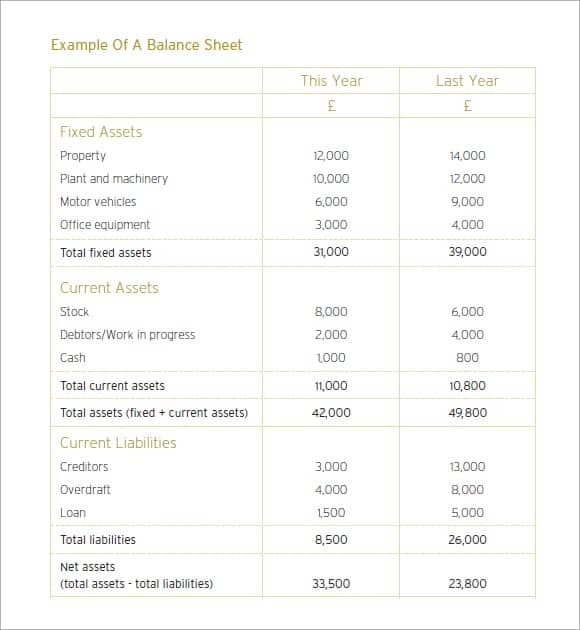
The P&L reports financial performance over a period, while the balance sheet provides a snapshot of financial position at a specific date.
A balance sheet generally presents assets, liabilities, and equity. The income statement, by contrast, focuses on revenue, expenses, and profit or loss.
Together, these financial reports can provide important information about both the performance and financial position of a business.
Why Use a Profit and Loss Statement Template?
Creating a P&L statement from scratch can take time, particularly if you need to prepare reports regularly. A template gives you a structured starting point and can help maintain consistency.
Benefits of using a profit and loss statement template include:
- Saves time when preparing financial reports
- Provides an organized P&L format
- Helps separate revenue and expenses
- Makes profitability easier to review
- Can be customized for different businesses
- Useful for monthly and annual reporting
- Helps compare financial performance over time
- Provides a professional document structure
- Can support budgeting and financial planning
- Useful for business owners, managers, students, and accountants
A template is a starting point rather than a substitute for accurate bookkeeping or professional accounting advice.
Who Can Use a P&L Statement Template?
A P&L template can be useful for many different types of users.
Small business owners can use it to monitor sales, expenses, and profitability.
Entrepreneurs and startups can use P&L reports to evaluate business performance and support financial planning.
Freelancers and independent professionals can adapt a simple format to track business income and expenses.
Accountants and bookkeepers may use structured templates as a starting point for organizing financial information, subject to applicable accounting requirements.
Students can use profit and loss statement examples to learn how financial statements are structured and how revenue and expenses affect profitability.
How to Prepare a Profit and Loss Statement
Start by selecting the reporting period, such as one month, quarter, or financial year.
Next, gather accurate financial records and identify all relevant sources of revenue. Record sales and other applicable income in the appropriate section.
Then identify the applicable direct costs and calculate gross profit where appropriate. List operating expenses such as payroll, rent, utilities, marketing, insurance, and administrative expenses.
Add any relevant other income or expenses and applicable taxes. Finally, calculate the resulting net profit or net loss.
Review all figures against your accounting records before using the completed statement for important business decisions.
Choose the Right Profit and Loss Template
The best profit and loss statement template depends on the type and size of your business and the purpose of the report.
A freelancer or small service business may need a simple P&L showing income and operating expenses. A retail or manufacturing company may need more detailed revenue and cost categories.
Consider whether you need a monthly P&L, annual profit and loss statement, small business P&L template, Excel spreadsheet, Word document, or PDF format.
A well-structured template can make it easier to organize financial information, understand profitability, compare periods, and communicate financial results.
Choose a format that fits your needs, customize the categories appropriately, and always use accurate financial information when preparing the final statement.
Download Monthly Profit and Loss Template
Enter monthly revenue and expenses in this Excel workbook to calculate gross profit, operating profit, net profit, annual totals, and profit margins automatically.

FAQs
1. What is a profit and loss statement?
A profit and loss statement is a financial report that summarizes revenue, costs, and expenses over a specific period and shows whether a business generated a profit or loss.
2. Is a profit and loss statement the same as an income statement?
In many business and accounting contexts, a profit and loss statement and an income statement refer to the same type of financial report. Terminology and presentation can vary depending on the organization and accounting framework.
3. What does a P&L statement include?
A typical P&L may include revenue, cost of goods sold, gross profit, operating expenses, other income and expenses, taxes, and net profit or loss.
4. Can I use a profit and loss template for a small business?
Yes. A small business can use a P&L template to track revenue, expenses, and profitability on a monthly, quarterly, or annual basis.
5. What is a monthly profit and loss statement?
A monthly P&L summarizes a business’s income and expenses for one month. It can help owners and managers monitor profitability and identify changes in financial performance.
6. Is there a profit and loss statement template in Excel?
Yes. An Excel P&L template can be useful for entering financial figures, calculating totals, comparing periods, and creating a structured financial report.
7. What is the difference between a P&L and a cash flow statement?
A P&L focuses on revenue, expenses, and profit or loss, while a cash flow statement focuses on the movement of cash into and out of a business.
8. What is the purpose of a profit and loss statement?
Its primary purpose is to show the financial performance of a business over a specified period and determine whether it generated a profit or loss.
9. Can I create a profit and loss statement in Word?
Yes. A Word P&L template can be edited and customized with business information, financial categories, reporting dates, and figures.
10. How often should a business prepare a P&L statement?
The appropriate frequency depends on the business and its reporting needs. Many businesses review P&L information monthly, while quarterly and annual reports are also commonly used.
You must be logged in to post a comment.