
A project scope statement establishes the boundaries of a project by defining its objectives, deliverables, requirements, assumptions, constraints, exclusions, and acceptance criteria. Its most important function is to clarify not only what is included but also what is outside the project, reducing the risk of uncontrolled scope expansion.
Effective scope statements use measurable language. A deliverable such as “create marketing materials” is difficult to verify, while “produce three approved digital advertisements in the specified dimensions by the agreed date” gives the team a clearer basis for planning, review, and acceptance.
Our free project scope statement templates provide a practical starting point for documenting project objectives, deliverables, requirements, milestones, assumptions, constraints, exclusions, and other important scope information. Instead of creating a scope document from a blank page, you can use a structured template and customize it according to the needs of your project.
A clear scope statement can be useful for software projects, construction projects, business initiatives, marketing campaigns, consulting engagements, product development, IT implementations, research projects, and many other types of work.
What Is a Project Scope Statement?
A project scope statement is a document that describes the boundaries and requirements of a project. It explains what the project is expected to accomplish and identifies the work that is included within the approved scope.
The scope statement can provide information about the project’s purpose, objectives, deliverables, requirements, major activities, assumptions, constraints, exclusions, and acceptance criteria.
Its primary purpose is to create a common understanding among stakeholders. When the scope is clearly documented, the project team has a reference point for determining whether requested work is part of the original project or represents a change.
A well-written project scope statement should be specific enough to reduce ambiguity without attempting to describe every minor task in excessive detail.
Free Project Scope Statement Templates
A free project scope statement template can make project planning easier by providing a predefined structure for documenting scope information.
You can customize the template with:
- Project name
- Project manager
- Client or sponsor
- Project objectives
- Project description
- Scope of work
- Deliverables
- Requirements
- Milestones
- Assumptions
- Constraints
- Exclusions
- Dependencies
- Acceptance criteria
- Approval information
The appropriate sections depend on the size and complexity of the project.
A simple internal project may require only a few sections, while a large project involving multiple teams, vendors, budgets, and stakeholders may require a more detailed scope document.
What Should a Project Scope Statement Include?
There is no single format that works for every project, but a useful project scope statement format generally covers several important areas.
Project Overview:
Provide a concise description of the project and the reason it is being undertaken.
Project Objectives:
State what the project is intended to accomplish. Objectives should be clear enough that stakeholders can understand the desired outcome.
Scope Description:
Describe the major work and activities included in the project.
Deliverables:
Identify the products, services, documents, systems, reports, or other results the project is expected to produce.
Requirements:
Document important functional, technical, business, or performance requirements where appropriate.
Exclusions:
Clearly identify work or outcomes that are outside the project scope.
Assumptions:
Document conditions believed to be true when planning the project.
Constraints:
Identify limitations involving time, budget, resources, technology, regulations, or other factors.
Acceptance Criteria:
Explain the conditions that must be satisfied for deliverables or project outcomes to be considered acceptable.
Project Scope Statement Example
A project scope statement example can make the concept easier to understand.
Suppose a company is planning a website redesign project. The project scope statement might explain that the project includes reviewing the existing website, creating a new design, developing responsive pages, migrating approved content, testing the website, and launching the new version.
The deliverables could include approved website designs, developed web pages, testing results, and a completed production website.
The scope statement could also identify exclusions. For example, creating a completely new brand identity or producing new video content might be outside the project’s approved scope.
By documenting these boundaries, the client and project team have a clearer understanding of what the project includes.
Project Scope vs. Scope of Work
The terms project scope and scope of work are closely related and are sometimes used interchangeably, but they can have different meanings depending on the organization.
Project scope generally describes the boundaries of the project and the work and outcomes included within it.
Scope of work often provides more detail about the specific work or services that a contractor, vendor, consultant, or project team will perform.
A project scope statement can therefore contain a description of the scope of work along with objectives, deliverables, exclusions, assumptions, constraints, and other project information.
The terminology used by different companies and industries can vary, so the most important consideration is that the document clearly defines the agreed work and expected results.
Project Scope Statement vs. Statement of Work
A project scope statement and a Statement of Work (SOW) can also overlap, but they are not necessarily identical.
A Statement of Work commonly describes the work, services, deliverables, responsibilities, schedule, and other requirements associated with an engagement or project.
A project scope statement is primarily concerned with defining the project’s boundaries, objectives, deliverables, and included work.
In some organizations, the SOW may be an input into project planning, while the project scope statement is developed as part of formal project planning.
Because terminology and documentation practices vary, organizations should establish their own definitions and document hierarchy.
Why Is a Project Scope Statement Important?
A clear scope statement can help establish expectations before significant project work begins.
Without a clearly defined scope, stakeholders may have different ideas about what the project should deliver. One person may consider a feature essential while another may assume it was never included.
This can contribute to scope creep, where additional work gradually gets added without corresponding changes to the schedule, budget, resources, or formal approval.
A documented scope provides a reference for discussing proposed changes and determining whether they belong within the approved project.
Benefits of Using a Project Scope Template
Creating a project scope document from scratch can take time. A project scope template provides a structured starting point and can help ensure that important areas are considered.
Benefits include:
- Saves time during project planning
- Provides a consistent scope format
- Clarifies project objectives
- Defines project boundaries
- Identifies deliverables
- Documents exclusions
- Helps identify assumptions and constraints
- Supports stakeholder communication
- Provides a reference during project execution
- Helps control scope creep
- Can improve project planning and coordination
- Makes project requirements easier to review
A template does not replace project-specific planning. Each section should be reviewed and customized to reflect the actual project.
Project Scope Statement for Small Projects
Small projects do not necessarily require a complicated scope document.
A simple project scope statement might include the project objective, key deliverables, major activities, deadline, responsibilities, assumptions, and exclusions.
For example, a small marketing project could define the goal of launching a campaign, identify the required advertisements and social media content, specify the campaign dates, and clarify which marketing activities are not included.
Keeping the scope concise can make it easier for a small team to understand and use.
Project Scope Statement for Large Projects
Large projects generally require more detailed scope documentation because they involve more stakeholders, dependencies, resources, and potential risks.
A large IT implementation might need to define systems, integrations, data migration, testing, training, documentation, deployment, and support.
A construction project may need detailed information about structures, materials, site work, inspections, approvals, exclusions, and project phases.
The larger and more complex the project, the more important it becomes to define scope boundaries clearly.
Project Scope Statement for Software Development
Software projects are particularly vulnerable to changing requirements and scope creep.
A software project scope statement can define the product or system being developed, major features, user groups, integrations, technical requirements, testing, deployment, documentation, and other expected deliverables.
It can also specify what is not included. For example, a project may include development of a web application but exclude mobile applications, third-party integrations, or ongoing maintenance unless separately approved.
Clearly documenting these boundaries can help stakeholders understand what the development team is expected to deliver.
Project Scope Statement for Construction
A construction project scope statement can describe the work included in a building, renovation, infrastructure, or other construction project.
Depending on the project, it may cover site preparation, materials, structural work, electrical systems, plumbing, finishing, inspections, documentation, and other activities.
Exclusions can be equally important. Clearly identifying work that is not included can help reduce disputes and misunderstandings during construction.
For complex construction projects, the scope statement should be consistent with the applicable contracts, drawings, specifications, schedules, and other project documents.
Project Scope Statement for Business Projects
Businesses can use scope statements for internal initiatives such as process improvement, system implementation, office relocation, product launches, training programs, marketing campaigns, and organizational changes.
A business project scope statement can help managers communicate what the project is expected to accomplish and prevent unrelated tasks from being added without proper review.
It can also help executives and project sponsors understand the boundaries of the initiative before approving resources.
Project Scope Template in Word
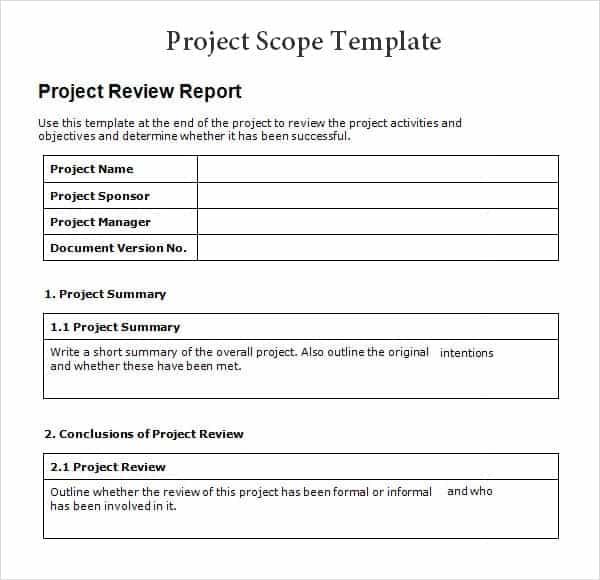
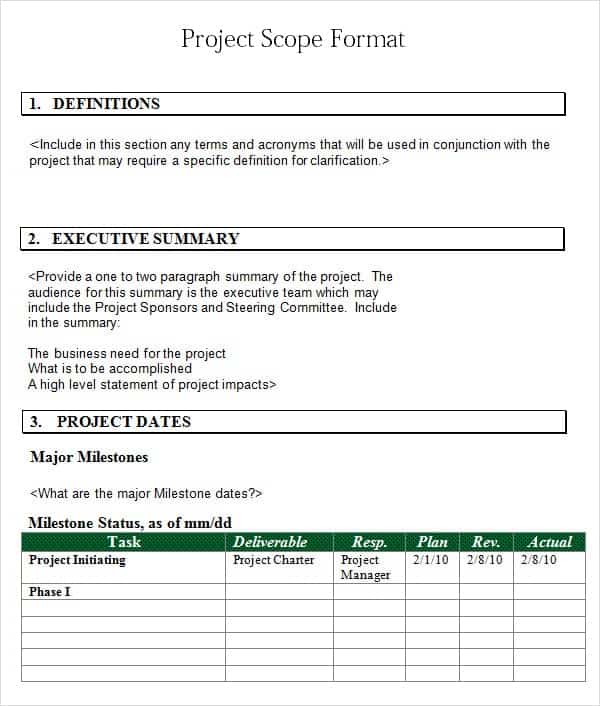
A project scope statement template in Word can be useful when you need an editable project document that can be customized and shared with stakeholders.
Word makes it easy to modify headings, add tables, insert company branding, describe deliverables, and adjust the layout.
A Word template can work particularly well for smaller projects or projects where the scope is primarily narrative.
Project Scope Template in Excel
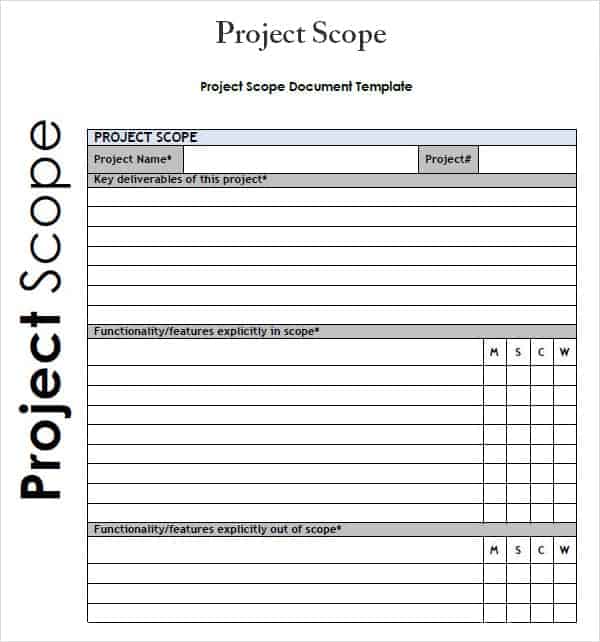
An Excel project scope template can be useful when the project contains structured lists of requirements, deliverables, milestones, tasks, resources, or other information.
Excel allows you to organize information into rows and columns and can make it easier to sort or filter project data.
For complex projects, an Excel scope document can complement a more detailed project scope statement or project management plan.
Project Scope Statement PDF
A project scope statement PDF can be useful for sharing an approved or finalized scope document with clients, sponsors, vendors, and project team members.
PDF helps preserve the document’s layout and can be convenient for distribution and recordkeeping.
It is usually better to prepare and edit the scope statement in an editable Word or Excel format before creating the final PDF version.
How to Write a Project Scope Statement
Start by defining the reason for the project. What problem is the project solving, or what outcome is the organization trying to achieve?
Next, establish the project’s objectives and major deliverables.
Describe the work required to produce those deliverables. Be specific enough to establish boundaries but avoid unnecessarily detailed task lists that belong in a project schedule or work breakdown structure.
Then identify what is not included. Exclusions are often overlooked but can be extremely valuable for preventing misunderstandings.
Document important assumptions, constraints, dependencies, and acceptance criteria.
Finally, review the scope with the project sponsor, client, project manager, and other relevant stakeholders. Resolve ambiguities before the project progresses.
How a Scope Statement Helps Prevent Scope Creep
Scope creep occurs when additional work, requirements, or expectations are gradually introduced without appropriate evaluation or approval.
A good scope statement does not eliminate scope changes. Projects naturally evolve, and some changes may be necessary.
Instead, the scope statement provides a baseline against which proposed changes can be evaluated.
If a stakeholder requests something that is outside the documented scope, the project team can determine its impact on cost, schedule, resources, and deliverables before deciding whether the change should be approved.
This creates a more controlled approach to project change management.
Project Scope and Stakeholder Expectations
Different stakeholders can interpret the same project differently if expectations are not documented.
A client may expect one set of deliverables, while the project team may be working toward another interpretation.
A well-written scope statement creates a shared reference point. Stakeholders can review the objectives, deliverables, requirements, exclusions, and acceptance criteria before work begins.
This can improve communication and reduce the risk of disagreements later in the project.
Choose the Right Project Scope Statement Template
The best project scope statement template depends on the size, industry, and complexity of the project.
A simple internal project may need only a short scope document covering objectives, deliverables, timeline, responsibilities, and exclusions.
A large software, construction, consulting, or business transformation project may require more detailed requirements, dependencies, assumptions, constraints, acceptance criteria, and scope boundaries.
Choose a format that provides enough structure without making the document unnecessarily complicated.
Our free project scope statement templates provide a practical starting point for documenting project objectives, scope, deliverables, requirements, exclusions, assumptions, and constraints.
Customize the template carefully for the specific project and review the completed scope with the appropriate stakeholders before treating it as the project’s agreed scope.
Download Project scope statement templates:
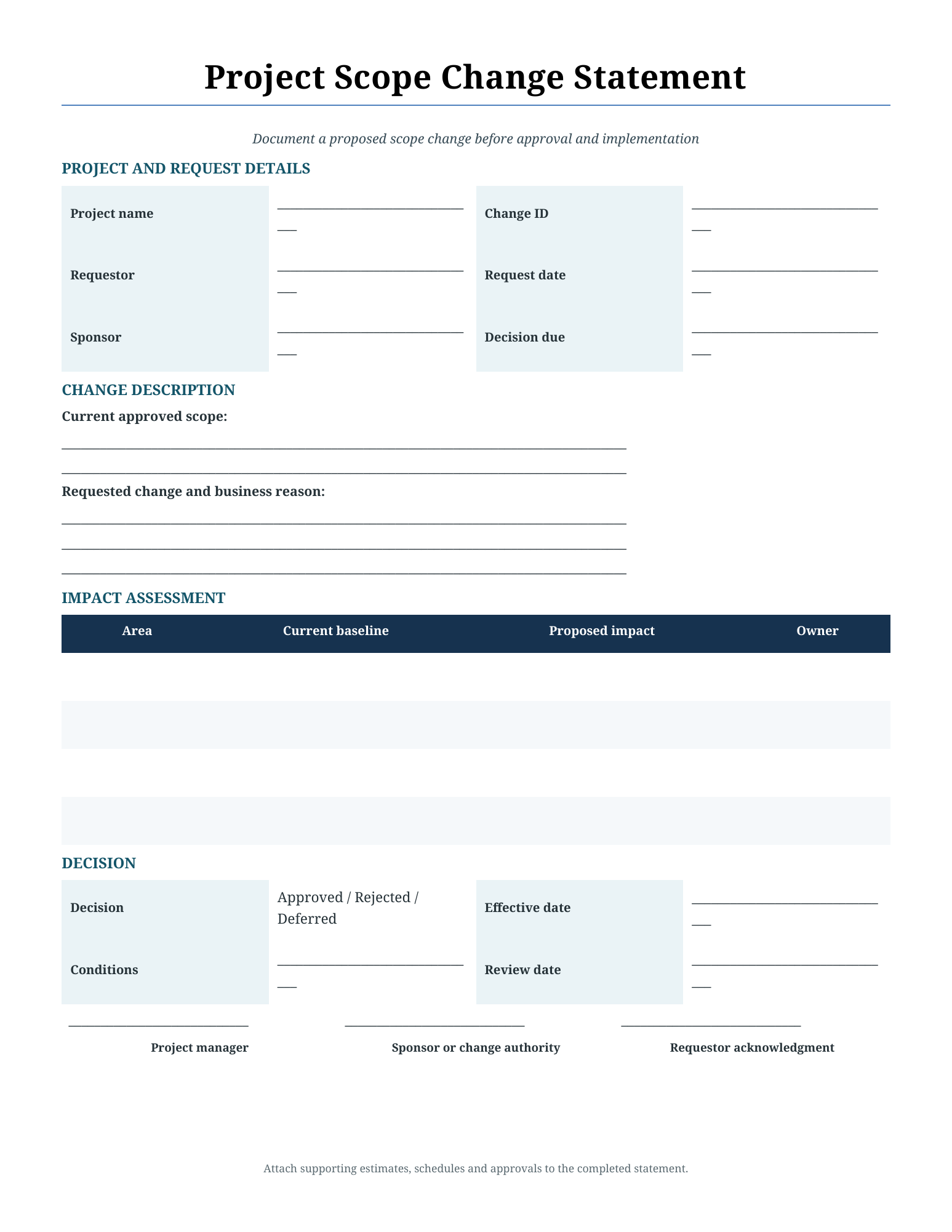
Download Project Scope Change Statement
This Word form records a proposed scope change, its business reason, schedule and cost effects, ownership, approval conditions, and the final decision.

FAQs
1. What is a project scope statement?
A project scope statement is a document that defines what a project will accomplish, what work and deliverables are included, and what falls outside the project’s boundaries.
2. What should a project scope statement include?
A typical scope statement can include the project overview, objectives, scope description, deliverables, requirements, exclusions, assumptions, constraints, dependencies, and acceptance criteria.
3. What is a project scope statement template?
A project scope statement template is a pre-formatted document that provides a structure for documenting the scope, objectives, deliverables, requirements, and boundaries of a project.
4. What is the difference between project scope and scope of work?
Project scope generally describes the boundaries and outcomes of a project, while scope of work often describes the specific work or services that will be performed. The terminology can vary by organization.
5. How does a scope statement prevent scope creep?
It establishes a documented baseline for what is included in the project. Proposed additions can then be evaluated against the approved scope before resources, budget, or schedule are changed.
6. Can I use a project scope template in Word?
Yes. A Word project scope template can be edited, branded, printed, and shared with clients, project teams, and stakeholders.
7. Can a project scope statement be used for software development?
Yes. Software projects can use scope statements to define features, requirements, integrations, testing, deployment, documentation, exclusions, and other expected deliverables.
8. What is the difference between a scope statement and an SOW?
A Statement of Work generally describes the work and services associated with an engagement, while a project scope statement focuses on the boundaries, objectives, deliverables, and included work of the project. The exact distinction varies between organizations.
9. Should a project scope statement include exclusions?
Yes. Clearly identifying what is not included can be just as important as describing what is included because it helps establish project boundaries and manage expectations.
10. Who should approve a project scope statement?
Approval depends on the organization’s project governance structure. It may involve the project sponsor, client, project manager, business owner, or other authorized stakeholders.
You must be logged in to post a comment.