
An investment policy statement, often shortened to IPS, records the rules that guide how a portfolio should be managed. It connects the purpose of the money to objectives, time horizon, liquidity needs, risk limits, asset allocation, permitted investments, rebalancing, monitoring, governance, and review.
The two free Word templates below serve different users. The first is a personal investment policy statement template for an individual or household that wants a disciplined decision framework. The second is a nonprofit reserve investment policy statement template for a board, finance committee, investment committee, or staff team responsible for organizational reserves or long-term funds.
These are educational working templates, not investment, legal, tax, accounting, or fiduciary advice. They intentionally leave allocation targets, return assumptions, spending rates, benchmarks, and risk limits blank because those decisions depend on the investor, organization, governing documents, jurisdiction, tax position, cash flows, and professional advice.
Download the Investment Policy Statement Templates
1. Personal Investment Policy Statement Template
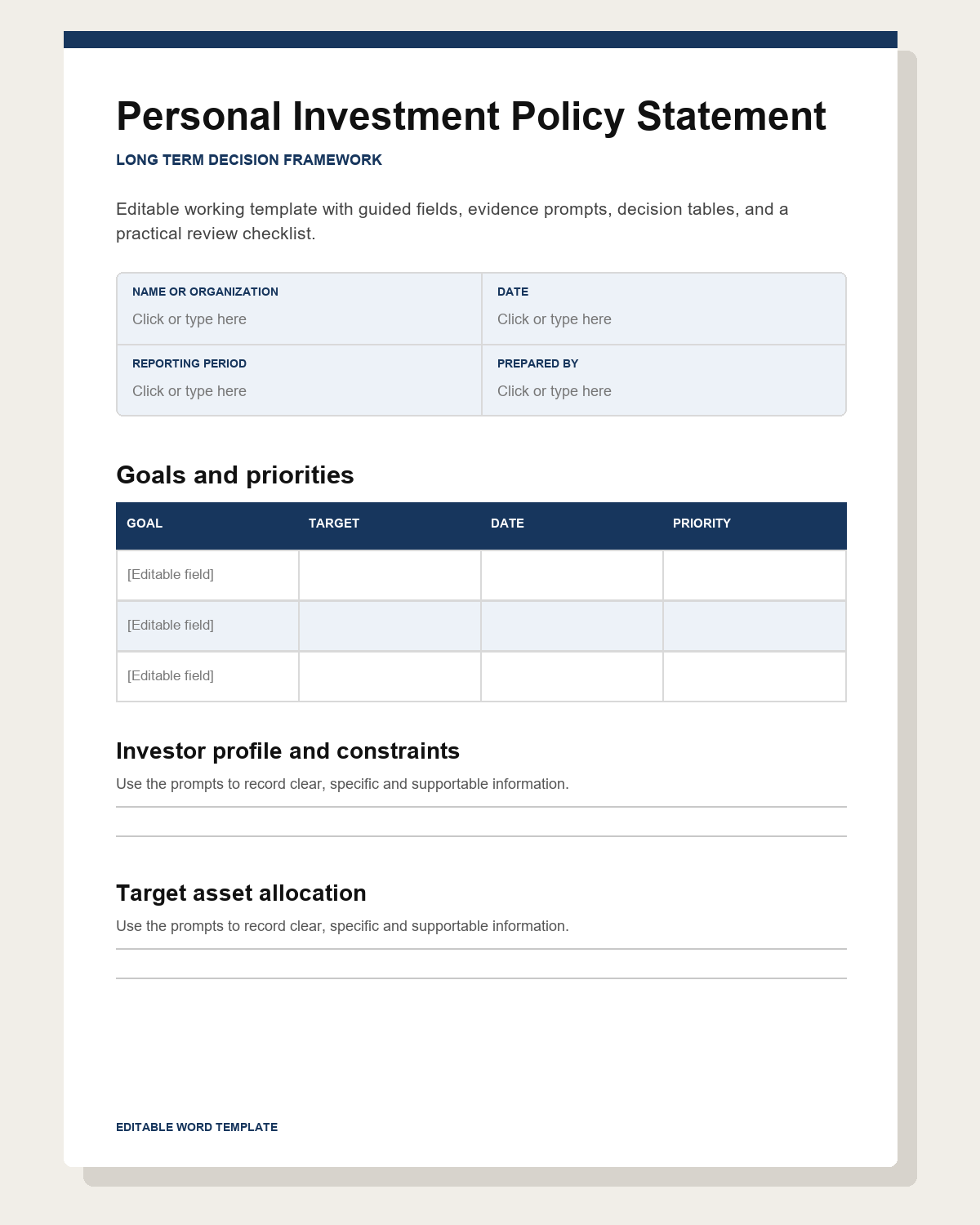
The navy personal IPS is organized around goals, time horizon, liquidity, capacity for loss, willingness to take risk, account and tax considerations, target allocation ranges, permitted and excluded investments, rebalancing triggers, behavior rules, monitoring, and an exception log. Its design is practical and decision-focused rather than board-oriented.
2. Nonprofit Reserve Investment Policy Statement Template
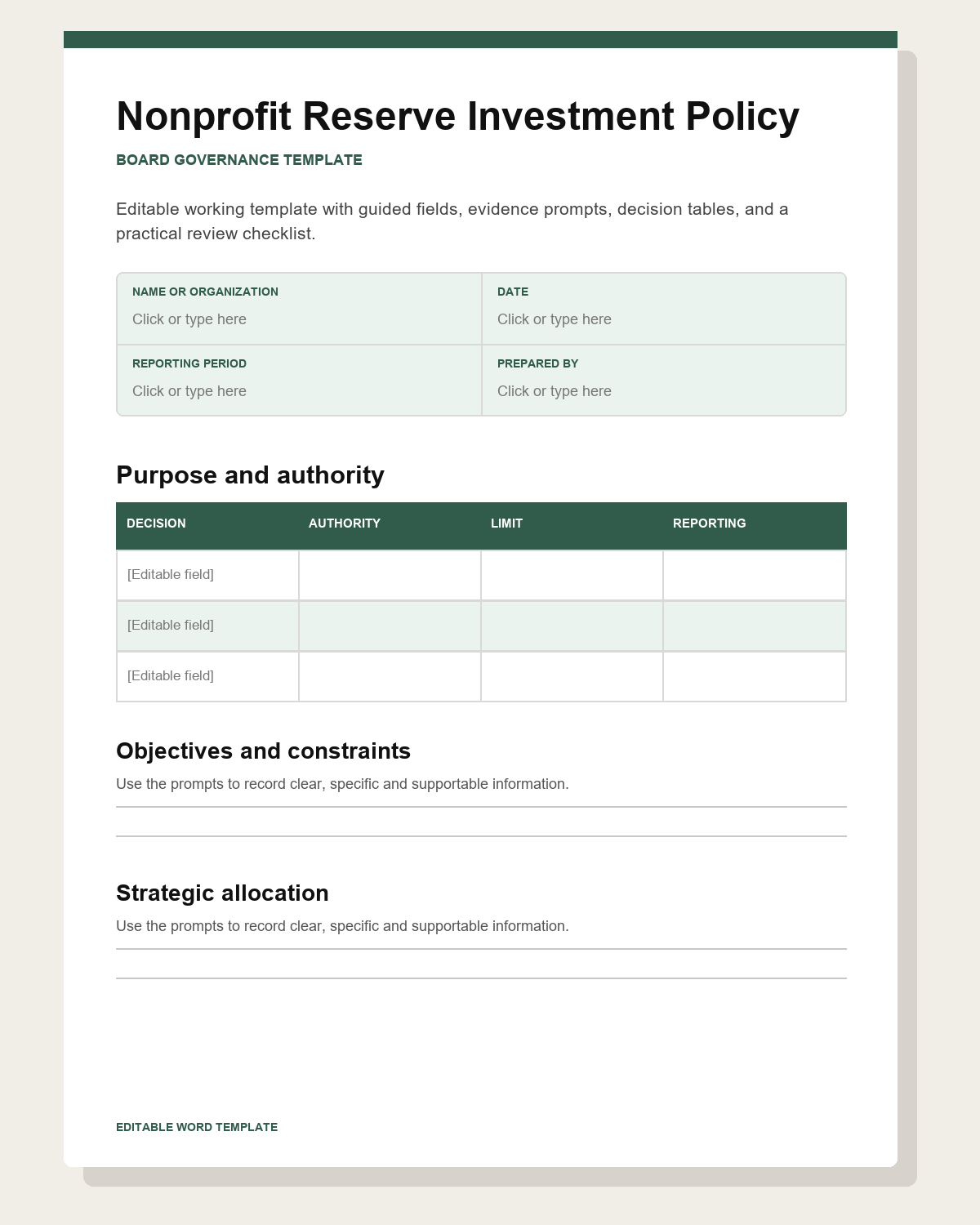
The green nonprofit version is a governance document. It provides sections for policy authority, delegation, reserve purpose, legal and donor restrictions, spending and distributions, strategic allocation ranges, permitted and prohibited practices, provider due diligence, conflicts, benchmarks, reporting, amendment, and formal board approval.
What Is an Investment Policy Statement?
An IPS is a written decision framework. It is not a prediction of returns and does not guarantee an outcome. Its value comes from documenting decisions before markets, organizational pressures, or emotions make those decisions harder.
For a personal investor, the statement can help connect investments to real goals and define when the portfolio should be reviewed or rebalanced. For a nonprofit, foundation, association, or other institution, the policy can clarify who has authority, which decisions are delegated, what restrictions apply, how reserves relate to operating needs, and what reporting the board expects.
Why Write an IPS?
- To connect a portfolio to a defined purpose and time horizon.
- To separate long-term policy from short-term market reactions.
- To establish liquidity and risk constraints before they are tested.
- To set target allocations and acceptable ranges.
- To define permitted investments and explicit exclusions.
- To explain when and how rebalancing should be considered.
- To clarify the roles of an investor, board, committee, staff member, custodian, adviser, or manager.
- To create a consistent basis for monitoring, reporting, exceptions, and review.
What a Personal Investment Policy Statement Should Include
Start with the purpose of the assets. “Retirement” may be too broad if the same portfolio also funds education, a home purchase, or near-term spending. Separate goals with different time horizons and liquidity needs when that improves decision-making.
Next, record both capacity and willingness to take risk. Capacity concerns the financial ability to withstand loss without jeopardizing essential goals. Willingness concerns how the investor is likely to react during uncertainty or a significant decline. The lower of the two may be the practical constraint, but the final decision should reflect the investor’s full circumstances.
The target allocation section should show the desired proportion and any permitted range for each asset category. The SEC’s Investor.gov explains that asset allocation divides investments among categories such as stocks, bonds, and cash, while diversification spreads exposure among and within categories. The appropriate mix depends on factors including time horizon and risk tolerance.
Target Allocation vs. Actual Holdings
A target allocation is the policy. Actual holdings are the portfolio at a particular moment. Market movements, contributions, withdrawals, fees, and distributions cause the actual mix to drift. The IPS should explain how much drift is acceptable and what should happen when a boundary is crossed.
Do not copy an example allocation simply because it looks balanced. A suitable policy may differ significantly according to goals, age, income stability, liabilities, emergency reserves, pension or business interests, concentration in employer stock, tax accounts, spending needs, and other assets.
How to Write Rebalancing Rules
Rebalancing means bringing a portfolio back toward its intended allocation. Investor.gov identifies several approaches: selling from an overweight category and buying an underweight category, adding new money to underweight categories, or redirecting ongoing contributions. It also warns that fees and tax consequences should be considered.
An IPS can use a calendar trigger, a range trigger, or both. A calendar rule might require a review every six or twelve months. A range rule might call for review when an asset category moves outside its approved minimum or maximum. The trigger should start a decision process; it does not have to require an automatic trade when taxes, transaction costs, liquidity, restrictions, or unusual circumstances make another response more appropriate.
Useful Personal IPS Behavior Rules
A personal IPS can include short behavior rules for stressful periods. Examples include reviewing the written purpose before making a major change, documenting the reason for an exception, avoiding strategy changes based only on headlines, and using new contributions or withdrawals to rebalance when practical.
These rules should not prevent necessary changes. A new goal, altered time horizon, job loss, retirement, inheritance, disability, major withdrawal, tax change, or changed capacity for risk can justify a full review. The distinction is between a change in circumstances and a reaction to ordinary market movement.
What a Nonprofit Investment Policy Statement Should Include
A nonprofit policy begins with governance. Identify the approving body, policy owner, delegated roles, limits of authority, reporting requirements, and the decisions that cannot be delegated. The language should match the organization’s bylaws, committee charter, gift instruments, contracts, applicable law, and other governing documents.
Define the fund or pool covered by the policy. Operating cash, emergency reserves, board-designated reserves, donor-restricted funds, and long-term assets may have different purposes and time horizons. Combining them without explaining their liquidity and restrictions can make the policy hard to implement.
Spending, Liquidity, and Reserve Needs
The nonprofit template includes a separate spending section because distributions and operating needs directly affect the portfolio. State the formula or approval process, measurement period, any smoothing method, treatment of restricted funds, exception process, and the amount of liquidity required for expected obligations.
A return objective should not be written without considering the spending rule, inflation, fees, taxes where applicable, and the risk required to pursue it. Avoid presenting a target as certain. If assumptions are used, record their source and review date.
Permitted Investments and Prohibited Practices
Write these sections clearly enough that a manager or committee can tell whether a proposed action is allowed. Address concentration, illiquidity, leverage, borrowing, derivatives, direct real estate, private investments, digital assets, related-party transactions, securities lending, and other practices only where relevant.
A blanket list copied from another institution may be inappropriate. The permitted universe should reflect the organization’s resources, governance capacity, liquidity, restrictions, and ability to monitor complexity.
Benchmarks and Monitoring
Benchmarks should match the decision being evaluated. A policy benchmark can reflect the strategic allocation, while category benchmarks can help evaluate components. Performance should be considered net of relevant fees and over a period consistent with the portfolio’s purpose. A short period may say more about market conditions than about the quality of a long-term policy.
Monitoring should cover more than returns. The board or investor may also need allocation ranges, liquidity, cash flows, fees, risk, compliance with restrictions, conflicts, provider service, custody, and changes in goals or circumstances.
Investment Policy Statement vs. Personal Financial Statement
A Personal Financial Statement summarizes assets, liabilities, income, and related financial information at a point in time. An investment policy statement sets forward-looking rules for managing a portfolio. The personal financial statement can inform the IPS, but the documents have different purposes.
Similarly, general Financial Statement Templates report financial position or performance; they do not replace governance and portfolio policy.
Common IPS Mistakes
- Using generic goals such as “growth” without a purpose or time horizon.
- Inserting an allocation copied from another investor or institution.
- Ignoring liquidity, withdrawals, spending, taxes, fees, or restrictions.
- Confusing willingness to take risk with financial capacity for loss.
- Setting targets that do not total 100%.
- Using ranges so narrow that routine market movement causes constant trading.
- Leaving prohibited practices or delegation limits ambiguous.
- Evaluating a long-term strategy using only recent performance.
- Changing policy because one asset class recently performed well or poorly.
- Failing to record why an exception was approved.
- Not updating the IPS after a material change in goals, cash flows, governance, or restrictions.
Final Review Checklist
- The owner, approving authority, effective date, and review date are clear.
- The purpose of every covered account, fund, or pool is defined.
- Goals, horizon, liquidity, and risk constraints are internally consistent.
- Target allocations total 100% and permitted ranges are usable.
- Permitted investments, exclusions, and concentration limits are clear.
- Rebalancing triggers and decision responsibilities are documented.
- Fees, taxes, spending, legal restrictions, and conflicts are addressed where relevant.
- Monitoring measures and benchmarks fit the policy decisions.
- Exceptions require a written reason and review date.
- A qualified adviser, attorney, accountant, or fiduciary has reviewed areas requiring professional judgment.
Frequently Asked Questions
Is an investment policy statement legally required?
Requirements depend on the investor, organization, jurisdiction, governing documents, fiduciary role, and type of assets. A general template cannot determine whether a policy is legally required or sufficient. Obtain advice appropriate to your situation.
How often should an IPS be reviewed?
Many policies use an annual review plus interim review after a material change. The right frequency depends on the portfolio and governance process. A review does not mean the strategy must change.
Should the IPS include expected returns?
It can include objectives or assumptions when they are necessary and supportable, but they should not be presented as guarantees. Record the basis, time horizon, and review date, and consider inflation, fees, spending, and risk.
Who approves a nonprofit IPS?
Approval authority should come from the organization’s governing documents and applicable law. It is often the board, with defined implementation or monitoring tasks delegated to a committee, staff, or investment provider.
Can I edit these templates in Word?
Yes. Both templates are editable DOCX files. Replace every bracketed field, remove sections that do not apply, and have the finished document reviewed for your circumstances before approval or use.