
A legal statement organizes facts, declarations, or explanations for a legal, administrative, business, or official purpose. Its value comes less from complicated language than from accuracy, chronology, clarity, and the ability to distinguish facts personally known to the writer from assumptions or second-hand information.
Before using a template, identify who will receive the statement and whether that court, agency, employer, insurer, or other organization requires a specific form, declaration, signature, witness, notarization, or statement of truth. A general template can help organize information, but it should not replace jurisdiction-specific requirements or professional legal advice where those are necessary.
Our free legal statement templates provide a practical starting point for organizing a formal written statement. Instead of creating the document from a blank page, you can use a structured format and customize it with the relevant names, dates, facts, circumstances, and other information required for your particular situation.
Legal statements can take many forms. A person may need a written statement concerning an incident, a witness statement, a declaration, a statement of facts, or another formal document. The appropriate format depends heavily on the purpose of the statement and the requirements of the organization, court, government agency, attorney, employer, or other recipient.
For that reason, a template should be treated as a starting point rather than a universal legal form.
What Is a Legal Statement?
A legal statement is a formal written account or declaration prepared for a legal, official, administrative, or other formal purpose.
The term does not necessarily refer to one specific type of document. Different legal and administrative situations may require different kinds of statements.
For example, a written statement might describe what a person saw during an incident. A declaration might confirm that certain facts are true to the best of the person’s knowledge. A statement of facts might present events in chronological order. Another document might explain a person’s position or response to a particular matter.
The exact requirements depend on the purpose and jurisdiction.
A good legal statement format should therefore make the information easy to identify, understand, review, and verify.
Free Legal Statement Templates
Using a free legal statement template can make it easier to organize important information in a professional format.
A template may provide sections for:
- Name of the person making the statement
- Date
- Address or contact information where appropriate
- Case or reference number
- Subject of the statement
- Background information
- Statement of facts
- Description of events
- Supporting details
- Relevant dates and locations
- Declaration or confirmation
- Signature
- Witness information where required
Not every statement requires all of these sections. The appropriate structure should be based on the instructions provided by the intended recipient.
Before using a template for an important legal matter, check whether the relevant court, agency, attorney, employer, insurer, or other organization has supplied its own required form.
Legal Statement Format
A clear legal statement format should make it easy for the reader to understand who is making the statement, what the statement concerns, and what facts or information are being provided.
A basic format may begin with the title of the document and the name of the person making the statement.
The document can then identify the relevant case, matter, incident, or subject. The main body should present the facts in a logical order.
When describing events, chronological organization is often helpful. Use specific dates, locations, names, and other details where they are relevant and known.
The statement should distinguish between facts the writer personally knows and information obtained from another source. Avoid adding assumptions or speculation simply to make the statement appear more complete.
The document can conclude with a declaration, signature, date, and any other information required by the recipient.
Legal Statement Example
A legal statement example can help demonstrate how a formal written statement might be organized.
Suppose a person witnessed an incident at a workplace. The statement could begin by identifying the witness and explaining their relationship to the matter.
The witness could then describe when and where the incident occurred and provide a chronological account of what they personally observed.
The statement should focus on relevant facts rather than opinions or exaggerated descriptions. If the witness does not know something, it is generally better to say so than to speculate.
The document could conclude with the person’s signature and date if required.
This example illustrates the importance of organizing information clearly. The actual requirements for a witness statement may differ depending on the legal proceeding or jurisdiction.
Statement of Facts
A statement of facts presents the relevant facts surrounding a particular matter in an organized manner.
It may be used in legal, administrative, business, insurance, or other formal situations.
A useful statement of facts should generally focus on relevant information and present events in a logical sequence.
When preparing one, consider:
- What happened?
- When did it happen?
- Where did it happen?
- Who was involved?
- What actions were taken?
- What documents or records are relevant?
- What facts can be personally verified?
Avoid including unnecessary information that does not help explain the matter.
Written Statement
A written statement is a broad term for a formal written account provided by an individual or organization.
Written statements can be used in many contexts, including workplace investigations, insurance claims, legal disputes, complaints, administrative proceedings, and other situations where a person’s account needs to be documented.
The appropriate format depends on the purpose.
For example, an employee may be asked to provide a written statement concerning an incident at work, while a witness may provide a statement describing what they observed.
Witness Statement
A witness statement records a person’s account of events that they personally observed or experienced.
A witness statement should generally distinguish firsthand observations from information received from other people.
When preparing a witness statement, include relevant details such as dates, locations, people involved, and what was actually seen or heard.
Avoid changing facts to make the story appear stronger. Accuracy and clarity are more important than dramatic language.
Depending on the jurisdiction and proceeding, a witness statement may need to meet specific procedural or evidentiary requirements.
Legal Declaration
A legal declaration is a formal statement in which a person declares that particular information is true or accurate according to the applicable requirements.
Some declarations may be signed under a specified form of wording, while others may need to be witnessed, notarized, or made under penalty of perjury depending on the jurisdiction and purpose.
Because these requirements can differ significantly, do not assume that a generic declaration template satisfies the requirements of a particular court or government agency.
Always follow the instructions associated with the specific matter.
Sworn Statement
A sworn statement is a statement made under oath or affirmation.
Depending on the jurisdiction and circumstances, the person making the statement may need to swear or affirm that the information provided is true.
A sworn statement can have specific formal requirements concerning signatures, witnesses, notaries, or authorized officials.
If you need a sworn statement for a legal proceeding, use the form or instructions provided by the relevant authority whenever possible.
Legal Statement for Business
Businesses may use formal statements for a variety of situations.
For example, a company may need to provide a written explanation concerning an incident, dispute, transaction, policy issue, employee matter, insurance claim, or other formal situation.
A business legal statement should be factual, organized, and appropriate to the purpose of the document.
Companies should also consider whether the statement should be reviewed by legal counsel before it is submitted or distributed, particularly when the matter involves litigation, contractual disputes, regulatory issues, or significant financial consequences.
Legal Statement for an Incident
An incident statement records what happened during a particular event.
Incident statements can be used in workplaces, schools, organizations, insurance matters, security situations, and other environments.
A useful incident statement generally identifies:
- Date and time
- Location
- People involved
- Description of events
- Actions taken
- Witnesses
- Relevant documents or evidence
- Additional information
The person preparing the statement should focus on facts they personally know or observed.
Legal Statement for an Insurance Claim
Insurance companies may request written statements concerning accidents, property damage, losses, or other events.
An insurance statement should accurately describe the relevant circumstances and provide the information requested by the insurer.
Do not guess about dates, amounts, causes, or other details. If something is unknown, identify it as unknown rather than providing an unsupported estimate.
If an insurance claim has significant financial or legal implications, consider obtaining appropriate professional advice before submitting a formal statement.
Legal Statement vs. Affidavit
A legal statement and an affidavit are not necessarily the same document.
An affidavit is generally a written statement made under oath or affirmation and may be subject to specific legal formalities.
A generic written statement may not require an oath or the same witnessing or notarization requirements.
Because legal terminology and requirements vary by jurisdiction, you should not assume that a generic legal statement template can be substituted for an affidavit.
Legal Statement vs. Declaration
A declaration is another term that can have a specific legal meaning depending on the jurisdiction and circumstances.
Some declarations are made under penalty of perjury, while others may simply communicate a person’s formal statement or position.
The difference between a declaration, affidavit, sworn statement, and other formal documents depends on the applicable law and the purpose of the document.
Use the terminology and format requested by the relevant authority.
Why Use a Legal Statement Template?
Writing a formal statement from scratch can be difficult, particularly when you are unsure what information to include.
A legal statement template can provide a basic structure and help organize information logically.
Potential benefits include:
- Provides a professional document structure
- Helps organize facts chronologically
- Makes important information easier to identify
- Provides space for dates and reference information
- Helps maintain consistent formatting
- Saves time when drafting a document
- Can be customized for different situations
- Provides a starting point for formal written statements
- Makes the document easier to review
A template should not be treated as a substitute for legal advice or a required court or government form.
How to Write a Legal Statement
Begin by identifying the purpose of the statement.
Determine who will receive the document and whether they have provided specific instructions or a required form.
Next, collect the relevant facts. Write down important dates, locations, names, events, documents, and other information before beginning the final draft.
Organize the information logically. If you are describing an incident, chronological order may be easiest for the reader to follow.
Use clear and factual language. Avoid unnecessary emotional language, accusations, exaggerations, or assumptions.
Review the statement carefully to make sure that names, dates, numbers, and other details are accurate.
If the statement concerns a legal dispute or could significantly affect your rights or obligations, consider having it reviewed by an appropriately qualified legal professional before submitting it.
Tips for Writing a Clear Legal Statement
Stick to relevant facts:
Include information that directly relates to the purpose of the statement.
Be specific:
Use dates, locations, names, and other details when they are known and relevant.
Avoid speculation:
Do not present assumptions as facts.
Use chronological order:
When describing an event, chronological organization can make the statement easier to understand.
Keep the language clear:
A formal statement does not need unnecessarily complicated legal terminology.
Review carefully:
Check spelling, dates, names, numbers, and other factual details before signing.
Follow required instructions:
If a court, agency, attorney, employer, insurer, or other organization provides specific requirements, follow those instructions instead of relying solely on a generic template.
Legal Statement Template in Word
A legal statement template in Word can be useful when you need an editable document.
Word allows you to modify headings, add names and dates, organize paragraphs, insert reference information, and adjust formatting.
An editable Word document can also make it easier to create a draft before converting the final version to PDF if required.
However, if the recipient requires a particular official form, use that form rather than substituting a generic Word template.
Legal Statement PDF
A legal statement PDF can be useful when a completed statement needs to be shared or printed while preserving its formatting.
PDF is generally better suited to a finalized document than an initial draft because editing can be less convenient.
Prepare and review the statement in an editable format first, then create the PDF if the recipient permits or requests it.
Legal Statement Template for Personal Use
Individuals may need formal written statements for many situations, including insurance matters, workplace incidents, disputes, complaints, declarations, or administrative applications.
A personal legal statement template can help organize the information before submission.
However, the appropriate format depends on the purpose. A statement for an insurance claim may be different from a witness statement for a court proceeding or a declaration submitted to a government agency.
Always check the recipient’s requirements.
Choosing the Right Legal Statement Template
The right legal statement template depends on what you need the document to accomplish.
A witness statement should focus on firsthand observations. An incident statement should clearly describe an event. A declaration may require specific language or formalities. An affidavit may require an oath, witness, or notarization.
For this reason, choose a template based on the actual purpose of the document rather than simply selecting the first generic legal statement format you find.
Our free legal statement templates can provide a practical starting point for organizing formal written information. Customize the document carefully and verify any specific requirements before using it for an important legal, court, administrative, insurance, employment, or business matter.
Important: A template is a general document resource and is not a substitute for legal advice. Legal forms and procedures vary by jurisdiction and situation. If your statement concerns significant legal rights, obligations, litigation, or a formal proceeding, consider obtaining advice from a qualified legal professional.
Download free Legal Statement Templates:
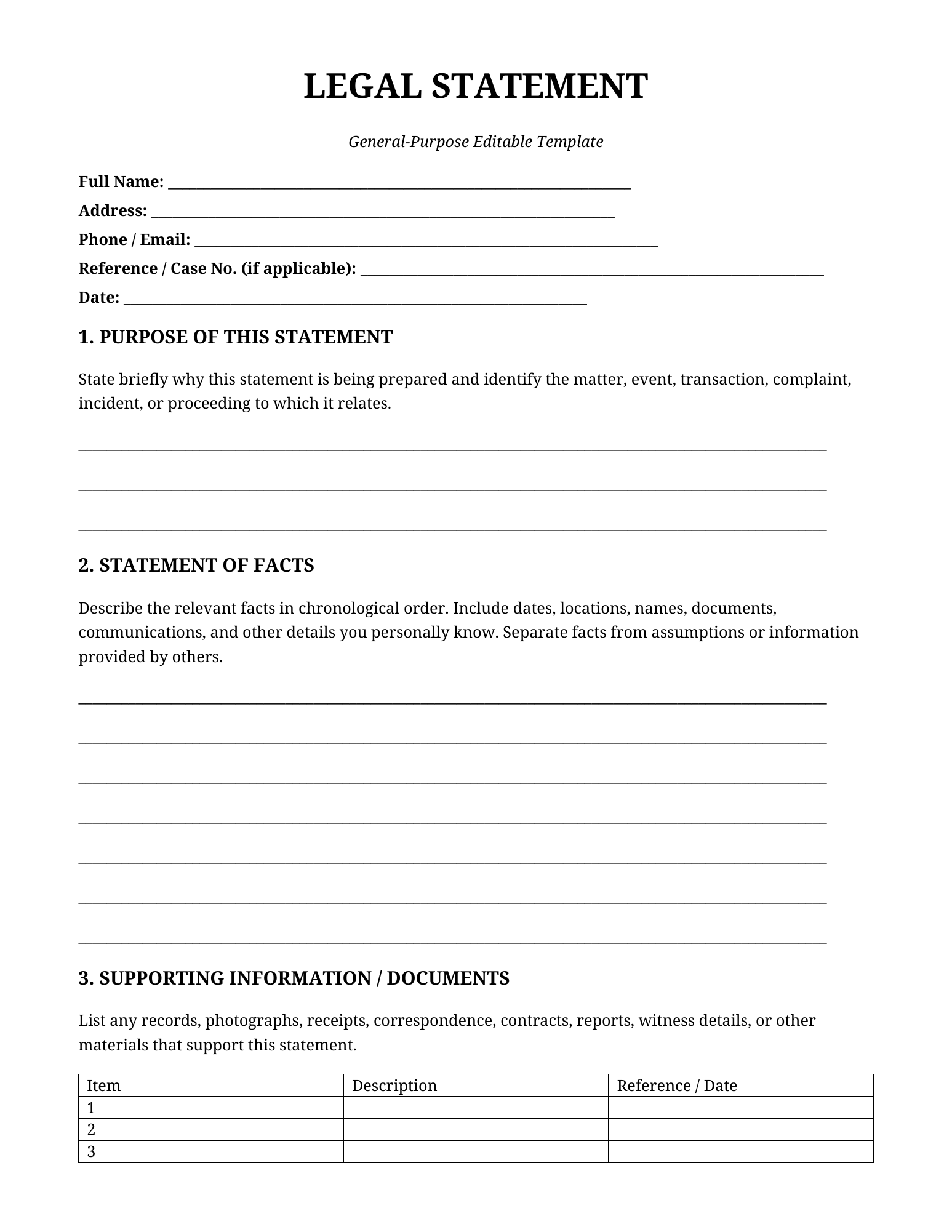
Download an Editable Legal Statement Template
Use this professionally formatted Word template to prepare a clear legal statement with sections for the matter reference, declarant details, numbered facts, supporting exhibits, verification, signature, witness, and notarization where required. Download the DOCX file, replace the sample prompts with accurate information, and check the receiving court, agency, employer, insurer, or legal professional’s requirements before submission.
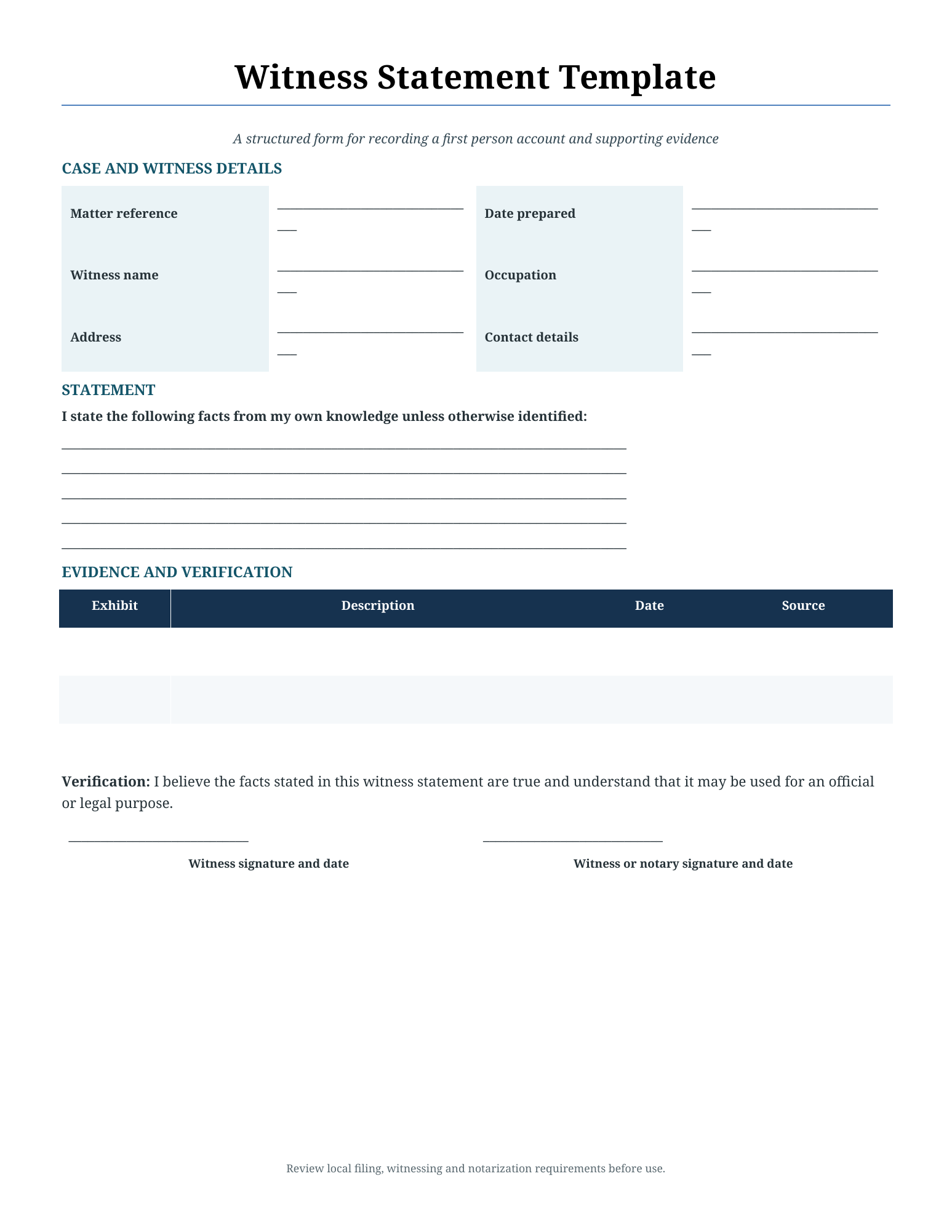
Download Witness Statement Template
This editable Word template provides a structured format for witness details, numbered facts, evidence references, verification, signatures, and witnessing or notarization information.
FAQs
1. What is a legal statement?
A legal statement is a formal written account, declaration, or explanation prepared for a legal, administrative, business, or other official purpose. The exact type and requirements depend on the situation.
2. What should a legal statement include?
It may include the name of the person making the statement, date, subject or case information, relevant facts, description of events, supporting details, and a signature or declaration where required.
3. What is a legal statement template?
A legal statement template is a structured document that provides a starting format for preparing a formal written statement. It should be customized to the purpose and requirements of the specific situation.
4. Is a legal statement the same as an affidavit?
No. An affidavit is generally a statement made under oath or affirmation and may have specific witnessing or notarization requirements. A generic written statement does not necessarily have the same formal status.
5. What is a witness statement?
A witness statement is a written account of events that a person personally observed or experienced. It should generally focus on firsthand information and relevant facts.
6. Can I use a legal statement template in Word?
Yes. A Word template can provide an editable format for drafting and organizing a statement. However, use an official form instead if the relevant court, agency, or organization requires one.
7. Can a legal statement be used for an insurance claim?
Yes. Insurance companies may request written statements concerning accidents, property damage, losses, or other events. Follow the insurer’s specific instructions when preparing the document.
8. What is the difference between a declaration and a legal statement?
The terms can have different meanings depending on the jurisdiction and context. Some declarations have specific formal requirements, so the document should be prepared according to the applicable instructions.
9. How should a legal statement be written?
Use clear, factual language and organize relevant information logically. Include specific dates, names, locations, and events where appropriate, and avoid speculation or unsupported claims.
10. Can I use a free legal statement template for court?
A generic template may help organize information, but courts can have specific forms, formatting rules, filing requirements, and procedural requirements. Always check the applicable court instructions before submitting a document.
You must be logged in to post a comment.