
A research statement explains the questions you investigate, the contribution of your past work, the methods you use, and the direction of your future research. The exact purpose depends on context. In academic hiring, a research statement helps a committee understand an applicant’s research identity, record, future program, and fit with the department. In industry and applied R&D, a research statement can define a technical uncertainty, research questions, success criteria, experimental approach, decision gates, and the way results will be transferred into products or processes.
The two free templates below are intentionally different. The first is an academic research statement template for faculty, postdoctoral, fellowship, or research-intensive applications. The second is an industry R&D research statement template for applied research planning. Both are professionally designed editable DOCX files with structured tables and writing prompts rather than plain text documents.
Download the Research Statement Templates
1. Academic Research Statement Template
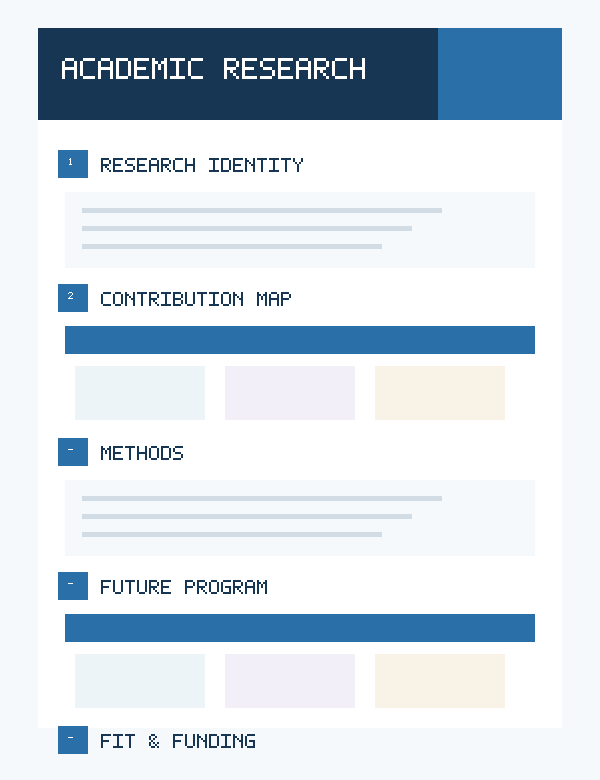
This template helps an academic applicant organize a research narrative around a central identity, past contributions, methods, significance, future directions, and institutional fit. It includes a Past / Now / Next visual framework, contribution map, research-method prompts, future-program table, and final drafting checklist.
2. Industry R&D Research Statement Template
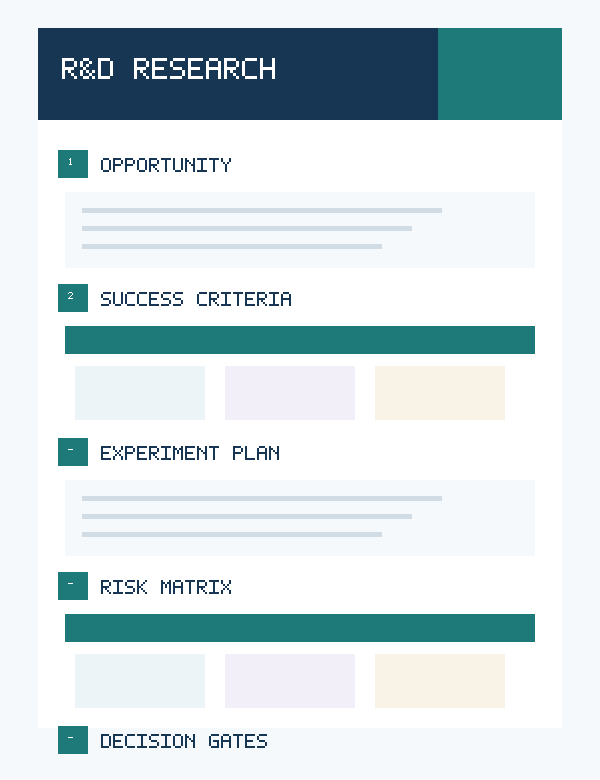
The second template is designed for applied research rather than academic hiring. It starts with a real business or technical uncertainty, then organizes measurable success criteria, research questions, methods, work phases, decision gates, risk controls, and expected transfer into a product, process, standard, investment decision, or next experiment.
What Is a Research Statement?
A research statement is a focused explanation of a research agenda. It normally connects previous work with current questions and future directions. Unlike a CV, which lists publications and appointments, the research statement explains how the pieces fit together and what intellectual or practical problem drives the work.
A strong statement should help a reader understand not only what you have done, but why the work matters, what role you personally played, what methods or evidence support the findings, and what questions logically follow.
Research Statement vs. Statement of Purpose
A research statement and a Statement of Purpose can overlap, especially in graduate or doctoral applications, but they usually serve different purposes. A statement of purpose often explains an applicant’s preparation, program fit, and educational goals. A research statement is more directly centered on a research agenda, contributions, methods, and future work.
Always follow the instructions of the institution or employer. Some applications use the term “research statement” for a broad narrative, while others request separate research, teaching, diversity, personal, or project documents.
What an Academic Research Statement Should Communicate
Academic committees often read research statements across candidates with different specializations. The document therefore needs enough technical substance to demonstrate expertise while still making the main questions and contributions understandable to readers adjacent to your field.
A useful research statement normally communicates five things:
- Research identity: the core questions or problem that connect your work.
- Past contribution: what you personally contributed to important projects.
- Methods and capability: how you investigate the problem and what tools, models, datasets, theories, or field approaches you can use.
- Significance: what the research adds to the discipline and, where appropriate, to a broader problem.
- Future program: the next questions you want to pursue and the environment needed to pursue them.
How to Use the Academic Research Statement Template
Start by writing the central research question or problem. Do not begin with a list of publications. Ask what connects the strongest parts of your work. The answer might be a theoretical problem, a class of systems, a methodological challenge, a population, a historical question, a scientific mechanism, or another coherent research theme.
The contribution map then forces each major project into four columns: project, question, your contribution, and evidence or output. This is valuable because applicants sometimes describe a successful team project without making their personal role clear. The statement should show what you designed, analyzed, discovered, developed, led, tested, interpreted, or contributed intellectually.
Describing Methods Without Losing the Reader
Methods matter because they demonstrate research capability, but the statement should not become a technical manual. Explain methods in relation to the question they answer. For example, instead of listing several statistical tools, explain why a particular design allowed you to distinguish competing explanations or evaluate a hypothesis.
The same principle applies to laboratory techniques, qualitative methods, simulations, archival work, field studies, computational models, design research, or other approaches. The reader should understand what the method enables.
Explain Significance at the Right Scale
Research significance can be overstated when every project is described as transformative or revolutionary. A stronger approach is to explain the specific gap the work addresses and the type of contribution it makes. That contribution may be a new method, dataset, theory, measurement, model, empirical result, mechanism, design principle, or synthesis.
If broader social, clinical, technological, environmental, policy, or commercial implications are relevant, describe them carefully without claiming outcomes the research has not established.
Writing the Future Research Program
The future section should feel like a logical extension of the applicant’s expertise, but it should not simply repeat completed projects. Use the template to identify two or more research directions, the near-term question in each direction, the longer-term opportunity, and the resources or collaborators that may be helpful.
A future program should be specific enough to show intellectual direction but flexible enough to adapt to new evidence, funding, collaborators, students, and institutional opportunities. Overly rigid five-year predictions can sound less credible than a coherent program with several connected questions.
How to Show Institutional Fit
Fit should be evidence-based. Naming a faculty member or research center is useful only when you can explain the intellectual or methodological connection. Avoid listing multiple names merely to demonstrate that you visited the institution’s website.
Possible fit factors include complementary faculty expertise, facilities, datasets, archives, laboratories, field sites, centers, graduate programs, collaborators, student opportunities, or regional access relevant to the research agenda. Verify that information before submitting.
What Is an Industry R&D Research Statement?
An industry research statement serves a different purpose. It helps a team define why research is needed before it begins. Instead of starting with an academic contribution, it usually starts with a decision, technical uncertainty, user need, performance gap, or risk that cannot be resolved confidently with existing information.
The applied template is useful for product development, engineering, manufacturing, energy, software, materials, healthcare technology, operations, or other settings where research must eventually inform a practical decision.
Start With the Research Opportunity
A useful industry research statement should explain what is unknown and why resolving that uncertainty matters. Examples include whether a new design can meet a performance threshold, whether a material will remain stable under real conditions, whether a process can reduce cost without reducing quality, or whether users behave as an existing assumption predicts.
This is similar to a Project Problem Statement, but the research statement emphasizes uncertainty and evidence. A project problem may already be known; a research problem often exists because the team does not yet know the right explanation, design, parameter, or decision.
Define Success Before Running the Research
The success-criteria table is one of the most important parts of the industry template. Record the current baseline, target or threshold, and the method of measurement before testing. This reduces the temptation to redefine success after seeing the results.
Useful criteria may involve performance, cost, reliability, safety, efficiency, quality, usability, accuracy, durability, emissions, energy consumption, manufacturability, or another measurable outcome relevant to the decision.
Write Research Questions That Support Decisions
The research-question table asks why each question matters. This prevents research activity from becoming disconnected from the decision it is supposed to support. A technically interesting question may still be a poor priority if the answer will not change design, investment, risk, or next-step decisions.
Where hypotheses are appropriate, define them clearly enough that an experiment or analysis could provide evidence for or against them. Avoid vague statements that cannot be tested.
Choose an Appropriate Research Approach
Industry research can use experiments, prototypes, simulations, benchmarks, user studies, field trials, data analysis, modeling, literature review, supplier testing, accelerated-life tests, or other methods. The method should match the uncertainty.
The template provides space for methods because teams often jump directly to a preferred experiment without first asking whether it can answer the actual research question. A simpler method may be sufficient, while a sophisticated method may still be inappropriate if it measures the wrong outcome.
Use Decision Gates, Not Just a Timeline
The workplan in the template is structured around phases and gates: explore, test, validate, and transfer. Each phase has an expected output and a decision point. That allows the team to stop, narrow, redesign, or continue based on evidence.
This is important in R&D because not every research program should continue to full scale. A useful negative result can save substantial time and investment if the plan includes clear stop or pivot criteria.
Risks, Ethics, Data, Safety, and Intellectual Property
Applied research can create risks beyond technical performance. Depending on the work, consider privacy, data rights, ethics, safety, regulation, intellectual property, export controls, environmental effects, cybersecurity, or confidentiality. The template includes a structured section so these constraints are visible early rather than discovered after the research begins.
Common Research Statement Mistakes
- Turning the document into a list of publications.
- Describing team achievements without making the applicant’s contribution clear.
- Using technical detail without explaining the research question.
- Claiming broad impact that the evidence does not support.
- Presenting future research that is disconnected from existing expertise.
- Using generic statements of institutional fit.
- In industry, starting experiments without defining success criteria.
- Running research that is interesting but does not support a decision.
- Ignoring data, safety, ethical, regulatory, or intellectual-property constraints.
Final Review Checklist
- The opening establishes a clear research identity or opportunity.
- Past contributions are specific and supported by evidence.
- Methods are explained in relation to the questions they answer.
- Significance is stated at an appropriate scale.
- Future directions are coherent and realistically connected to capability.
- Success criteria are measurable where applied research is involved.
- Decision gates and stop or pivot criteria are visible.
- Institutional or organizational fit is specific rather than generic.
- The final document follows the requested page or word limit.
Frequently Asked Questions
How long should an academic research statement be?
Follow the application instructions. Requirements vary by discipline and institution, and some positions specify a page limit while others give only broad guidance.
Should I include citations in a research statement?
Use citations when they help the reader identify important work and when the application format permits them. Keep the document readable and do not turn it into a literature review unless that is requested.
Can graduate students use the academic template?
Yes, but graduate applicants should adapt the emphasis. If the program asks for a statement of purpose rather than a research statement, follow that prompt and use the appropriate document type.
Should future research be very detailed?
It should be specific enough to show direction and feasibility without pretending that every question, method, and result is already known. Research plans should leave room for evidence to change the next step.
What is the difference between an R&D statement and a project plan?
The R&D statement focuses on uncertainty, research questions, evidence, methods, and decision criteria. A project plan normally goes further into schedule, resources, tasks, dependencies, budgets, and delivery management.
Can I edit these templates in Microsoft Word?
Yes. Both downloads are editable DOCX files. You can change colors, tables, section labels, prompts, and the amount of writing space to match your field or organization.