
A statement of intent explains what you plan to pursue, why you want to pursue it, and how your background, goals, or proposed contribution support that direction. The term appears in academic admissions, research and professional programs, partnerships, projects, collaborations, and other situations where a person or organization needs to communicate serious future intent before the next stage begins.
The two free Word templates on this page are deliberately different. The first is a graduate and academic statement of intent template designed to help applicants connect their preparation, academic interests, program fit, future direction, and contribution. The second is a business and project statement of intent template for documenting shared objectives, proposed contributions, assumptions, milestones, unresolved issues, and the intended status of an early-stage collaboration.
Both downloads are editable DOCX files with structured sections, tables, visual hierarchy, and prompts rather than plain text pages. A statement of intent should still be customized for the recipient. Universities, funding bodies, employers, partners, and contracting parties may provide their own instructions, word limits, required headings, or formal documents, and those requirements should take priority over a general template.
Download the Statement of Intent Templates
1. Graduate Statement of Intent Template
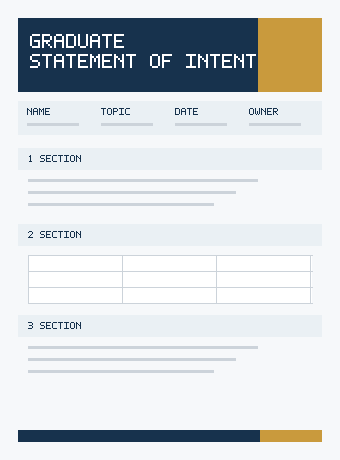
This professionally designed Word template is intended for graduate programs, academic applications, research-oriented study, professional programs, fellowships, and similar situations where the applicant must explain direction and fit. It includes an intent-at-a-glance panel, opening-statement prompts, a preparation-and-evidence table, program-fit mapping, future-direction section, paragraph plan, evidence bank, and final review checklist.
2. Business & Project Statement of Intent Template
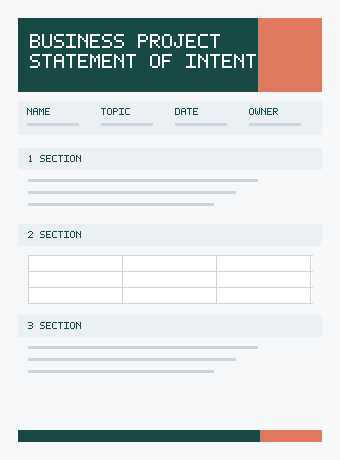
The second template serves a different purpose. It can help two parties record the direction of a proposed collaboration, project, commercial relationship, community initiative, research partnership, service arrangement, or other early-stage undertaking. It contains sections for the intended relationship, shared objectives, each party’s contribution, assumptions and dependencies, milestones, open issues, status wording, and sign-off.
What Is a Statement of Intent?
A statement of intent is a written expression of planned direction. In an academic application, it normally explains what the applicant wants to study, the preparation that supports that goal, why the particular program is relevant, and what the applicant hopes to do with the opportunity. In a business or project setting, it can record what parties presently intend to explore or accomplish and the issues that must be resolved before a more detailed agreement or implementation plan is completed.
The phrase is not used identically everywhere. One institution may use “statement of intent” as another institution uses “statement of purpose,” while a business may use the phrase for a document that resembles a letter of intent, memorandum of understanding, term sheet, or project concept note. Before drafting, identify what the recipient actually expects rather than relying on the title alone.
Statement of Intent vs. Statement of Purpose
In academic admissions, the two terms can overlap. A Statement of Purpose often emphasizes academic preparation, research interests, program fit, and future goals. A statement of intent may cover much of the same ground, especially when the institution uses the terms interchangeably.
The practical rule is to follow the prompt. If the university asks how your prior work prepared you, which faculty or areas interest you, what you intend to study, and where the degree fits into your future plans, make sure the final document answers those questions directly even if your preferred template uses slightly different headings.
Statement of Intent vs. Letter of Intent
A business letter of intent is often used during negotiations to summarize a proposed transaction or relationship before final agreements are signed. A statement of intent can be less letter-like and more structured, but the labels alone do not determine the legal effect of a document.
If money, exclusivity, confidentiality, intellectual property, employment, acquisition terms, property, procurement, regulatory obligations, or another material legal issue is involved, do not assume that calling a document “non-binding” settles every question. The wording, conduct of the parties, surrounding documents, and applicable law can matter. The business template on this page is a planning and alignment tool, not a substitute for legal advice or a transaction-specific agreement.
How to Write an Academic Statement of Intent
Start with direction rather than biography. The reader usually needs to understand what you want to study or develop and why the next program is a logical step. A short opening can identify the central academic interest, professional problem, research question, or experience that shaped your direction without spending half the document on a dramatic life story.
Then establish preparation. Useful evidence can include relevant coursework, research, employment, fieldwork, internships, publications, design work, clinical experience, community work, technical projects, leadership, or another experience connected to the program. Instead of writing that you are “passionate” or “hard-working,” show what you did, what you learned, and how it changed your capabilities or questions.
Show Program Fit with Specific Evidence
Program fit is stronger when it is specific and accurate. Depending on the field, you might refer to a faculty research area, laboratory, clinic, studio, archive, curriculum, methodology, practicum, specialization, industry connection, community partnership, or other feature that genuinely supports your goal.
Avoid turning the statement into a list of names copied from the institution’s website. The important connection is why a particular feature matters to your intended work. A sentence that links your past preparation, an identifiable program resource, and a future question is usually more informative than several sentences of praise.
Connect Past Experience to Future Direction
A statement of intent should usually move forward. The past provides evidence, but the document should also explain what the applicant wants to learn, investigate, build, practice, or contribute next. This helps the reader see a coherent path rather than a résumé rewritten as paragraphs.
The planning table in the graduate template is designed for this purpose. For each important experience, record what you actually did and why it matters for the program. This simple step can expose weak claims before they reach the final draft.
How to Use the Business Statement of Intent Template
Begin with the intended relationship in plain language. Identify the parties, the project or opportunity, and the outcome they are exploring. The statement should be detailed enough to create a common understanding without pretending that unresolved issues have already been agreed.
Next, separate shared objectives from each party’s contributions. Shared objectives describe the result both sides hope to achieve. Contributions explain who may provide funding, personnel, data, technology, facilities, expertise, access, distribution, approvals, or other resources. Keeping these sections separate makes it easier to detect assumptions that the parties have not actually discussed.
Document Assumptions, Dependencies, and Boundaries
Many early-stage projects fail because a hidden dependency is treated as a certainty. Record important assumptions such as financing, due diligence, permits, internal approval, data access, technical feasibility, staffing, procurement, or third-party consent. Also identify what is outside the current scope.
The open-issues table should be used for questions that need resolution before a formal commitment. Examples might include commercial terms, intellectual property, data responsibilities, service levels, budget authority, risk allocation, implementation timing, or approval rights. An unresolved issue is easier to manage when it is named, owned, and given a target date.
Use Milestones Without Creating False Precision
Milestones can keep discussions moving, but early dates may be provisional. Distinguish an aspiration from a binding deadline. If the parties are still validating feasibility, write that the target is subject to specified approvals or information rather than presenting an uncertain date as guaranteed.
The same principle applies to quantities, costs, deliverables, and expected results. A statement of intent should clarify what is known, what is proposed, and what still requires agreement.
When a Mission or Vision Statement Is More Appropriate
A statement of intent is not a replacement for an organization’s enduring purpose or desired future. A Mission Statement explains why an organization exists and whom it serves, while a Vision Statement describes a desired future state. Intent is usually more situational: it communicates what a person or organization plans to pursue in a particular application, project, partnership, or next stage.
Common Statement of Intent Mistakes
- Using a generic opening that never clearly states the intended direction.
- Repeating a résumé without explaining why the experiences matter.
- Making claims about skills or motivation without concrete evidence.
- Praising an academic program without explaining the actual fit.
- Using the same academic statement for every institution without adapting the details.
- Confusing current intent with a final binding commitment in a business context.
- Leaving important dependencies, approvals, costs, or unresolved issues unstated.
- Using vague phrases such as “strategic partnership” when neither party has defined the work.
- Signing a business document without understanding the effect of its wording.
- Ignoring the recipient’s required length, format, questions, or submission method.
Final Review Checklist
- The document clearly identifies the intended program, project, relationship, or direction.
- The opening communicates a specific purpose rather than a generic ambition.
- Important claims are supported by relevant evidence or experience.
- Academic program details have been checked for accuracy.
- Future goals are realistic and connected to the opportunity.
- Business objectives and each party’s proposed contribution are separated clearly.
- Dependencies and unresolved issues are visible rather than hidden.
- The wording does not accidentally imply certainty where decisions are still pending.
- Any legal or commercial language has been reviewed appropriately for the situation.
- The final version follows the recipient’s instructions and has been proofread.
Frequently Asked Questions
Is a statement of intent the same as a statement of purpose?
Sometimes. Academic institutions may use the terms interchangeably, while others give them different prompts. Follow the specific questions and instructions provided by the institution rather than assuming a universal distinction.
How long should an academic statement of intent be?
Use the program’s stated word, character, or page limit. If no limit is given, write only as much as needed to explain direction, preparation, fit, and future goals clearly. Do not add material simply to make the document longer.
Is a business statement of intent legally binding?
The title alone does not answer that question. Legal effect can depend on the wording, context, conduct of the parties, and applicable law. For a material transaction or commitment, obtain appropriate legal review before signing or relying on the document.
Should a statement of intent be signed?
An academic application usually follows the institution’s submission process and may not require a traditional signature. A business document may include sign-off if that is useful, but parties should understand what they are acknowledging before signing.
Can I edit these templates in Microsoft Word?
Yes. Both downloads are editable DOCX files. You can replace the prompts, adjust the colors, add your logo or institution details, expand tables, and remove sections that do not apply.
Can I reuse the same statement of intent for different applications or projects?
You can reuse a strong structure and some underlying evidence, but the final document should be adapted to the specific institution, recipient, collaboration, scope, goals, and instructions. Generic reuse is one of the easiest ways to make a statement feel unconvincing.