
A Statement of Work (SOW) translates a project agreement into specific work expectations. A useful SOW defines the scope, deliverables, acceptance criteria, responsibilities, schedule, assumptions, dependencies, exclusions, and payment or commercial terms relevant to the engagement. The goal is to reduce ambiguity before work begins rather than document disagreements after they occur.
Scope and deliverables should be measurable whenever possible. Instead of stating that a contractor will “improve the website,” for example, the SOW can identify the pages or features to be delivered, technical requirements, review stages, completion dates, and the conditions that determine acceptance.
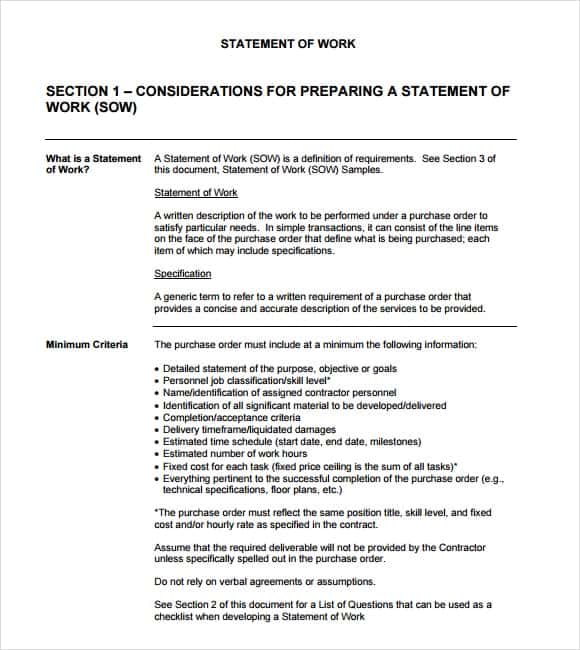
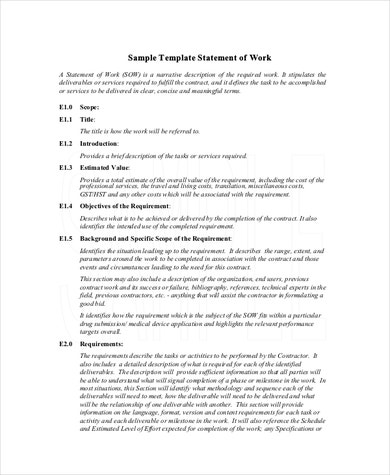
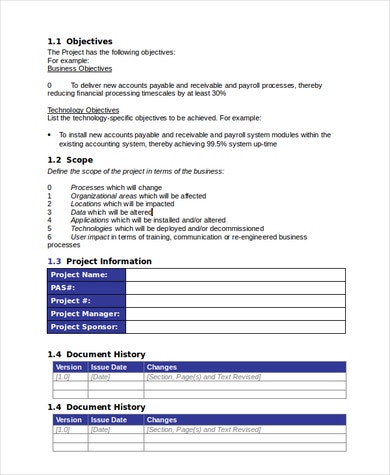
Our free Statement of Work templates provide a practical starting point for creating a professional SOW without having to build the entire document from scratch. You can use a template to organize project information, describe the work to be completed, establish milestones and deadlines, identify deliverables, and document important project requirements.
A well-prepared Statement of Work template can be useful for business projects, consulting engagements, software development, construction work, marketing services, freelance projects, IT services, professional services, and many other types of contractual or project-based work.
What Is a Statement of Work?
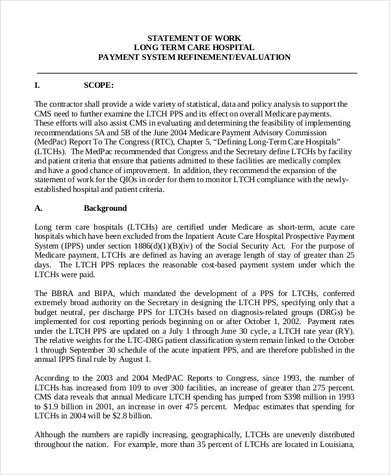
A Statement of Work, commonly abbreviated as SOW, is a formal document that describes the work that needs to be completed as part of a project or service engagement. It provides a detailed description of what the project involves, what will be delivered, who is responsible for specific tasks, and when the work is expected to be completed.
The SOW is often prepared before or alongside a contract, proposal, or project agreement. While the exact relationship between these documents depends on the circumstances, the Statement of Work is generally focused on defining the actual work and expected outcomes.
A good SOW document reduces ambiguity by putting important project information in writing. Instead of relying on informal conversations or assumptions, the client and service provider can refer to the agreed scope, deliverables, schedule, and responsibilities.
Free Statement of Work Templates
Using a free SOW template can save time when preparing project documentation. A pre-formatted template gives you an organized structure that can be customized for your particular project.
You can add the client and contractor information, project description, objectives, scope of work, deliverables, milestones, timeline, payment information, assumptions, acceptance criteria, and other relevant requirements.
The amount of detail required will depend on the complexity of the project. A small freelance assignment may need a relatively simple statement of work, while a large software development, construction, consulting, or corporate project may require a much more detailed SOW.
What Should a Statement of Work Include?
A professional Statement of Work format can vary depending on the industry and type of project, but several sections are commonly included.
Project Information:
Begin with the project name, client name, service provider or contractor, document date, project number if applicable, and other identifying information.
Project Overview:
Provide a concise explanation of the project and why the work is being undertaken.
Objectives:
Clearly describe the intended goals and outcomes of the project. Objectives should help everyone understand what the project is expected to accomplish.
Scope of Work:
This is one of the most important sections of an SOW. Explain what work is included, what activities will be performed, and what the service provider is expected to deliver.
Deliverables:
List the specific products, services, reports, documents, software, designs, or other outputs that will be delivered.
Timeline and Milestones:
Include important dates, project phases, milestones, deadlines, and expected completion dates.
Roles and Responsibilities:
Identify which tasks are the responsibility of the client, contractor, vendor, consultant, or project team.
Payment Terms:
Where appropriate, document project fees, payment schedules, rates, invoicing requirements, deposits, or milestone-based payments.
Acceptance Criteria:
Explain how deliverables will be reviewed and what conditions must be met for work to be considered completed or accepted.
Assumptions and Constraints:
Document important assumptions, limitations, dependencies, resources, or conditions that could affect project delivery.
Statement of Work Example
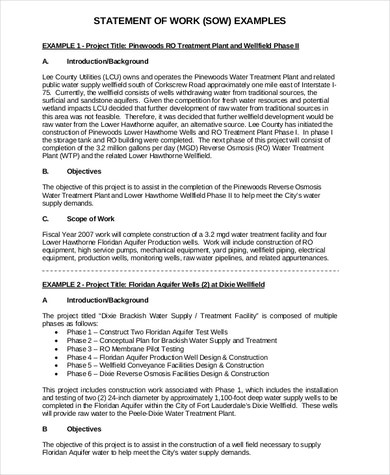
A Statement of Work example can make it easier to understand how an SOW is structured. For example, suppose a company hires a web development agency to redesign its corporate website.
The SOW could identify the project objective as redesigning the company’s website and improving its usability. The scope might include website planning, user interface design, development, content integration, testing, and deployment.
The deliverables could include approved page designs, a responsive website, testing documentation, and a completed production website. The project schedule could then define design, development, testing, and launch milestones.
The SOW could also specify which responsibilities belong to the client, such as providing content and approving designs, while the development agency would be responsible for programming, testing, and deployment.
This type of SOW example demonstrates why a detailed scope and clearly defined deliverables are important.
Statement of Work Template in Word
A Statement of Work template in Word can be useful when you need an editable document that can be customized for a particular project. Word makes it easy to change headings, add company branding, modify tables, insert project details, and adjust the document’s formatting.
A Word SOW can also be printed or converted into PDF after the document has been completed and approved.
For straightforward projects, an editable Word template may provide everything needed to prepare a professional project scope document.
Statement of Work Template in Excel
An SOW template in Excel can be useful when the project involves detailed schedules, task lists, milestones, costs, or structured data.
Excel can make it easier to organize project activities into rows and columns and track information such as task names, responsible parties, start dates, due dates, estimated costs, and completion status.
For projects requiring extensive calculations or project tracking, Excel can complement the main Statement of Work document.
SOW Template PDF
A Statement of Work PDF template can be useful when you need to share a finalized document while preserving its formatting. PDF is particularly convenient for sending an approved SOW to a client, contractor, vendor, or project stakeholder.
It is usually easier to make changes using an editable Word or Excel version before creating the final PDF.
Scope of Work vs. Statement of Work
The terms scope of work and statement of work are sometimes used interchangeably, but they do not always mean exactly the same thing.
The scope of work generally refers to the specific work included in a project. A Statement of Work is typically a broader project document that can include the scope along with objectives, deliverables, schedules, responsibilities, assumptions, acceptance criteria, and other project information.
In practical business use, terminology varies by organization and industry. The important goal is to clearly document what has been agreed upon.
Statement of Work vs. Contract
An SOW and a contract can also serve different purposes.
A contract generally establishes the broader legal and commercial relationship between the parties, including terms and conditions, obligations, rights, payment provisions, confidentiality, liability, termination, and other applicable matters.
A Statement of Work focuses more specifically on the project or services being performed.
In some engagements, the SOW may be incorporated into a contract or referenced as an attachment or exhibit. Whether an SOW itself creates contractual obligations depends on how the documents are drafted and the applicable law.
For important commercial or legal arrangements, the completed document should be reviewed by an appropriately qualified professional.
Why Use a Statement of Work Template?
Creating a detailed SOW from a blank document can be time-consuming. A template gives you a starting framework and helps ensure that important project information is not overlooked.
A Statement of Work template can help you:
- Define project scope clearly.
- Document project objectives.
- Identify specific deliverables.
- Establish project milestones.
- Assign responsibilities.
- Record deadlines and schedules.
- Clarify payment arrangements.
- Document assumptions and constraints.
- Establish acceptance criteria.
- Reduce misunderstandings between project parties.
- Provide a consistent project documentation format.
- Create a professional document for clients and stakeholders.
The template should always be customized to match the actual requirements of the project rather than being used without review.
Benefits of a Well-Written SOW
A detailed SOW can improve communication before and during a project. When everyone understands what is included in the engagement, there is less room for conflicting assumptions.
A clearly defined scope can also help control scope creep. If a client requests work that falls outside the original scope, the parties can refer back to the SOW and determine whether the additional work requires a change request, revised estimate, new milestone, or additional fee.
An SOW can also provide a useful reference when evaluating whether project deliverables have been completed.
How to Write a Statement of Work
Start by identifying the project and the parties involved. Next, describe the purpose and objectives of the project in clear language.
Define the scope of work carefully. Explain what is included and, where useful, identify major exclusions. Avoid vague descriptions that could be interpreted differently by different people.
List each major deliverable and explain what constitutes completion. Establish realistic milestones and deadlines and identify who is responsible for each major activity.
If applicable, document fees, payment schedules, assumptions, dependencies, acceptance criteria, and change-management procedures.
Finally, review the completed SOW with the relevant stakeholders before the project begins. Everyone should have an opportunity to identify unclear requirements or missing information.
Statement of Work for Freelancers and Consultants
Freelancers, consultants, agencies, and independent contractors can benefit significantly from using an SOW.
For example, a graphic designer could use an SOW to define the number of design concepts, revisions, final file formats, delivery dates, and client responsibilities.
A marketing consultant could use one to document campaign activities, reporting requirements, milestones, meetings, and deliverables.
A software developer could define features, development phases, testing requirements, deployment responsibilities, and project acceptance criteria.
In each case, the SOW helps establish a shared understanding before substantial work begins.
Statement of Work for Software and IT Projects
IT and software projects can become complicated quickly, making a detailed SOW particularly valuable.
A software development SOW might include project objectives, system requirements, features, integrations, testing, security requirements, deployment, documentation, training, maintenance, and support.
The document can also identify milestones for planning, design, development, testing, user acceptance, and production deployment.
The more complex the project, the more important it becomes to define requirements and deliverables precisely.
Statement of Work for Business Projects
Businesses can use SOW documents for a wide range of projects, including consulting engagements, marketing campaigns, process improvements, technology implementation, research, training, construction, design, and outsourced services.
A standardized business SOW template can help organizations maintain consistency across different projects while still allowing individual project managers or departments to customize the details.
Choose the Right SOW Template
The best Statement of Work template depends on the size, complexity, and type of project.
A simple project may require only a few sections covering the objectives, scope, deliverables, timeline, responsibilities, and payment terms. A large project may require detailed requirements, milestones, acceptance criteria, dependencies, assumptions, risk considerations, and change-control procedures.
Choose a template that provides enough structure without adding unnecessary complexity. Then customize every section so that the finished document accurately reflects the actual agreement and project requirements.
Our free Statement of Work templates can give you a practical starting point for creating a clear, organized, and professional SOW for your next project.
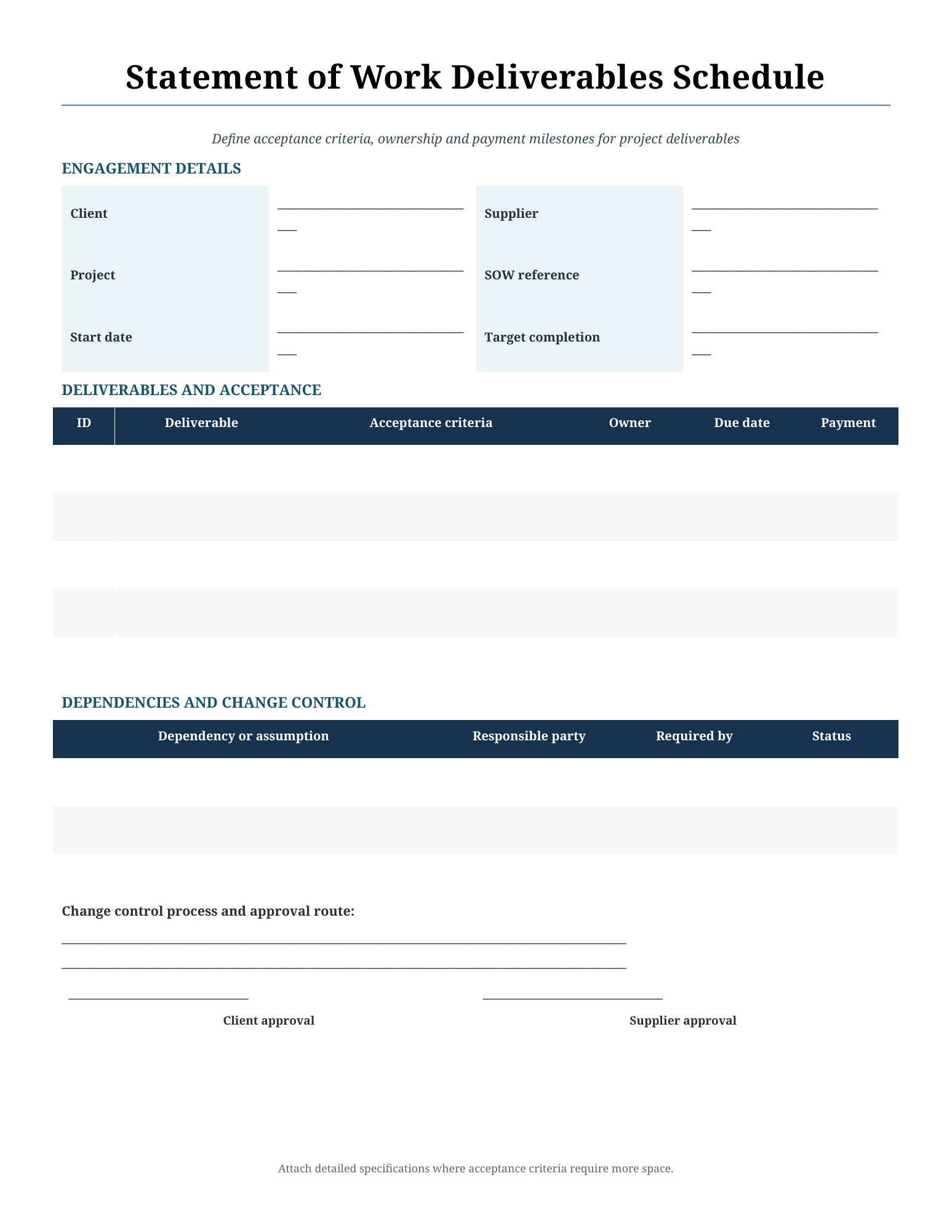
Download Statement of Work Deliverables Schedule
This editable schedule defines deliverables, acceptance criteria, owners, due dates, payment milestones, dependencies, and the agreed change-control route.

FAQs
1. What is a Statement of Work template?
A Statement of Work template is a pre-formatted document used to describe a project’s scope, objectives, deliverables, responsibilities, timeline, payment terms, and other important requirements.
2. What does SOW stand for?
SOW stands for Statement of Work. It is commonly used in project management, consulting, contracting, IT, construction, and professional services.
3. What should be included in an SOW?
A typical SOW can include project information, objectives, scope of work, deliverables, milestones, timeline, responsibilities, payment terms, acceptance criteria, assumptions, and constraints.
4. What is the difference between an SOW and a contract?
A contract generally establishes the broader legal relationship between parties, while an SOW focuses primarily on the specific work, services, deliverables, and requirements of a project.
5. Can I use an SOW template for freelance work?
Yes. Freelancers can use an SOW to define project deliverables, revisions, deadlines, responsibilities, fees, and other requirements before starting work.
6. Can I edit a Statement of Work template in Word?
Yes. A Word SOW template can be customized with project information, company branding, tables, deadlines, deliverables, and other details.
7. What is the difference between scope of work and Statement of Work?
Scope of work generally describes the work included in a project, while a Statement of Work can contain the scope along with objectives, deliverables, schedule, responsibilities, acceptance criteria, and other project information.
8. Why is a Statement of Work important?
An SOW helps establish clear expectations about what work will be performed, what will be delivered, who is responsible, and when the project should be completed. It can also help reduce misunderstandings and scope creep.
You must be logged in to post a comment.