
A bank statement is an official record issued by a financial institution that summarizes account activity for a defined period, including opening and closing balances, deposits, withdrawals, transfers, card transactions, fees, and interest where applicable. It is commonly used to reconcile personal or business records against transactions actually processed by the bank.
The templates on this page are intended for education, bookkeeping practice, internal record organization, and sample-document design. They are not bank-issued documents and should not be represented as authentic statements for identity, lending, immigration, verification, or other official purposes.
Our free bank statement templates provide a convenient starting point for creating sample account records, organizing financial information, preparing bookkeeping documents, or understanding the typical structure of a bank statement. You can customize an appropriate template with transaction dates, descriptions, deposits, withdrawals, balances, and other information according to your legitimate purpose.
These templates can be useful for personal financial organization, accounting practice, bookkeeping exercises, business recordkeeping, financial education, demonstrations, and sample documentation. They can also help students and professionals understand how transaction histories are commonly presented.
It is important to distinguish a template or sample document from an official bank statement. An actual bank statement is issued or authenticated by the relevant financial institution. A template should not be used to misrepresent a document as an authentic statement issued by a bank.
What Is a Bank Statement?
A bank statement is a periodic record of transactions and account activity provided by a bank or financial institution.
A typical statement identifies the account holder and account information and then lists transactions during a specified period. It may show money deposited into the account, money withdrawn, transfers, payments, fees, and the resulting balance.
Depending on the bank and account type, a statement may include:
- Account holder name
- Account number or masked account number
- Statement period
- Opening balance
- Transaction dates
- Transaction descriptions
- Deposits
- Withdrawals
- Transfers
- ATM transactions
- Card transactions
- Bank charges
- Interest
- Closing balance
The exact bank statement format varies between financial institutions. Different banks use different layouts, terminology, transaction codes, and presentation styles.
Free Bank Statement Templates
A free bank statement template can provide a useful structure for organizing transaction information when an official bank statement is not what you need.
For example, a business owner may use a spreadsheet to maintain an internal record of transactions before reconciling them with official bank records. A student studying accounting may use a sample bank statement to understand deposits, withdrawals, and balances.
A template can also be useful when demonstrating financial software, teaching bookkeeping concepts, or preparing a fictional example for an educational presentation.
The templates can generally be customized with appropriate dates, descriptions, amounts, and balances.
However, if you need an official bank statement for a loan application, visa application, tax matter, legal proceeding, proof of funds, or another formal purpose, obtain the document directly from your bank or financial institution.
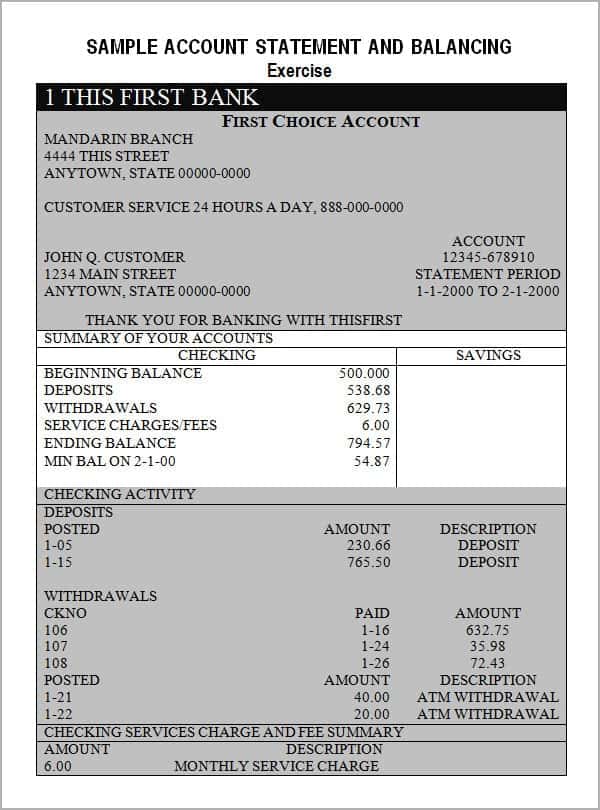
Bank Statement Example
A bank statement example can help explain how account transactions are organized.
A simple statement might begin with an opening balance. It could then list several transactions during the month, such as a salary deposit, ATM withdrawal, utility payment, card purchase, bank fee, and transfer.
Each transaction may have a date, description, amount, and resulting balance.
For example:
| Date | Description | Deposit | Withdrawal | Balance |
|---|---|---|---|---|
| June 1 | Opening Balance | — | — | $2,000 |
| June 3 | Salary Deposit | $2,500 | — | $4,500 |
| June 5 | Utility Payment | — | $200 | $4,300 |
| June 8 | ATM Withdrawal | — | $300 | $4,000 |
The exact columns and terminology will vary between financial institutions.
Bank Statement Format
There is no single universal bank statement format used by every bank.
A bank may display transactions in chronological order, categorize transactions, use transaction codes, or provide separate sections for deposits, withdrawals, fees, and other activities.
Some statements are designed primarily for online viewing, while others are optimized for printing or PDF downloads.
A typical format may include the bank’s name and contact information, account holder details, statement dates, opening balance, transaction history, and closing balance.
The design and terminology should not be assumed to be identical across different banks.
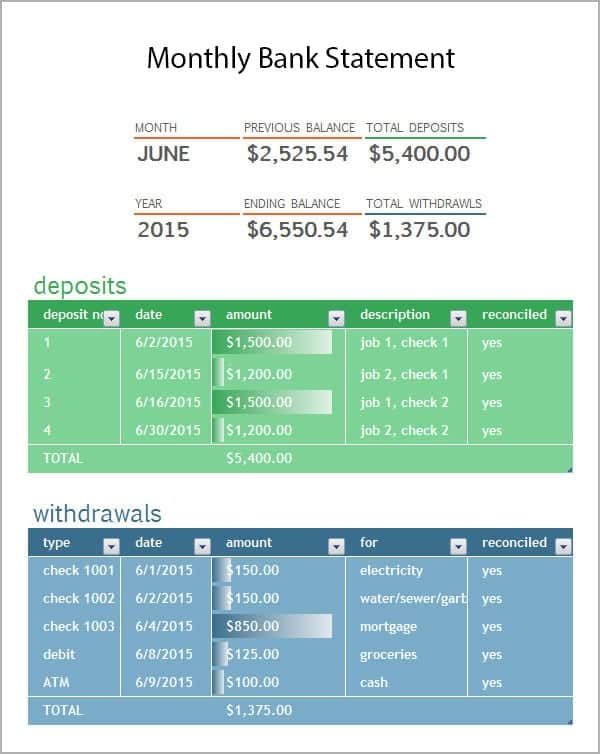
Monthly Bank Statement
A monthly bank statement summarizes account activity during a particular month.
Many banks make monthly statements available through online banking, although the exact statement frequency can depend on the account type and financial institution.
A monthly statement can help account holders review:
- Money received
- Money spent
- Transfers
- ATM withdrawals
- Card payments
- Bank charges
- Interest
- Beginning balance
- Ending balance
Regularly reviewing statements can also help identify unfamiliar transactions and support personal or business financial reconciliation.
Bank Statement Template in Excel
A bank statement template in Excel can be particularly useful for organizing transactions and calculating balances.
Excel allows you to create columns such as:
- Date
- Transaction description
- Reference number
- Deposit
- Withdrawal
- Debit
- Credit
- Running balance
- Notes
You can use formulas to calculate the running balance based on deposits and withdrawals.
Excel also makes it possible to sort transactions, filter records, calculate totals, and compare financial activity across different periods.
For bookkeeping purposes, an Excel transaction ledger can be useful alongside official bank statements.
Bank Statement Template in Word
A bank statement template in Word can be useful when the goal is to create an editable sample or educational document.
Word allows you to modify headings, tables, descriptions, dates, and other document elements.
It can be useful for creating a fictional example for training, accounting lessons, demonstrations, or internal documentation.
For extensive calculations, however, Excel is generally more convenient.
Bank Statement PDF
A bank statement PDF is commonly used by banks to provide customers with downloadable copies of official account statements.
Banks may allow customers to download statements through online banking or mobile applications.
A PDF template, on the other hand, is simply a document format that can be used for sample or organizational purposes. It should not be confused with an authentic bank-issued PDF.
If you require an official statement, download it directly through your bank’s authorized banking system or request it from the bank.
Personal Bank Statement
A personal bank statement shows activity in an individual’s bank account.
People commonly review personal statements to track income, spending, transfers, recurring payments, fees, and account balances.
A personal transaction template can help organize financial activity, particularly when someone wants to create a personal spending record or reconcile transactions against their bank account.
However, an internal transaction spreadsheet is different from an official bank statement.
Business Bank Statement
A business bank statement summarizes transactions in a company’s bank account.
Businesses may review statements to reconcile accounting records, verify payments, track deposits, identify fees, and monitor cash activity.
A business may have several types of bank transactions, including customer payments, supplier payments, payroll, tax payments, transfers, loan repayments, and bank charges.
Maintaining accurate internal records and reconciling them with official bank statements is an important part of bookkeeping.
Bank Statement for Bookkeeping
Bank statements are particularly useful in bookkeeping and bank reconciliation.
A business can compare the transactions recorded in its accounting system with transactions appearing on the bank statement.
This process can help identify:
- Missing transactions
- Duplicate entries
- Bank fees
- Unrecorded deposits
- Outstanding checks
- Timing differences
- Incorrect transaction amounts
- Unexpected transactions
An Excel bank transaction template can help organize this information before or during reconciliation.
Bank Statement vs. Transaction History
A bank statement and an online transaction history are related but may not be identical.
Online banking systems often provide a current list of recent transactions that can be searched or filtered. A formal bank statement generally covers a defined statement period and is presented as an official document by the financial institution.
The exact features depend on the bank.
If you need documentation for a formal purpose, check what type of record the receiving organization requires.
Bank Statement vs. Bank Account Ledger
A bank account ledger is typically an internal accounting record maintained by an individual or organization.
A bank statement is generated by the financial institution.
The two records should generally correspond, but they may differ temporarily because of timing, pending transactions, bank fees, outstanding checks, or other reconciliation items.
This is why businesses regularly compare their accounting records with official bank statements.
Why Use a Bank Statement Template?
A bank statement template can be useful when you need to organize or demonstrate transaction information without creating a spreadsheet from scratch.
Potential benefits include:
- Provides a structured transaction format
- Helps organize deposits and withdrawals
- Makes running balances easier to track
- Useful for bookkeeping exercises
- Supports accounting education
- Can be used for financial demonstrations
- Helpful for personal transaction organization
- Can be customized in Word or Excel
- Provides a consistent recordkeeping format
- Helps explain how transaction statements are structured
The template should be used for legitimate organizational, educational, or sample purposes.
How to Create a Bank Transaction Statement
If you are creating an internal transaction record, start by identifying the account or financial period you want to document.
Create columns for the transaction date, description, deposit or credit, withdrawal or debit, and balance.
Enter transactions in chronological order. Calculate the running balance after each transaction and compare the resulting totals with your official bank records.
For a business, include appropriate reference information such as invoice numbers or payment references when useful.
Review the completed record carefully for missing, duplicated, or incorrectly entered transactions.
If the objective is formal financial reporting, use the official bank statement and applicable accounting records rather than treating a generic template as an official document.
Bank Reconciliation and Bank Statements
A bank reconciliation compares an organization’s internal accounting records with the bank’s records.
The purpose is to identify differences and ensure that the accounting records accurately reflect the organization’s financial activity.
For example, a company may have recorded a payment that has not yet cleared the bank. Conversely, the bank may have charged a fee that has not yet been entered into the company’s accounting system.
The reconciliation process helps explain these differences and keep financial records accurate.
Bank Statement for Small Business
Small businesses can benefit from regularly reviewing their bank statements.
A business bank statement can provide useful information about cash coming into the company and payments leaving the account.
Business owners can use this information alongside accounting software, bookkeeping records, invoices, receipts, and other financial documents.
A template can help organize information for internal review, but official bank statements should remain the authoritative source for transactions recorded by the financial institution.
Understanding Deposits and Withdrawals
Most bank statements distinguish between money entering and leaving the account.
A deposit or credit generally increases the account balance, while a withdrawal or debit generally decreases it.
However, terminology and presentation can vary by bank and account type. Some statements may use debit and credit terminology differently depending on the perspective of the account holder and the institution.
For this reason, always review the transaction descriptions and statement legend provided by your bank.
Bank Statement Template for Educational Use
Bank statement templates can be useful in accounting and financial education.
Teachers and instructors can use fictional transaction examples to demonstrate concepts such as running balances, deposits, withdrawals, bank fees, reconciliation, and transaction classification.
Students can practice entering transactions and calculating balances using an Excel spreadsheet.
When creating educational examples, use fictional names, account numbers, and transaction information rather than real financial information.
Important Difference Between a Template and an Official Bank Statement
A bank statement template is not an official bank statement.
Official statements are issued by banks and financial institutions and contain information drawn from their own account records.
A generic template can help with learning, internal recordkeeping, demonstrations, or creating fictional examples, but it should never be presented as an authentic document issued by a bank.
If an organization asks you for a bank statement as proof of income, funds, address, financial activity, or account ownership, obtain the required document directly from your bank.
Choose the Right Bank Statement Template
The best bank statement template depends on what you need to accomplish.
If you are learning accounting, an educational transaction format may be sufficient. If you need to organize personal transactions, an Excel ledger may be more practical. If you are preparing internal business records, a transaction statement with running balances and reference numbers may be useful.
For formal financial or legal purposes, however, use the official statement provided by your financial institution.
Our free bank statement templates can provide a convenient starting point for sample bank statements, bookkeeping exercises, financial education, transaction organization, and internal recordkeeping. Customize the format to suit your legitimate purpose while keeping official bank documents separate from template-based records.
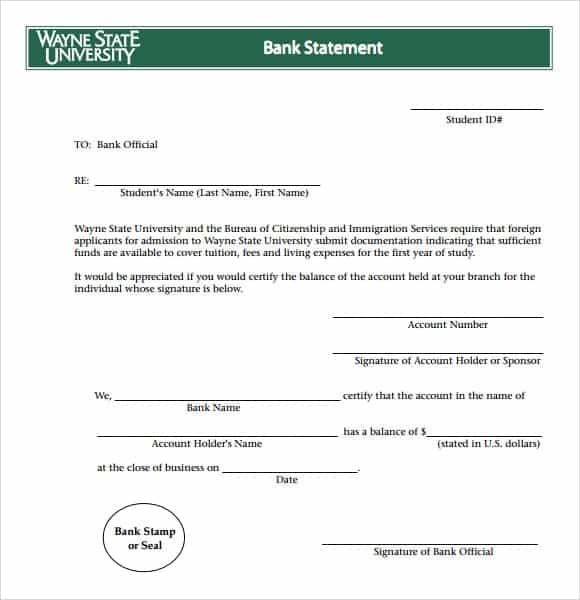
Download and See Bank statement templates:
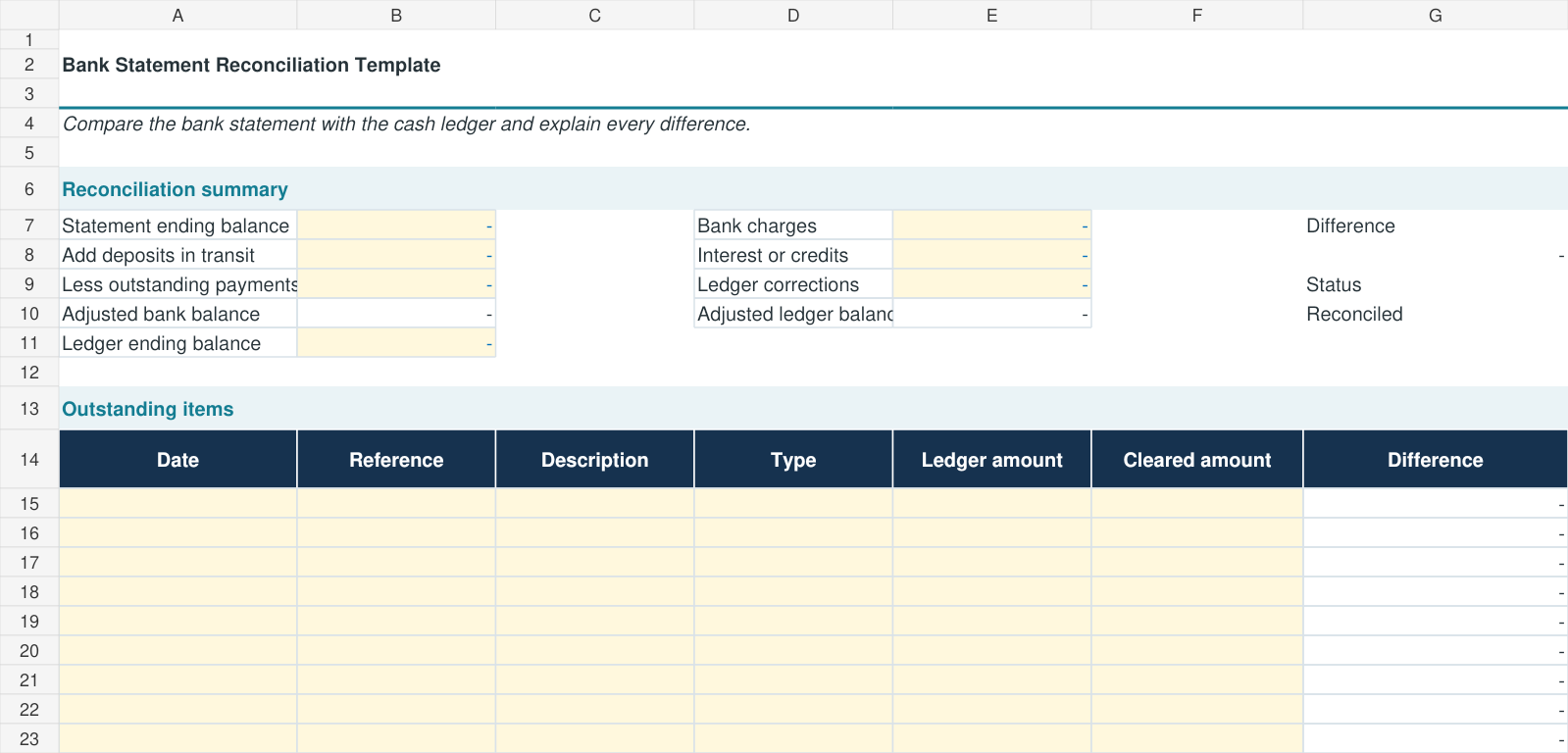
Download Bank Statement Reconciliation Template
This Excel reconciliation template compares the statement balance with the cash ledger, records deposits in transit and outstanding payments, calculates adjusted balances, and flags any unresolved difference.

FAQs
1. What is a bank statement?
A bank statement is a record issued by a bank or financial institution showing account activity during a specified period, including transactions, deposits, withdrawals, fees, and balances.
2. What does a bank statement include?
A typical bank statement may include account holder information, statement dates, opening balance, transaction dates, descriptions, deposits, withdrawals, fees, and closing balance. The exact format varies by bank.
3. What is a bank statement template?
A bank statement template is a pre-formatted document or spreadsheet that can be used for sample records, financial education, bookkeeping exercises, transaction organization, or other legitimate purposes. It is not an official bank-issued statement.
4. Can I use a bank statement template in Excel?
Yes. Excel is useful for organizing transaction dates, deposits, withdrawals, and running balances. It can also be used for bookkeeping exercises and financial record organization.
5. Can I download a bank statement as a PDF?
Many banks allow customers to download official account statements as PDFs through online or mobile banking. Availability and procedures depend on the financial institution.
6. What is the difference between a bank statement and a transaction history?
A transaction history is often a current list of account activity available through online banking, while a formal bank statement generally covers a defined period and is issued by the financial institution.
7. What is a bank reconciliation?
Bank reconciliation is the process of comparing an organization’s internal accounting records with the transactions shown on its bank statement and investigating differences between them.
8. Can a small business use a bank statement template?
Yes. A business can use a template for internal transaction organization, bookkeeping exercises, or demonstrations. Official bank statements should still be obtained from the financial institution when required.
9. Is a bank statement the same as a statement of account?
Not necessarily. A bank statement specifically records activity in a bank account, while a statement of account can refer more broadly to a summary of transactions between a business and a customer, supplier, or other account holder.
10. Can a template be used instead of an official bank statement?
No. A generic template should not be represented as an authentic bank-issued statement. If an official statement is required, obtain it directly from the relevant bank or financial institution.
You must be logged in to post a comment.