
Financial statements turn accounting records into reports that explain a company’s performance, financial position, and cash movement. The three core reports answer different questions: an income statement shows whether operations produced profit or loss, a balance sheet shows what the business owns and owes at a point in time, and a cash flow statement explains why the cash balance changed.
These reports are most useful when reviewed together. A profitable company can still face cash shortages, while a business with strong cash on hand may carry significant liabilities. Comparing statements across consistent reporting periods also makes trends in margins, expenses, debt, working capital, and liquidity easier to identify.
Our free financial statement templates provide a convenient starting point for organizing important financial information. Instead of creating a financial report from a blank document or spreadsheet, you can use a ready-made format and customize it with your business name, reporting period, financial figures, and other relevant information.
Financial statements are used by businesses of different sizes and industries. A small business may use simple financial statements to monitor revenue, expenses, assets, liabilities, and cash flow, while a larger organization may require more detailed financial reporting.
Common financial statements include the income statement, balance sheet, and statement of cash flows. These reports provide different but complementary views of a company’s finances.
What Is a Financial Statement?
A financial statement is a formal report that presents financial information about a business or organization for a particular period or at a particular date.
Financial statements help answer important questions such as:
- How much revenue did the business generate?
- Did the company make a profit or loss?
- What assets does the business own?
- What liabilities does it owe?
- How much equity does the business have?
- How much cash was generated or used?
- Where did the company’s cash come from?
- How were financial resources used?
The exact presentation and reporting requirements depend on the type of organization, accounting framework, jurisdiction, and purpose of the financial statements.
A financial statement template can help organize this information into a structured and easy-to-review format.
Free Financial Statement Templates
A free financial statement template can save time when preparing financial reports for internal business use, financial analysis, planning, or other appropriate purposes.
Templates provide predefined sections and layouts that can be adapted to the organization’s needs. You can enter revenue, expenses, assets, liabilities, equity, cash flows, and other financial information depending on the type of statement being prepared.
A template can also help maintain a consistent format when financial reports are prepared regularly.
For example, a business may prepare monthly income statements and cash flow reports while preparing more comprehensive financial statements on a quarterly or annual basis.
The templates on this page can provide a practical starting point, but they should always be reviewed and customized to ensure that the final financial statement accurately reflects the underlying accounting records.
Three Main Financial Statements
The three financial statements most commonly discussed in business accounting are the income statement, balance sheet, and cash flow statement.
Each serves a different purpose.
1. Income Statement
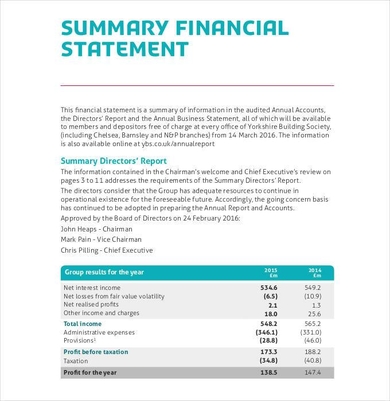
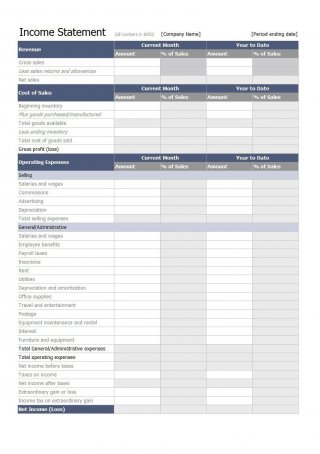
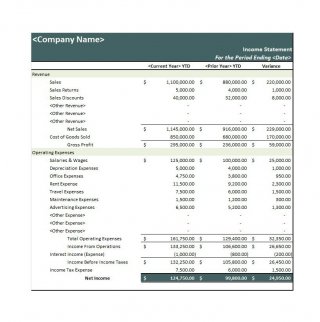
An income statement, also called a profit and loss statement in many business contexts, summarizes revenue and expenses over a particular period.
It shows whether the business generated a net profit or net loss after accounting for applicable costs and expenses.
Common income statement categories can include:
- Sales or revenue
- Cost of goods sold
- Gross profit
- Operating expenses
- Other income
- Other expenses
- Taxes
- Net income or net loss
An income statement is useful for evaluating business profitability and financial performance.
2. Balance Sheet
A balance sheet provides a snapshot of a company’s financial position at a specific date.
It generally presents three major categories:
Assets: What the business owns or controls.
Liabilities: What the business owes.
Equity: The residual interest in the business after liabilities are deducted from assets.
A balance sheet follows the fundamental accounting relationship:
Assets = Liabilities + Equity
Unlike an income statement, which covers a period of time, a balance sheet represents financial position at a particular point in time.
3. Cash Flow Statement
A cash flow statement reports movements in cash and cash equivalents during a specific period.
Cash flows are commonly organized into:
- Operating activities
- Investing activities
- Financing activities
A cash flow statement helps explain why a company’s cash balance increased or decreased during the reporting period.
It is particularly important because profitability and cash availability are not necessarily the same thing.
Financial Statement Example
A financial statement example can help illustrate how the different reports work together.
Imagine a small company that generates $500,000 in annual sales. Its income statement might show revenue, cost of goods sold, operating expenses, and the resulting net profit.
Its balance sheet could show the company’s cash, inventory, equipment, accounts receivable, loans, accounts payable, and owner’s or shareholders’ equity at the end of the reporting period.
The cash flow statement could then explain how operating activities, investments in equipment, loan transactions, and other activities affected the company’s cash during the year.
Looking at these statements together provides a much more complete picture than relying on a single report.
Financial Statement Format
There is no single financial statement format that applies identically to every organization. The appropriate structure depends on the type of statement, business, accounting framework, reporting purpose, and level of detail required.
However, a professional financial statement format should generally include:
- Business or organization name
- Title of the financial statement
- Reporting period or statement date
- Appropriate financial categories
- Clearly labeled amounts
- Subtotals and totals
- Currency or units where relevant
- Supporting notes where appropriate
Consistency is particularly important when preparing statements for multiple reporting periods because it makes financial performance easier to compare.
Financial Statement Template in Excel
A financial statement template in Excel can be useful when calculations and financial analysis are required.
Excel allows you to organize financial information into rows and columns and use formulas to calculate totals and subtotals.
For example, an Excel financial statement might contain formulas for:
- Total revenue
- Total expenses
- Gross profit
- Operating income
- Net income
- Total assets
- Total liabilities
- Total equity
- Cash inflows
- Cash outflows
- Net change in cash
Excel can also be useful for comparing monthly, quarterly, or annual results.
However, formulas should always be checked carefully. A template is only as reliable as the financial information and calculations entered into it.
Financial Statement Template in Word
A financial statement template in Word can be useful when you need an editable and printable document.
Word allows you to customize headings, tables, company information, logos, reporting periods, and other document elements.
It can work particularly well for simple financial reports or situations where the primary requirement is a clean presentation rather than complex calculations.
If the statement requires extensive formulas or comparisons, Excel will generally provide greater functionality.
Financial Statement PDF
A financial statement PDF can be useful when sharing a completed financial report with a client, manager, investor, lender, or other authorized recipient.
PDF preserves the visual layout of the document and can be convenient for printing and recordkeeping.
An editable Word or Excel version is usually more suitable for preparing and changing the statement. Once the information has been reviewed and finalized, it can be saved or exported as a PDF.
Financial Statements for Small Businesses
A small business financial statement can help owners understand the financial health and performance of their company.
Small businesses may not need extremely complex reports, but they can benefit from regularly reviewing:
- Revenue
- Expenses
- Profit or loss
- Cash flow
- Assets
- Liabilities
- Owner’s equity
- Accounts receivable
- Accounts payable
Regular financial reporting can help identify increasing expenses, declining revenue, cash shortages, growing debt, or other issues that may require attention.
A simple financial statement template can therefore be useful for organizing financial information before reviewing it with an accountant or financial professional.
Monthly Financial Statements
Businesses may prepare monthly financial statements to monitor performance throughout the year.
Monthly reporting can provide earlier insight into changes in revenue, expenses, profitability, assets, liabilities, and cash flow.
For example, comparing January’s income statement with February’s can reveal changes in sales or operating expenses. Comparing monthly cash flow can reveal periods where cash availability becomes tighter.
Monthly reporting can therefore support budgeting, forecasting, and management decisions.
Annual Financial Statements
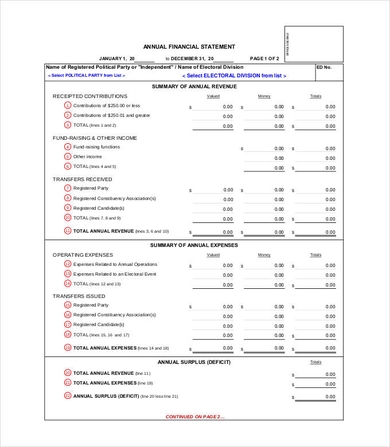
An annual financial statement summarizes or presents financial information for a full financial year, depending on the type of statement.
Annual financial reports can be used for internal management analysis, financial planning, business evaluation, and other appropriate reporting purposes.
Businesses may also compare annual results across multiple years to identify changes in revenue, profitability, assets, liabilities, and cash flow.
The exact reporting requirements depend on the organization and applicable accounting standards or regulations.
Why Are Financial Statements Important?
Financial statements help transform accounting records into information that people can use to understand a business.
They can help management evaluate financial performance and make decisions about pricing, expenses, investment, financing, and growth.
They can also help owners understand whether the business is generating sufficient revenue and managing its resources effectively.
Other stakeholders may use financial information for different purposes. For example, lenders may evaluate financial information when assessing financing applications, while investors may analyze financial performance and financial position when making investment decisions.
The appropriate use and required level of assurance or compliance will depend on the purpose of the financial statements.
Benefits of Using a Financial Statement Template
Creating financial statements from scratch can be time-consuming. A template provides a structured starting point.
Using a financial statement template can help:
- Save time when preparing reports
- Organize financial information clearly
- Maintain a consistent reporting format
- Separate different financial categories
- Calculate totals and subtotals
- Compare financial periods
- Present information professionally
- Simplify recurring financial reporting
- Support internal financial analysis
- Provide a starting point for customized reports
Templates are particularly useful when the same type of report needs to be prepared repeatedly.
Financial Statement vs. Income Statement
A financial statement is a broad term covering several types of financial reports, while an income statement is one specific type.
The income statement focuses on revenue, expenses, and profit or loss during a period.
Other financial statements, such as the balance sheet and cash flow statement, provide different information.
Therefore, an income statement is a financial statement, but not every financial statement is an income statement.
Financial Statement vs. Balance Sheet
A balance sheet is another type of financial statement.
The key difference is that a balance sheet presents assets, liabilities, and equity at a specific date, while an income statement presents financial performance over a period.
For example, a balance sheet might show a company’s financial position as of December 31, while an income statement might show revenue and expenses from January 1 through December 31.
Financial Statement vs. Cash Flow Statement
A cash flow statement is also a financial statement, but it focuses specifically on cash and cash equivalents.
It helps explain changes in cash resulting from operating, investing, and financing activities.
This is different from the income statement, which focuses on revenues and expenses and determines profit or loss.
Reviewing both reports can help management understand why a profitable business may still experience periods of limited cash availability.
How to Prepare Financial Statements
The process of preparing financial statements generally begins with accurate accounting records.
First, collect and organize the relevant financial transactions for the reporting period. Depending on the report being prepared, this can include sales, expenses, assets, liabilities, payments, receipts, investments, financing transactions, and other accounting information.
Next, classify the information into the appropriate accounts and prepare the relevant statement.
For an income statement, calculate revenue, applicable costs, expenses, and resulting profit or loss.
For a balance sheet, organize assets, liabilities, and equity.
For a cash flow statement, classify relevant cash movements into operating, investing, and financing activities.
Finally, review the statements for accuracy and consistency with the underlying accounting records.
For financial statements intended for tax filings, regulated reporting, lending, investment, or other formal purposes, appropriate professional review may be necessary.
Financial Statement Template for Business Planning
Financial statements can also support business planning.
Historical financial information can help a business understand revenue trends, expense patterns, profitability, cash requirements, and changes in assets and liabilities.
This information can be used as a foundation for budgets, forecasts, financial models, and strategic decisions.
For a new business that does not yet have extensive historical records, projected financial statements may be used as part of a business plan. These should clearly be identified as projections rather than historical results.
Choose the Right Financial Statement Template
The right financial statement template depends on what you need to report.
If you need to calculate revenue and expenses, an income statement template may be appropriate. If you need to report assets, liabilities, and equity, you need a balance sheet format. If your objective is to track cash movement, a cash flow statement template is more suitable.
Some businesses may need all three.
Consider whether you need a monthly financial statement, annual financial statement, small business financial statement, Excel financial statement, Word financial statement, or PDF financial statement.
The templates on this page provide a practical starting point for organizing financial information. Customize the format according to your business, reporting period, accounting records, and intended purpose.
A financial statement template should make financial information easier to organize and review—not replace proper bookkeeping, accounting procedures, or professional advice where required.
Download Financial Statement Templates:
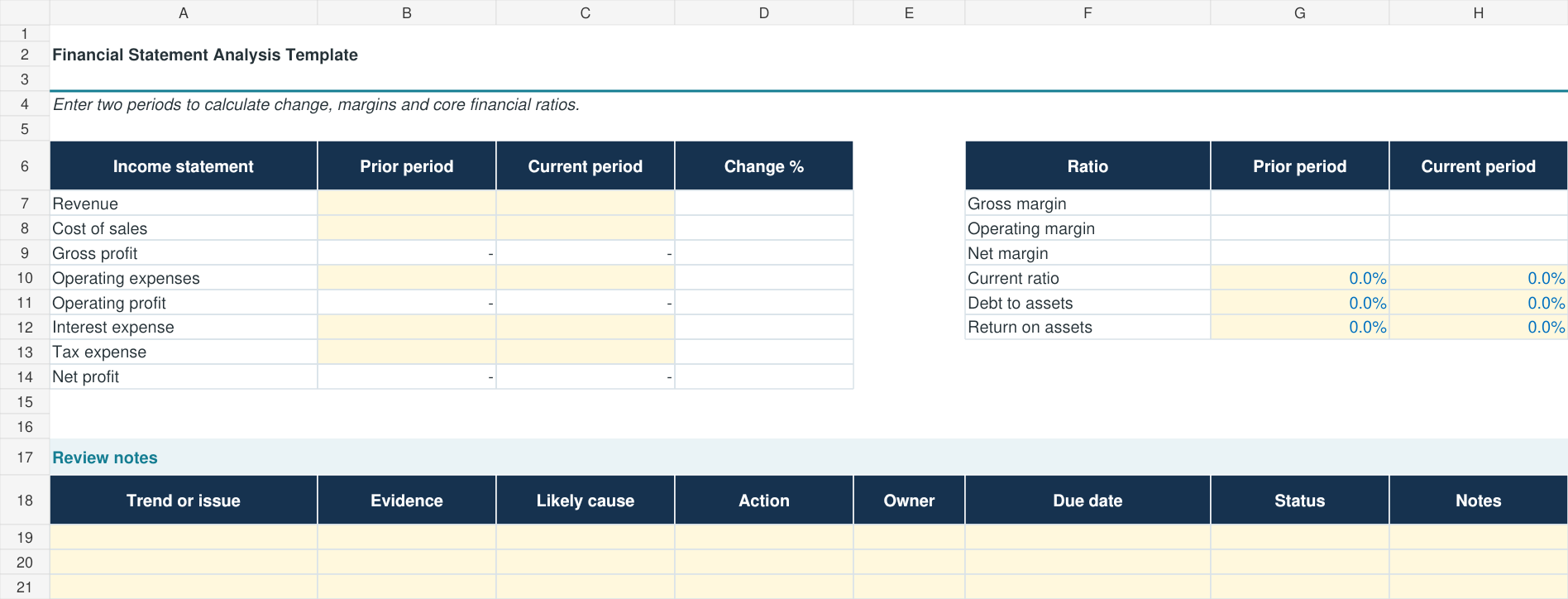
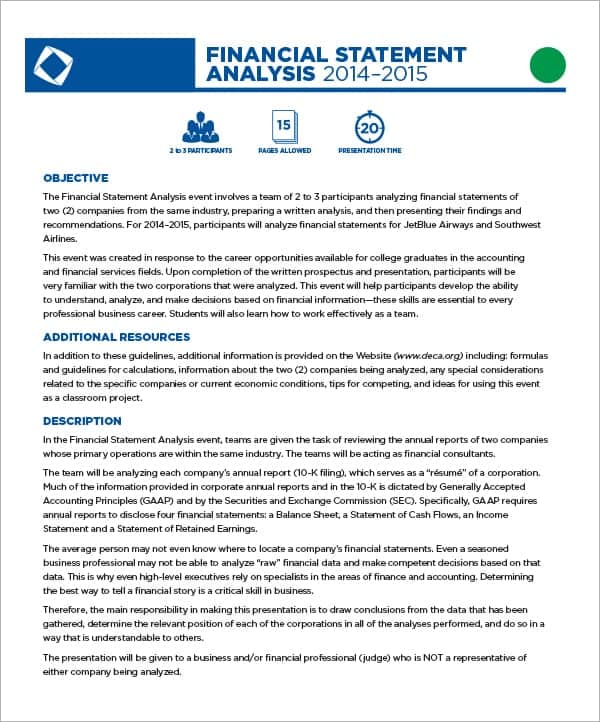
Download Financial Statement Analysis Template
Use this Excel workbook to compare two reporting periods, calculate percentage changes and profit margins, record core ratios, and document management actions arising from the review.

FAQs
1. What is a financial statement?
A financial statement is a formal report that presents financial information about a business or organization. Common financial statements include the income statement, balance sheet, and cash flow statement.
2. What are the three main financial statements?
The three commonly used financial statements are the income statement, balance sheet, and statement of cash flows. Each provides a different view of a company’s finances.
3. What is included in a financial statement?
The information depends on the type of statement. An income statement includes revenue and expenses, a balance sheet includes assets, liabilities and equity, and a cash flow statement reports cash inflows and outflows.
4. Can a small business use a financial statement template?
Yes. Small businesses can use financial statement templates to organize revenue, expenses, assets, liabilities, equity, and cash-flow information.
5. Is there a financial statement template in Excel?
Yes. Excel is particularly useful for financial statements because it supports formulas, calculations, totals, comparisons, and structured financial data.
6. Can I create financial statements in Word?
Yes. Word can be useful for simple, editable financial statement documents. Excel is generally more convenient when extensive calculations are required.
7. What is the difference between an income statement and a balance sheet?
An income statement reports revenue, expenses, and profit or loss over a period. A balance sheet shows assets, liabilities, and equity at a specific date.
8. What is the purpose of a cash flow statement?
A cash flow statement shows how cash and cash equivalents changed during a period and generally organizes cash activity into operating, investing, and financing activities.
9. How often should financial statements be prepared?
The appropriate frequency depends on the business and its reporting requirements. Businesses may prepare financial information monthly, quarterly, annually, or at other intervals for management and reporting purposes.
10. Are financial statement templates suitable for official financial reporting?
A template can provide a useful structure, but formal financial statements may have specific accounting, regulatory, tax, or reporting requirements. The completed statements should be reviewed appropriately before being used for formal purposes.
You must be logged in to post a comment.