
Owners, investors and auditors want to know more than the closing equity figure. They want to know why it changed. Did the business make a profit? Did it pay dividends, issue new shares, revalue its property or lose money on currency translation? The statement of changes in equity answers those questions in one table. A well-built statement of changes in equity template makes the statement quick to prepare and easy to check against the balance sheet and income statement.
This guide explains what the statement shows and how its layout works. It covers each component and movement you are likely to meet and walks you through filling in a template step by step. You’ll also find five free downloadable templates, for companies, partnerships, sole proprietors and multi-member LLCs.
What Is a Statement of Changes in Equity?
The statement of changes in equity (SOCE) reconciles opening and closing equity for a reporting period. Under IFRS (IAS 1) it is one of the primary financial statements, presented with the balance sheet, the statement of profit or loss and other comprehensive income, and the cash flow statement. US GAAP requires the same information, either as a separate statement or in the notes. Smaller businesses often prepare a simpler version, the statement of owner’s equity or partners’ capital.
Its purpose is transparency. Equity can change for two very different reasons:
- Transactions with owners acting as owners: share issues, buybacks, dividends, capital contributions and distributions or drawings.
- Total comprehensive income: the profit or loss for the period plus other comprehensive income (OCI), such as revaluation gains or currency translation differences.
Keeping these two groups apart shows whether equity grew because the business performed well or because the owners put more money in.
How the Statement Is Laid Out
Most company statements use a matrix format:
- Columns represent the components of equity, such as share capital, share premium, retained earnings, revaluation reserve, translation reserve and, for groups, non-controlling interests. A final column shows total equity.
- Rows represent movements during the period: the opening balance, profit, each item of OCI, dividends, share issues, transfers between reserves and the closing balance.
Each row adds across to the total column, and each column adds down to the closing balance. The closing balance of every column must equal the matching line in the equity section of the balance sheet. That double check makes the SOCE one of the easiest statements to verify, and one of the quickest ways to find an error elsewhere.
Components of Equity Explained
Share capital and share premium
Share capital is the nominal value of shares issued. Share premium is the extra amount investors paid above that nominal value. Both rise when new shares are issued and fall on buybacks or capital reductions.
Retained earnings
Retained earnings are accumulated profits that haven’t been paid out. They increase with profit for the year and fall with dividends and losses. Our statement of retained earnings templates focus on this single column if that is all you need.
Other reserves
Reserves hold gains and losses recognised outside profit or loss. Common examples are the revaluation reserve for property, the translation reserve for foreign subsidiaries, the hedging reserve and the fair value reserve for certain investments. Under US GAAP these are grouped as accumulated other comprehensive income (AOCI).
Non-controlling interests
In consolidated accounts, the share of a subsidiary’s equity owned by outside shareholders appears in its own column. It includes their share of profit and OCI, less the dividends they receive.
Typical Movements to Include
- Opening balance (with a restatement line if prior-year errors or policy changes were corrected)
- Profit or loss for the year
- Each item of other comprehensive income, net of tax
- Issue of new shares or capital contributions
- Share buybacks or capital withdrawals
- Dividends declared, or partner and member distributions
- Share-based payment charges
- Transfers between reserves, for example realised revaluation surplus moved to retained earnings
- Changes in ownership interests in subsidiaries
Download 5 Free Statement of Changes in Equity Templates
The five layouts below cover companies, partnerships, sole proprietors and LLCs. The Excel versions add across and down automatically and link opening balances where that makes sense. The Word versions are ready to print and sign.
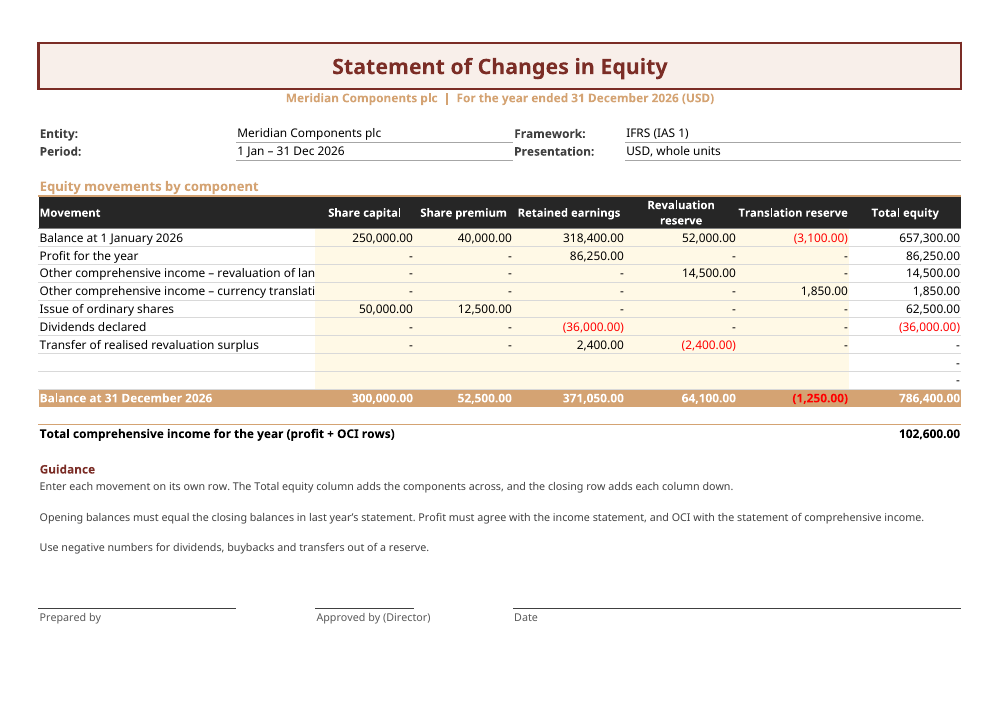
1. Statement of Changes in Equity Template (IFRS Matrix)
The standard IAS 1 matrix layout, with a column for each equity component and a row for each movement. Totals across and down calculate themselves, and total comprehensive income is shown separately.
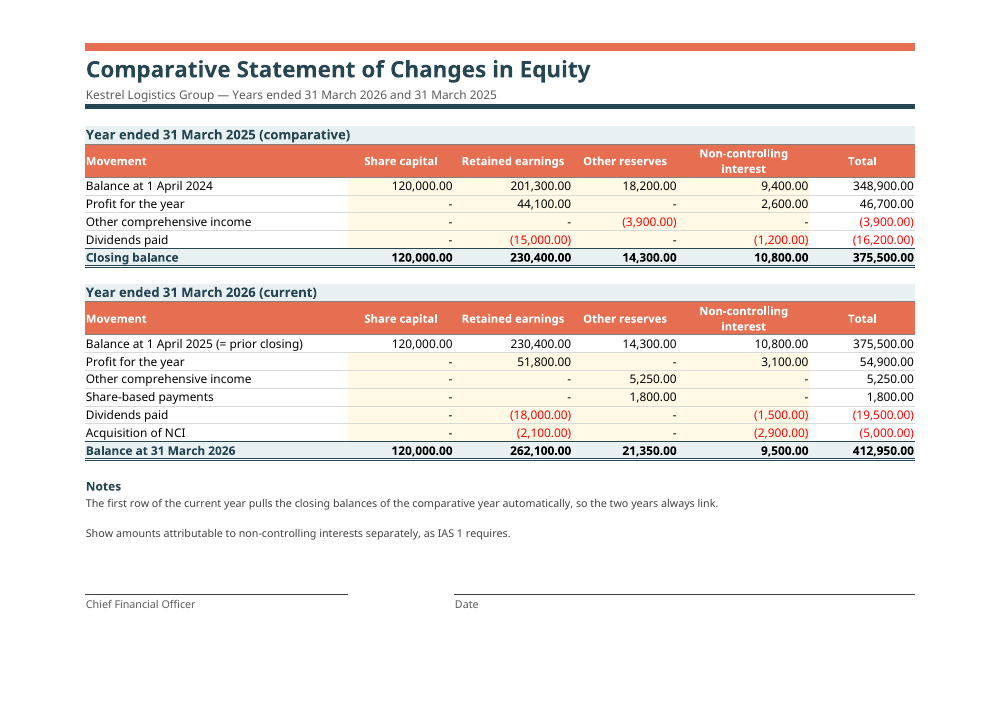
2. Comparative Statement of Changes in Equity
Two linked years on one sheet. The current year opens from the prior year’s closing balances automatically, and non-controlling interest has its own column.
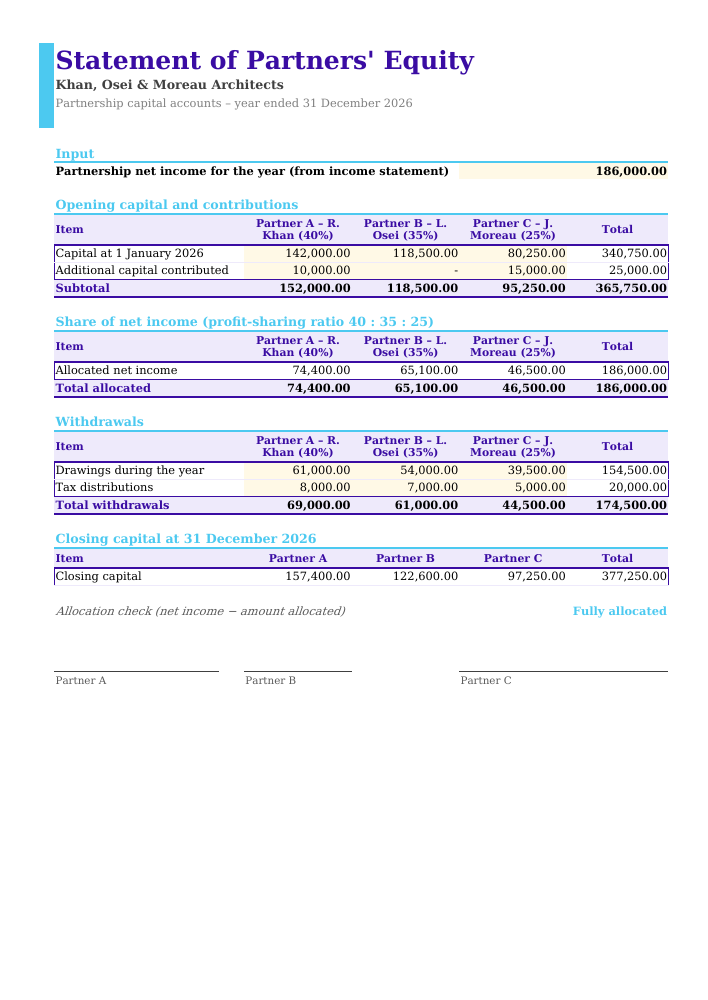
3. Statement of Partners' Equity Template
Capital accounts for a three-partner firm. Enter net income once and it splits by profit-sharing ratio, and a check confirms 100% has been allocated.
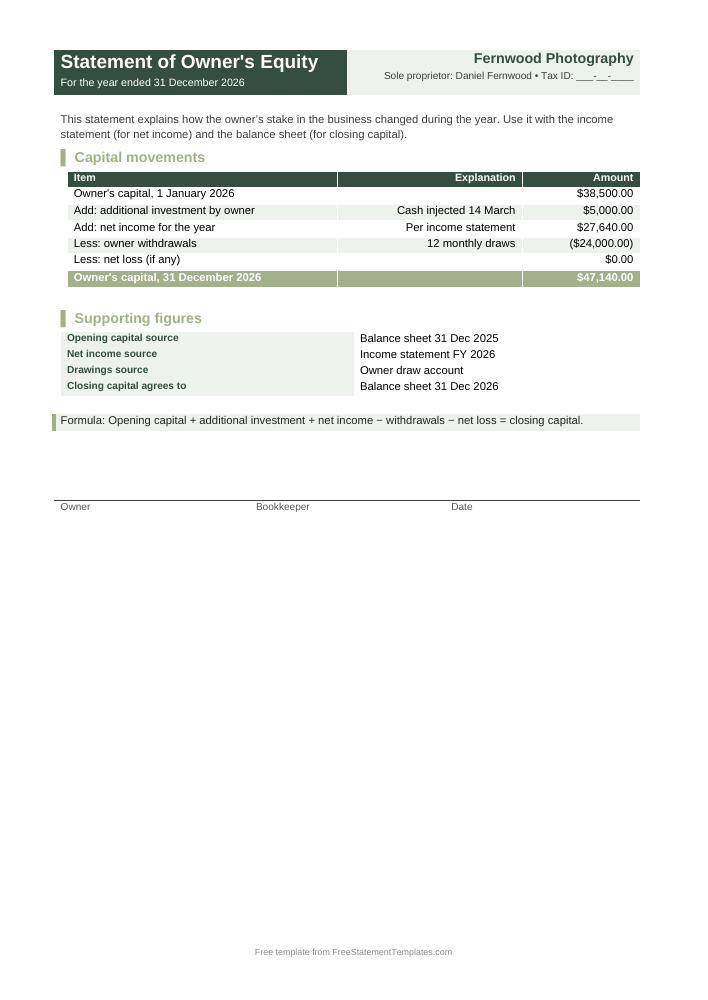
4. Statement of Owner's Equity (Sole Proprietor)
A short Word statement for a one-owner business that walks from opening capital to closing capital, with source references for each figure.
5. Statement of Changes in Members' Equity (LLC)
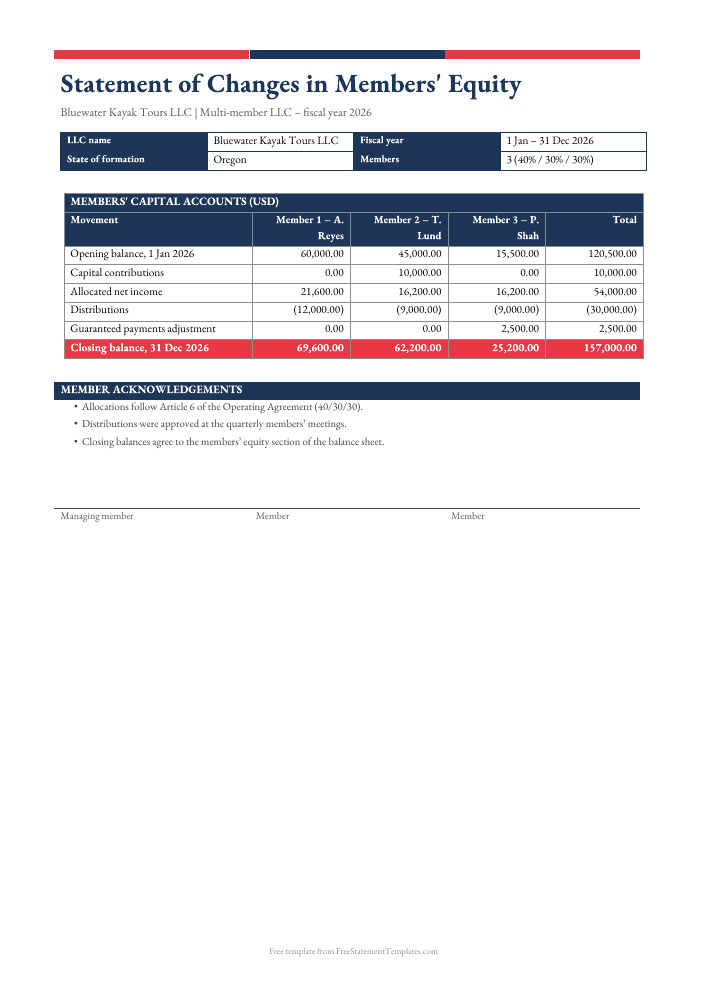
A member-by-member capital statement for multi-member LLCs, with operating-agreement references and signature lines for each member.
How to Prepare a Statement of Changes in Equity
- Start with last year’s closing balances. Copy each component from the prior-year balance sheet into the opening row. In the comparative Excel template the current year links to the prior year’s closing row automatically.
- Record any restatements. If you corrected a prior-period error or changed an accounting policy, show the adjustment as its own row just below the opening balance.
- Add profit or loss. Take the figure straight from the income statement. It goes in the retained earnings column, with the non-controlling share shown separately for groups.
- Add other comprehensive income. Post each OCI item to its reserve. These amounts come from the OCI section of the statement of comprehensive income, which extends the income statement beyond profit.
- Record transactions with owners. Enter share issues as positive amounts and dividends, buybacks and distributions as negative amounts in the right columns.
- Post transfers between reserves. A transfer moves an amount from one column to another, so it adds to zero in the total column.
- Total each column and agree it to the balance sheet. If a column doesn’t agree, one of the movements is missing or in the wrong column.
How to Use Each Template
The IFRS matrix template has columns for five equity components and calculates total equity automatically. Type each movement on a new row using positive and negative numbers. A separate line adds up the comprehensive income rows (profit plus OCI), which auditors often ask to see.
The comparative template shows two years. Fill in the comparative year first. The first row of the current year then pulls the comparative closing balances by formula, so the two years can’t drift apart.
The partners’ equity template splits net income using the profit-sharing ratio written into the formulas (40:35:25 in the sample). Change those percentages to match your partnership agreement. An allocation check confirms that all the income has been shared out.
The sole proprietor statement and the LLC members’ equity statement are Word documents for smaller entities. Replace the sample names and amounts with your own, then check that the closing capital agrees to the balance sheet.
Common Mistakes
- Putting OCI into retained earnings. Revaluation and translation gains go to their own reserves unless and until a transfer is made.
- Getting dividend signs wrong. Dividends reduce equity, so enter them as negative amounts.
- Opening balances that don’t match. The opening row must equal last year’s closing balance exactly. Any difference needs a separate restatement line.
- Leaving out the non-controlling interest. Group statements must show the NCI share separately in each relevant row.
- Treating drawings as expenses. For sole traders and partnerships, drawings go through the equity statement, not the income statement.
Who Needs This Statement?
Companies reporting under IFRS must present it as a primary statement. Private companies, partnerships and LLCs prepare one for lenders, tax advisers and owners who want to see how their stake changed. Partnerships rely on it to keep each partner’s capital account accurate, because those balances drive profit sharing and the payout when a partner leaves. You’ll find more formats in our Financial Statements category and our financial statement templates.
Frequently Asked Questions
Is the statement of changes in equity the same as the statement of retained earnings?
Not quite. A statement of retained earnings covers only one component, retained earnings. The statement of changes in equity covers every component: share capital, premium, reserves, retained earnings and non-controlling interests. Small businesses with no reserves sometimes use the retained earnings statement instead, but IFRS requires the full statement of changes in equity.
Where does profit for the year go in the statement?
Profit or loss goes into the retained earnings column, or into the non-controlling interests column for the share owned by minority shareholders. It must match the profit in the income statement exactly.
Are dividends shown in the statement of changes in equity?
Yes. Dividends declared during the period are distributions to owners and appear as a negative movement in retained earnings. Dividends declared after the reporting date are usually disclosed in the notes rather than recognised.
What is “total comprehensive income” in this statement?
It is profit or loss plus other comprehensive income for the period. IAS 1 asks for it to be shown in the statement of changes in equity, split between owners of the parent and non-controlling interests. The IFRS matrix template calculates it from the profit and OCI rows.
How do I show a transfer between reserves?
Enter the amount as a negative in the reserve it leaves and as a positive in the reserve it joins, usually retained earnings. The row then adds to zero in the total column, because a transfer doesn’t change total equity.
Can a sole proprietor use a statement of changes in equity?
Yes, usually in its simpler form, the statement of owner’s equity. It starts with opening capital, adds any new investment and the year’s net income, and deducts drawings and losses to reach closing capital. The Word template on this page follows that structure.
Final Review Checklist
Before you finalise the statement, check that the opening balances equal last year’s closing balances and that profit agrees to the income statement. OCI should agree to the statement of comprehensive income, dividends to board minutes and every column total to the balance sheet. Explain unusual movements in a short note. A tidy, consistent statement of changes in equity helps readers trust the rest of your accounts.