
A personal statement connects your experiences, motivations, abilities, and future goals to a specific opportunity. The strongest statements do not simply list achievements already visible elsewhere in an application; they select a few relevant experiences and explain what happened, what you learned, how you changed, and why that matters for the opportunity you are pursuing.
Before drafting, review the exact prompt and selection criteria. Then identify two or three experiences that provide evidence for the qualities you want to demonstrate. Specific details and reflection usually communicate more than broad claims such as being passionate, hardworking, or motivated.
Our free personal statement templates provide a practical starting point for organizing your ideas and creating a clear, focused statement. Rather than staring at a blank page, you can use a structured format to decide what information to include, how to introduce yourself, how to explain your goals, and how to connect your experiences with the opportunity you are pursuing.
A good personal statement should do more than repeat information from a résumé, transcript, or application form. It should give the reader a better understanding of who you are, what motivates you, what you have learned, and why you are a suitable candidate.
What Is a Personal Statement?
A personal statement is an essay or written statement that allows an applicant to present their background, experiences, interests, abilities, aspirations, and motivation in their own words.
The exact purpose varies depending on the application.
For a university application, a personal statement may explain your academic interests and why you want to study a particular subject.
For graduate school, it may focus on your academic preparation, research interests, professional goals, and reasons for choosing a specific program.
For a scholarship application, it may explain your achievements, circumstances, goals, values, and why the scholarship would be meaningful.
For a professional opportunity, a personal statement may describe your experience, skills, career goals, and suitability for the position.
Because the purpose varies, the best personal statement template should always be customized for the particular application.
Free Personal Statement Templates
A free personal statement template can make the writing process more manageable by providing an organized framework.
You can use a template to plan sections such as:
- Introduction
- Personal background
- Academic or professional experience
- Skills and achievements
- Motivation and interests
- Relevant experiences
- Future goals
- Reasons for applying
- Conclusion
Not every personal statement needs separate headings for these sections. In many applications, the final statement is written as a connected essay rather than a form with visible headings.
The template is simply a planning tool. Your final document should follow the instructions and formatting requirements provided by the school, university, scholarship provider, employer, or other organization receiving the application.
What Should a Personal Statement Include?
A strong personal statement format depends on the purpose of the application, but several elements are commonly useful.
Introduction:
Begin with an engaging introduction that establishes your main interest, motivation, or purpose. Avoid generic statements that could apply to every applicant.
Background:
Provide relevant information about your academic, professional, personal, or extracurricular background.
Relevant Experience:
Explain experiences that have prepared you for the opportunity. Focus on what you learned from those experiences rather than simply listing activities.
Skills and Strengths:
Discuss skills that are relevant to your application and support them with specific examples.
Motivation:
Explain why you are interested in the subject, course, program, scholarship, career, or opportunity.
Future Goals:
Where appropriate, describe what you hope to accomplish and how the opportunity fits into your longer-term plans.
Conclusion:
End by reinforcing your interest and suitability without simply repeating the introduction.
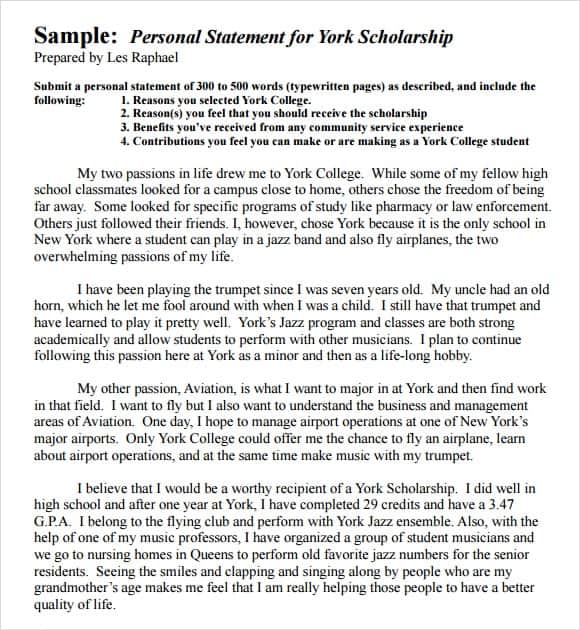
Personal Statement Example
A personal statement example can help you understand how experiences can be connected to goals.
Imagine a student applying to study environmental science. Instead of simply writing that they have always loved nature, a stronger statement might explain how participating in a local environmental project introduced them to conservation challenges, what they learned from that experience, how it influenced their academic interests, and why they now want to study environmental science.
The example demonstrates an important principle: specific experiences are generally more meaningful than unsupported claims.
Rather than saying, “I am hardworking and passionate,” explain an experience that demonstrates persistence, curiosity, leadership, problem-solving, or another relevant quality.
Use examples as inspiration for structure and approach, but do not copy another applicant’s personal story or wording.
How to Write a Personal Statement
Start by carefully reading the application instructions. Identify the questions you need to answer, the required length, the deadline, and any specific formatting requirements.
Next, make a list of your most relevant experiences, achievements, interests, challenges, skills, and goals.
Do not start by trying to write perfect sentences. Brainstorm first.
After collecting your ideas, identify the experiences that best support your application. Choose examples that demonstrate something meaningful about you.
Create a simple outline and decide how the ideas will connect. Then write a first draft without worrying too much about perfection.
After completing the draft, revise it for clarity, structure, relevance, and originality. Remove unnecessary information and strengthen places where you make unsupported claims.
Finally, proofread the statement carefully and verify that it follows the application requirements.
Personal Statement for College
A college personal statement gives an applicant an opportunity to explain their interests, experiences, goals, and motivation beyond grades and test scores.
Depending on the application system, the statement may answer specific prompts rather than simply asking for a general autobiography.
A strong college statement should focus on experiences that reveal something meaningful about the applicant.
For example, a student interested in engineering might discuss a project that introduced them to problem-solving and explain how that experience developed their interest in engineering.
The objective is not to impress the reader with complicated vocabulary. Clear and authentic writing is generally more effective.
Personal Statement for University
A university personal statement can be used to explain why you want to study a particular subject and what experiences have prepared you for it.
Academic interests should be supported by evidence where possible. Reading relevant books, completing projects, participating in competitions, volunteering, internships, employment, independent study, or other activities can provide material for the statement when they are genuinely relevant.
Rather than listing activities, explain what you learned and how those experiences influenced your academic interests.
Always follow the specific university or application system’s current requirements because expectations can vary.
Graduate School Personal Statement
A graduate school personal statement often requires a more advanced discussion of academic preparation, professional experience, research interests, and career objectives.
Applicants may need to explain why they are interested in a particular field, what experiences have prepared them for graduate study, and why the specific program is appropriate for their goals.
Depending on the program, there may also be a separate statement of purpose or research statement. These documents are not always interchangeable, so applicants should carefully review the institution’s instructions.
Scholarship Personal Statement
A scholarship personal statement allows an applicant to explain their background, achievements, goals, motivation, and reasons they are seeking financial support.
Scholarship prompts may ask about leadership, community involvement, academic achievement, financial circumstances, career plans, or personal challenges.
The best approach is to answer the specific prompt directly and support important claims with concrete examples.
Avoid turning the statement into a list of accomplishments. Explain why those accomplishments matter and what they taught you.
Personal Statement for a Job
Some employers or professional organizations may request a personal statement for a job application or ask candidates to provide a supporting statement.
In this situation, focus on your professional experience, relevant skills, achievements, motivation, and suitability for the role.
Read the job description carefully and identify the qualities the employer is looking for. Then provide specific evidence showing how your experience relates to those requirements.
A professional statement should remain focused on the employer’s requirements rather than becoming a general autobiography.
Personal Statement Outline
Creating an outline before writing can make the process significantly easier.
A simple personal statement outline could be:
Opening:
Introduce your main interest or motivation.
Background and Experience:
Discuss relevant academic, professional, personal, or extracurricular experiences.
What You Learned:
Explain how those experiences developed your knowledge, skills, interests, or perspective.
Why This Opportunity:
Explain why you are applying and why the particular program, school, scholarship, or opportunity is relevant to your goals.
Future Goals:
Describe your intended direction where appropriate.
Conclusion:
End with a concise statement that reinforces your motivation and readiness.
This structure can be adapted to different applications.
Personal Statement vs. Statement of Purpose
A personal statement and a statement of purpose can overlap, but they are not always identical.
A personal statement may place greater emphasis on personal experiences, motivations, background, values, and development.
A statement of purpose often places greater emphasis on academic preparation, research interests, professional goals, and reasons for pursuing a particular program.
However, institutions use these terms differently. Always follow the specific instructions provided by the institution rather than assuming that one format applies everywhere.
Personal Statement vs. Cover Letter
A personal statement is also different from a cover letter.
A cover letter is typically written for a specific job and focuses on how the applicant’s qualifications match the position.
A personal statement can be used for academic, scholarship, professional, or other applications and often provides more room to discuss motivation, experiences, goals, and personal development.
The appropriate document depends on the application requirements.
Why Use a Personal Statement Template?
Writing an application essay from a blank page can be difficult. A template gives you a framework for organizing ideas before you begin drafting.
Benefits include:
- Provides a clear writing structure
- Helps organize experiences and achievements
- Makes it easier to identify relevant information
- Reduces the difficulty of starting from a blank page
- Helps maintain a logical flow
- Can be customized for different applications
- Useful for college and university applications
- Helpful for scholarship applications
- Can support graduate school applications
- Useful when planning professional statements
A template should not make every applicant’s statement look identical. Its purpose is to help organize your thinking while allowing your individual voice and experiences to remain central.
How to Make a Personal Statement Stronger
One of the most effective ways to improve a personal statement is to replace general claims with specific evidence.
Instead of writing:
“I am an excellent leader.”
Explain a situation in which you had to lead a team, describe what you did, and explain what you learned from the experience.
Instead of saying:
“I have always been passionate about medicine.”
Describe an experience that genuinely influenced your interest in medicine and explain how it changed your understanding of the field.
Specific examples make the statement more personal and credible.
You should also make sure that every major paragraph contributes to the overall purpose of the application.
Common Personal Statement Mistakes
Applicants often make several avoidable mistakes when writing personal statements.
Being too general:
Statements filled with generic claims can make it difficult for the reader to understand what makes the applicant distinctive.
Listing achievements without reflection:
A list of activities is less useful than explaining what you learned from important experiences.
Ignoring the prompt:
A well-written essay can still be ineffective if it does not answer the actual question.
Using excessive vocabulary:
Complicated language does not automatically make writing stronger. Clear and natural language is usually easier to understand.
Repeating the résumé:
A personal statement should add context and personality rather than simply reproduce an application résumé.
Failing to proofread:
Grammar, spelling, punctuation, and formatting errors can distract from otherwise strong content.
Using copied examples:
Personal statements should be authentic. Templates and examples should help with organization, not replace your own experiences and voice.
Personal Statement Template in Word
A personal statement template in Word can be useful when you want an editable document for drafting and revising your application.
Word makes it easy to write multiple drafts, move paragraphs, check spelling and grammar, and adjust formatting.
However, always check the final submission requirements. Some applications require text to be entered into an online form rather than uploaded as a Word document.
Personal Statement PDF
A personal statement PDF can be useful when an application specifically requests a PDF document or when you need to preserve the formatting of a completed statement.
PDF is generally more appropriate for a final version than for extensive editing. Draft your statement in an editable format, review it carefully, and then convert it to PDF if the application instructions require that format.
How Long Should a Personal Statement Be?
There is no universal length for every personal statement.
Some applications specify a maximum word count, while others impose a character limit or provide a particular number of questions.
Always follow the requirements of the specific institution or organization. Do not assume that a statement written for one application can simply be reused for another.
If no length is specified, focus on providing enough relevant information to answer the purpose of the application without unnecessary repetition.
Choose the Right Personal Statement Template
The best personal statement template depends on the type of application.
A college statement may emphasize academic interests and personal development. A graduate school statement may require more discussion of research and professional goals. A scholarship statement may focus on achievements, circumstances, community involvement, and future plans.
Use the template as a planning framework, then adapt it to the exact prompt and requirements.
The strongest personal statements are specific, authentic, relevant, well organized, and written in the applicant’s own voice.
Our free personal statement templates can help you organize your thoughts, plan your structure, and begin drafting with greater confidence. Before submitting your final statement, carefully review the application instructions and make sure the content, length, format, and information are appropriate for the specific opportunity.
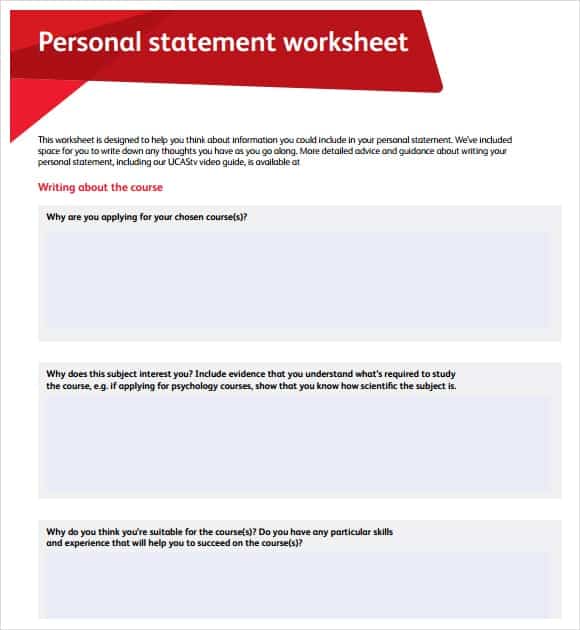
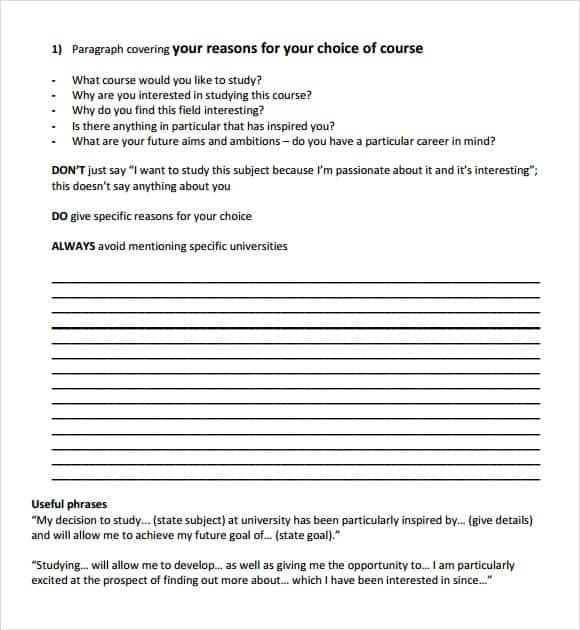
Download Personal statement templates:
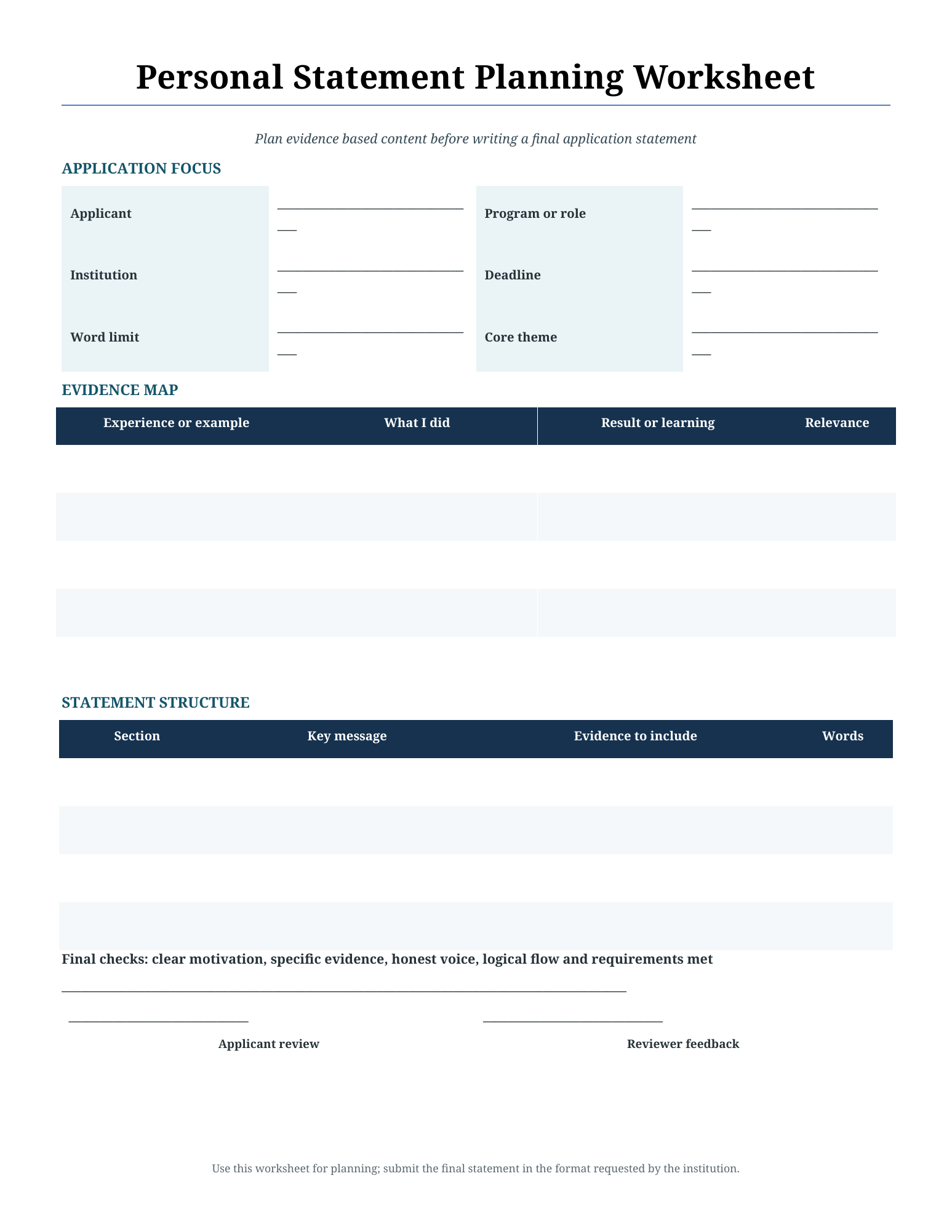
Download Personal Statement Planning Worksheet
Plan a stronger application statement with dedicated sections for motivation, evidence, achievements, relevance, word allocation, review notes, and final quality checks.

FAQs
1. What is a personal statement template?
A personal statement template is a structured guide that helps applicants organize their background, experiences, skills, motivation, and goals when preparing a personal statement.
2. What should a personal statement include?
Depending on the application, it may include relevant experiences, academic or professional interests, skills, achievements, motivation, future goals, and reasons for applying.
3. How long should a personal statement be?
The required length varies by application. Always follow the word, character, page, or formatting requirements specified by the school, university, scholarship provider, employer, or organization.
4. What is a good personal statement example?
A good example uses specific experiences to demonstrate the applicant’s interests, skills, motivation, and development rather than relying on generic claims.
5. Can I use a personal statement template for college?
Yes. A template can help organize a college application statement, but the final content should be customized to the specific college or application requirements.
6. What is the difference between a personal statement and a statement of purpose?
A personal statement may focus more on personal experiences, motivations, background, and development, while a statement of purpose often emphasizes academic preparation, research interests, and professional goals. Requirements vary between institutions.
7. Can I use the same personal statement for every application?
It is usually better to customize the statement for each application. Different institutions and programs may ask different questions and have different priorities.
8. Can I create a personal statement in Word?
Yes. Word is useful for drafting, editing, proofreading, and formatting a personal statement. However, follow the specific submission requirements of the application.
9. What makes a personal statement strong?
A strong personal statement is relevant, specific, authentic, well organized, and supported by concrete examples. It should answer the application’s requirements rather than simply provide a general autobiography.
10. Should a personal statement include achievements?
Relevant achievements can strengthen a personal statement, but they should be connected to the purpose of the application. Explain what you learned or how the experience influenced your development rather than simply listing accomplishments.
You must be logged in to post a comment.