
An artist statement is a short first-person explanation of what you make, what concerns or questions shape the work, and how your materials, process, or formal choices connect to those ideas. It helps a viewer, curator, gallery, teacher, grant panel, residency, or open-call reviewer enter the work without replacing the experience of the work itself.
The two free Word templates below serve different purposes. The first is a professional artist statement template for portfolios, websites, galleries, exhibitions, grants, residencies, and open calls. The second is a student artwork statement template for explaining one artwork through observation, intention, choices, process, context, reflection, and revision.
The designs, prompts, structures, and visual themes are different. The professional template develops several statement lengths and adapts them to an opportunity. The student template is a guided worksheet centered on one piece of art and the decisions that shaped it.
Download the Artist Statement Templates
1. Professional Artist Statement Template
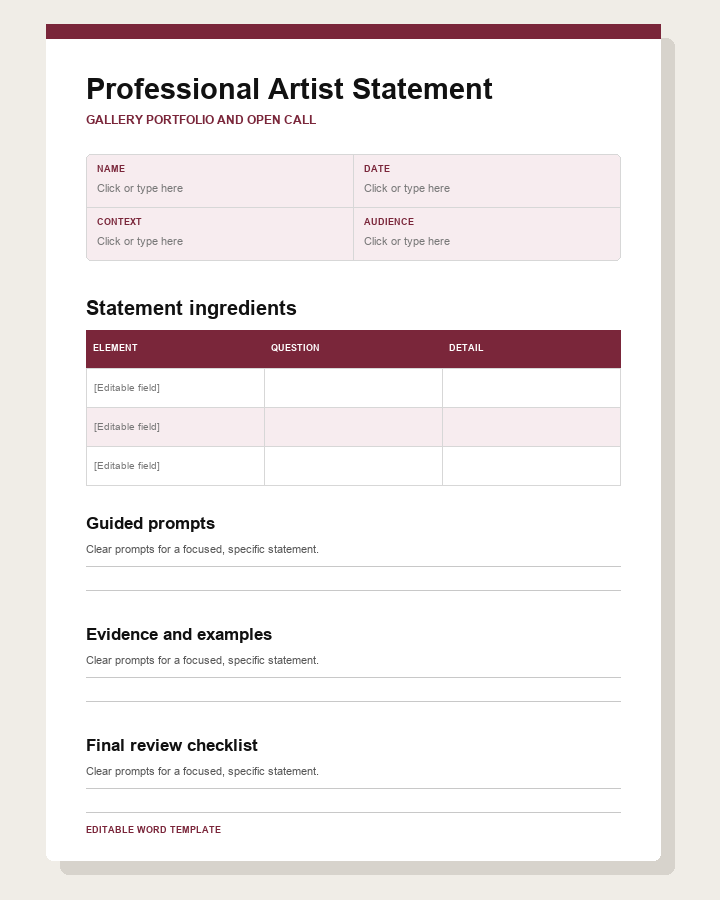
This burgundy portfolio-style template helps a practicing or emerging artist collect specific language about a body of work. It covers the work, inquiry, method, form and meaning, a representative artwork, short and extended versions, opportunity-specific adaptation, and a final editing checklist.
2. Student Artwork Statement Template
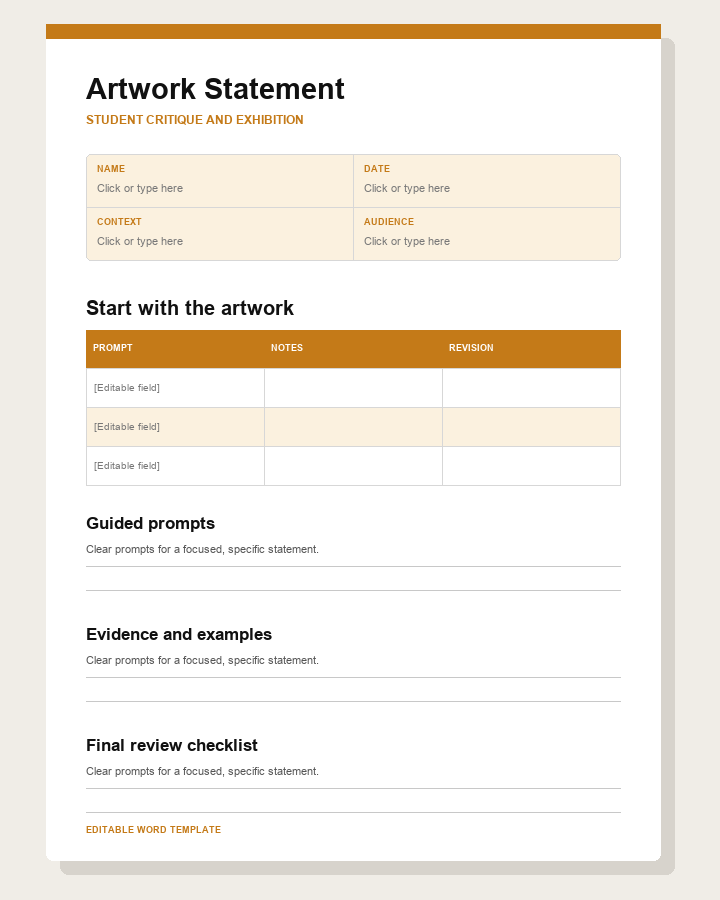
The ochre student version is a critique and exhibition worksheet. It starts with direct observation, then moves through intention, material and formal choices, process, problem-solving, influences, reflection, and a final statement. It can be adapted for painting, drawing, photography, sculpture, ceramics, textiles, installation, digital work, performance, sound, film, and mixed media.
What Is an Artist Statement?
An artist statement introduces an artistic practice or a particular body of work in the artist’s own voice. It normally describes what the artist makes, the questions or experiences that inform the work, and the relationship between materials, process, form, and meaning.
The statement is not a biography, CV, press release, review, or list of awards. Those documents may accompany a portfolio, but they answer different questions. An artist statement should help the reader understand the work more clearly without telling them that there is only one correct interpretation.
Artist Statement vs. Artist Biography
An artist biography is usually written in the third person and summarizes background, education, exhibitions, awards, collections, or professional milestones. An artist statement is usually written in the first person and focuses on the work itself.
For example, “She completed an MFA and has exhibited in…” belongs in a biography. “I build small ceramic structures from repeated hand-pressed forms…” belongs in a statement. Keep the two separate unless an application explicitly asks for a combined text.
What to Include in an Artist Statement
- What you make: medium, form, scale, subject, space, sound, sequence, or audience experience.
- What sustains the work: a question, tension, observation, memory, place, history, system, or experience.
- How you work: material and process choices that matter to the meaning.
- Formal language: relevant decisions about color, composition, texture, repetition, time, movement, framing, or installation.
- A concrete example: one artwork or series that makes the broader practice easier to understand.
- Current direction: what you are exploring now or what remains unresolved.
How to Start an Artist Statement
Begin with what you make. A reader should be able to picture the work before meeting a large abstract idea. “My work explores identity and memory” is too broad by itself. Add the form, material, and specific point of attention that make the sentence yours.
A useful drafting structure is: “I make [kind of work] using [materials or process] to examine [specific question, subject, or tension].” Treat it as scaffolding. Replace generic terms and revise the sentence until it sounds natural in your voice.
Connect Materials to Meaning
Do not list every material simply because it appears in the work. Select the choices that help the reader understand why the work takes its particular form. If repetition matters, explain what repetition does. If a fragile material changes over time, explain why that instability belongs to the work. If images are cropped, layered, erased, or sequenced, connect that decision to the central inquiry.
The goal is not to assign a symbolic meaning to every color or tool. It is to show that the process and the ideas are related rather than two separate paragraphs.
Use Specific Language
Specific language creates a picture. Name the kind of space, surface, movement, sound, or process involved. Identify a recurring form, a source image, a place, a method of collecting material, or a constraint that shaped the work.
Remove phrases that could appear unchanged in almost any artist statement, such as “I have always been creative,” “my work is a journey,” or “I want viewers to feel something.” Replace them with what the work actually does and what prompted the decision.
How Long Should an Artist Statement Be?
The opportunity determines the length. A short wall label may need only 50 to 80 words. A website or portfolio statement often works well at approximately 100 to 200 words. A grant, residency, catalog, or project proposal may permit a longer version.
Keep several versions rather than forcing one statement into every use. The professional template includes spaces for a short, standard, and extended version so the core language stays consistent while the emphasis changes.
Writing for a Gallery, Portfolio, or Open Call
For a gallery or exhibition, emphasize the current body of work and the experience or questions it creates. For a website, make the language accessible to a reader who may encounter the work without you present. For an open call, answer the actual prompt and connect the selected work to the stated theme or criteria without pretending the work was created for an opportunity when it was not.
For a grant or residency, the artist statement should remain about the practice. A separate project proposal normally explains what you intend to create, why the opportunity matters, how the work will be completed, and what resources are required.
Writing a Statement for One Artwork
A statement for one artwork should be narrower than a professional practice statement. Start with accurate information: title, date, medium, dimensions or duration, and the direct experience of the work. Then explain the intention, the decisions that shaped the result, one meaningful process detail, and what you learned or would investigate next.
Students should avoid copying art-historical descriptions or claiming that a viewer must feel a particular emotion. Describe the choices clearly and allow the audience room to respond.
Writing About Influences
Include an influence only when you can explain the connection. Naming a famous artist without describing what you learned from the work adds little. Identify whether the influence concerns material, method, scale, composition, subject, research, ethics, display, or another specific aspect.
Influence can also come from a place, craft tradition, archive, family practice, scientific process, social system, sound, object, language, or ordinary observation. Give enough context for the reader to understand its relevance.
Artist Statement vs. Personal Statement
An artist statement explains the work. A Personal Statement usually explains the applicant’s background, motivation, experience, and fit for a program or opportunity. An art-school application may request both, so check whether the prompts expect separate documents.
If the application asks for academic or professional direction, a Statement of Purpose may require a different structure focused on preparation, program fit, and future goals.
Common Artist Statement Mistakes
- Beginning with a childhood biography instead of the work.
- Using theoretical language that the artist cannot explain plainly.
- Listing materials without connecting them to decisions or meaning.
- Writing only about themes and leaving the physical work invisible.
- Telling viewers what they must think or feel.
- Explaining every detail until the work has no room to remain open.
- Using praise words such as powerful, unique, beautiful, or innovative as evidence.
- Copying the same statement into every application without adapting it.
- Including awards and exhibitions that belong in the biography or CV.
- Leaving an outdated series in a current portfolio statement.
- Ignoring the required word limit or prompt.
Final Review Checklist
- The first paragraph tells the reader what I make.
- The statement is written in my own first-person voice.
- Materials, process, and formal choices are connected to the work’s inquiry.
- At least one detail could not describe another artist’s practice.
- The statement does not duplicate the biography or CV.
- References and influences are accurate and relevant.
- The language is understandable without removing necessary complexity.
- The current body of work receives the most attention.
- The final version matches the opportunity and word limit.
Frequently Asked Questions
Should an artist statement be written in first person?
Usually yes. The statement represents the artist’s own account of the work. A biography is more commonly written in the third person.
Can I mention personal experiences?
Yes, when the experience helps explain the work. Include only the context needed and do not assume that disclosure is required for the work to be taken seriously.
Should I explain what every artwork means?
No. Explain the central questions and relevant decisions while leaving room for complexity and interpretation. A statement should support the work, not close it down.
Do student artist statements need art vocabulary?
Use accurate terms that help explain real choices, but do not add vocabulary only to sound formal. Clear language is more useful than unexplained jargon.
Can I edit these templates in Microsoft Word?
Yes. Both files are editable DOCX templates. Replace every prompt, adapt the sections to the medium or opportunity, and keep a dated master version for future updates.