
A credit card statement packs a month of spending, payments, interest and fees into a few dense pages. It is easy to glance at the amount due and move on, and that is how duplicate charges, forgotten subscriptions and creeping interest slip through. A good credit card statement template gives you a structured way to check every line, see where the money went and plan how to pay the balance down. If you are a business, it can also help you run an employee card programme or bill customers who buy on credit.
This guide explains each section of a typical card statement and how interest is calculated. It then shows how to reconcile a statement against your receipts and how to use the five templates below. A quick note before you start: these templates are for your own records, reconciliations and internal reporting. The official statement always comes from your card issuer, and you should never present a self-made document as one.
What Is a Credit Card Statement?
A credit card statement is a periodic summary, usually monthly, of all activity on a credit card account. Card issuers are required to send one each billing cycle. It shows what you owe, the minimum you must pay, the payment due date and every transaction posted during the cycle. It works much like a bank statement, except that the balance is money you owe rather than money you hold.
The Main Sections of a Credit Card Statement
Account summary
The summary shows the previous balance, payments and credits, new purchases, cash advances, balance transfers, fees, interest charged and the new balance. The arithmetic always follows the same pattern: previous balance − payments and credits + purchases + cash advances + fees + interest = new balance. The reconciliation template rebuilds this calculation so you can confirm it.
Payment information
This box gives the new balance, the minimum payment due and the due date. Many statements in the US and other markets also include a minimum-payment warning that estimates how long payoff would take if you paid only the minimum. It is worth reading, because the numbers are often startling.
Transaction list
Each purchase, refund, payment and fee is listed with its transaction date, posting date, merchant description and amount. Merchant names on statements are often abbreviated or show a parent company’s name, which is why some charges look unfamiliar at first.
Interest charge calculation
This section shows the annual percentage rate (APR) for each balance type, such as purchases, cash advances and promotional balances, along with the balance subject to interest and the interest charged. Cash advances usually carry a higher APR and have no grace period.
Credit limit and available credit
Your credit limit minus your current balance is your available credit. The ratio of balance to limit, called credit utilisation, is one of the factors credit scoring models look at.
Download 5 Free Credit Card Statement Templates
These templates help you check, organise and plan around your card statements, and help businesses bill their own credit customers. Excel versions have working formulas, and every template includes a PDF. They are recordkeeping tools, not substitutes for the official statement your card issuer sends.
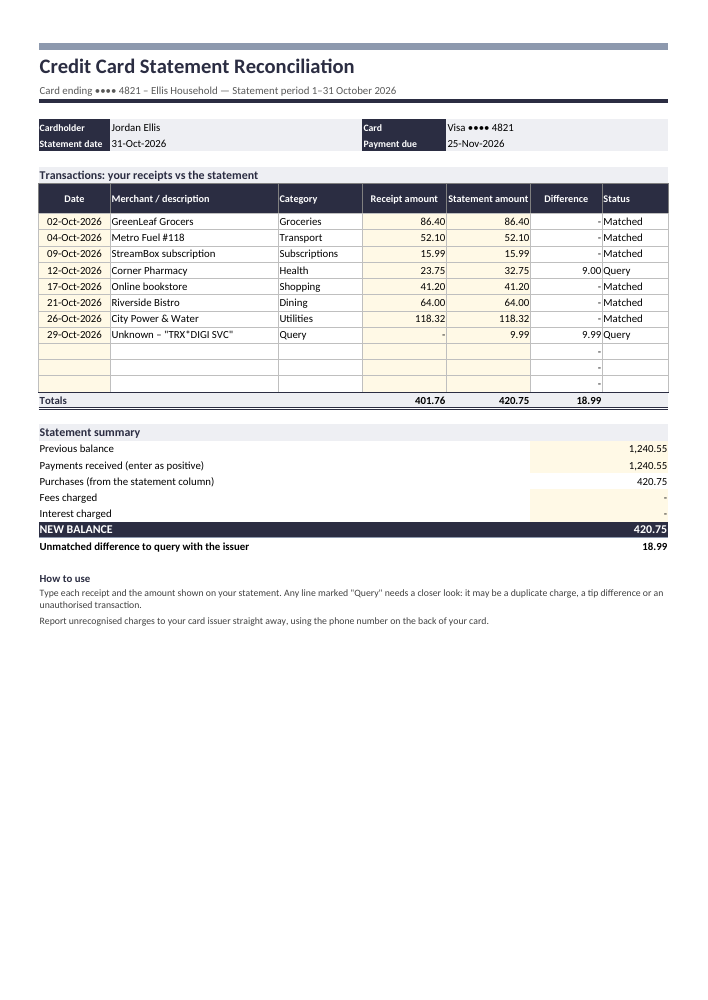
1. Credit Card Statement Reconciliation Template
Checks every receipt against the amount on your statement and flags any line that doesn’t match. It also rebuilds the new balance from the previous balance, payments, purchases, fees and interest.
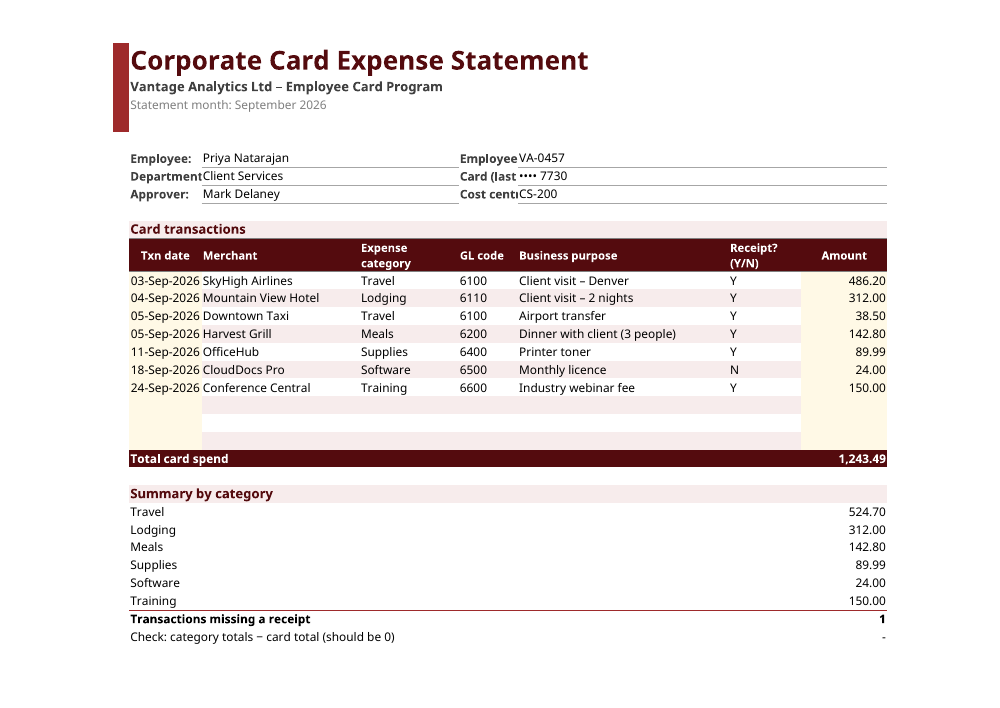
2. Corporate Card Expense Statement
A monthly statement for employees with company cards, with GL codes, business purpose, a receipt check and an automatic summary by category for finance approval.
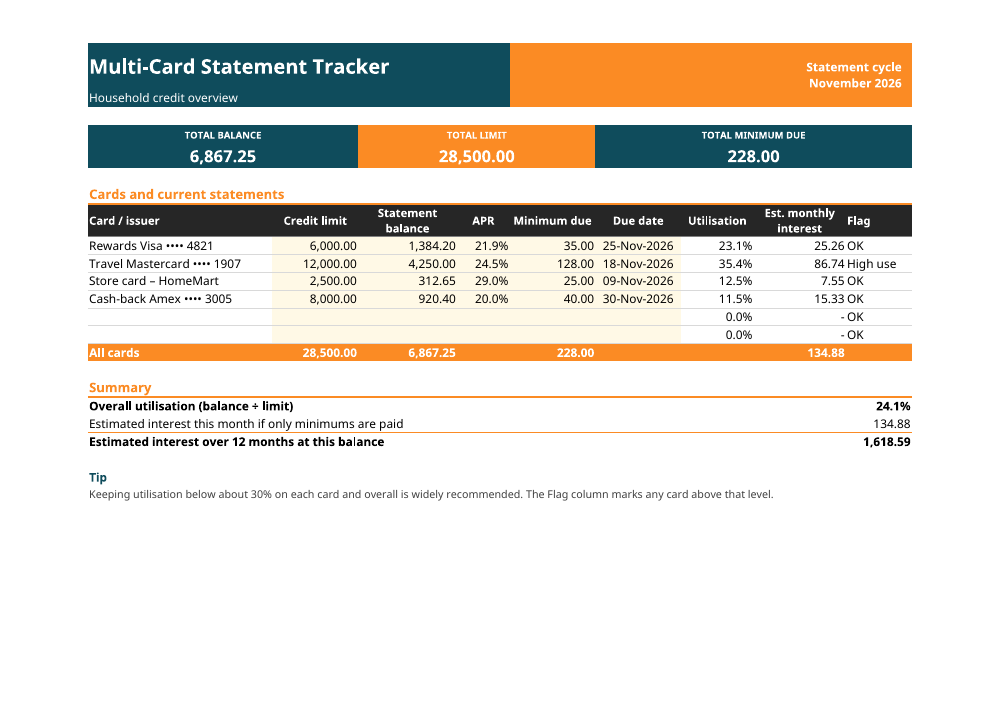
3. Multi-Card Statement Tracker
Every card on one page, showing balance, limit, APR, minimum due, utilisation, estimated interest and a high-use flag.
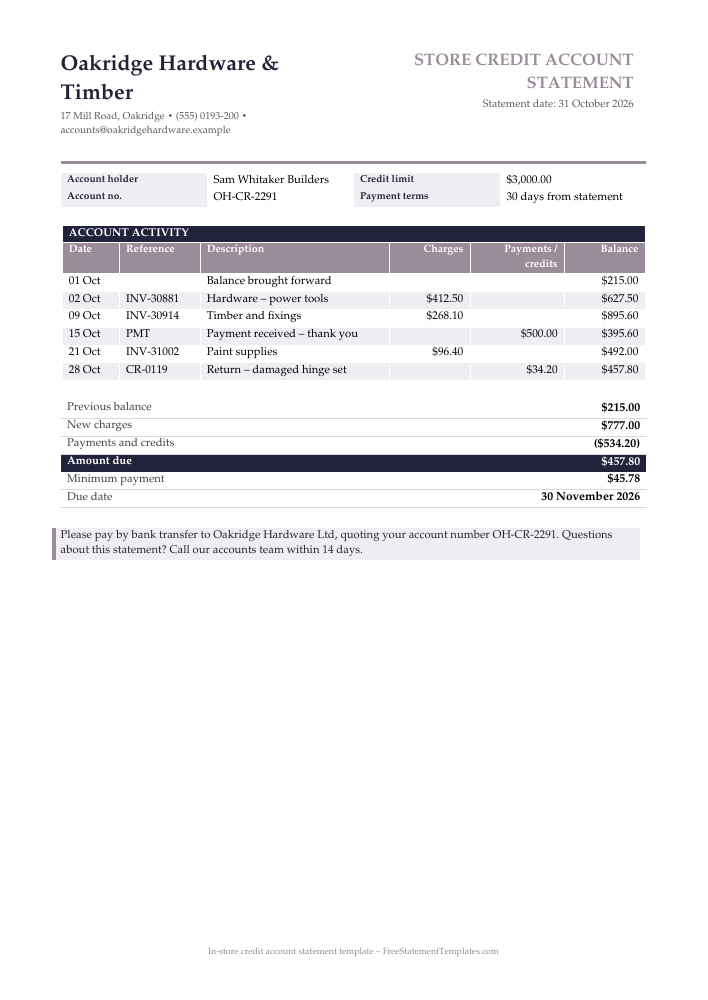
4. Store Credit Account Statement (Word)
For shops and trade suppliers that give customers an in-house credit line. It has charges, payments, a running balance, the minimum payment and payment instructions.
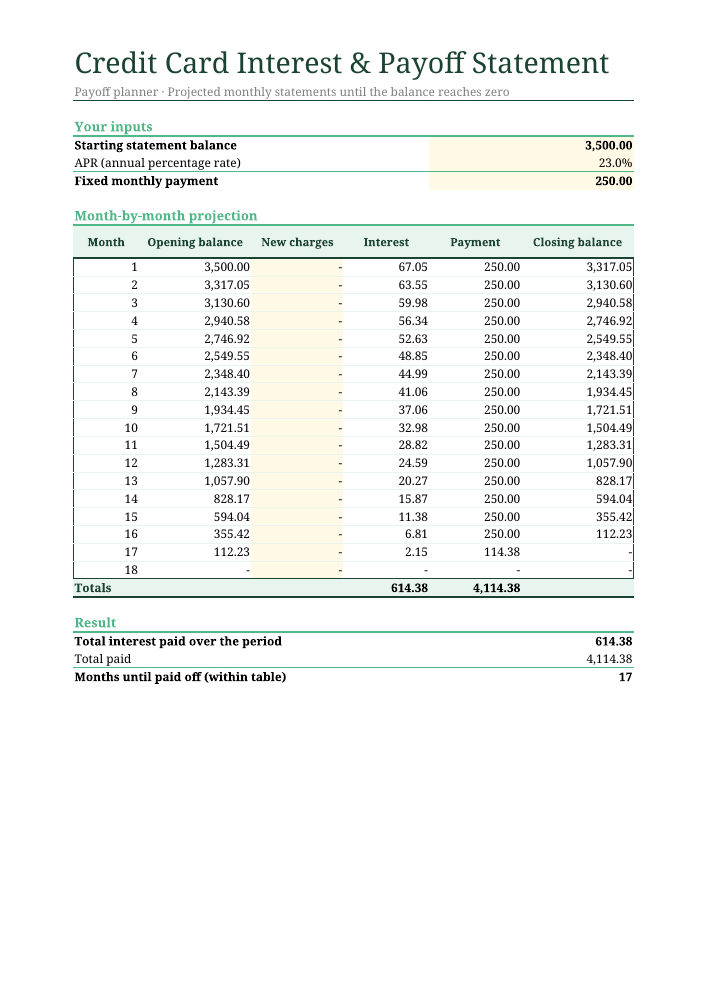
5. Credit Card Interest & Payoff Statement
Projects monthly statements from your balance, APR and fixed payment, then shows total interest and the month the card is paid off.
How to Reconcile a Credit Card Statement
Reconciling means checking that every charge on the statement is genuine and correct. It takes about ten minutes a month and is the best defence against fraud and billing errors.
- Collect your receipts for the billing period, whether paper, email confirmations or app notifications.
- List each receipt in the reconciliation template with its date, merchant, category and amount.
- Enter the statement amount for each transaction beside the receipt amount. The Difference column calculates automatically, and the Status column shows “Matched” or “Query”.
- Investigate every “Query” line. Common causes are restaurant tips added after the receipt, currency conversion on foreign purchases, a duplicate charge, a subscription you forgot about or a fraudulent transaction.
- Rebuild the new balance in the summary section from the previous balance, payments, purchases, fees and interest, and compare it with the statement.
- Contact the card issuer quickly about any unauthorised or incorrect charge. Dispute rights usually have time limits that start from the statement date, so don’t wait until next month.
Businesses should reconcile company cards the same way and post each transaction to the right expense account. The corporate card template adds GL codes, a business-purpose field and a receipt check so finance teams can approve statements faster. It also pairs well with our expense statement templates.
How Credit Card Interest Is Calculated
Most issuers use the average daily balance method. The daily periodic rate (APR ÷ 365) is applied to the average balance over the billing cycle, then multiplied by the number of days in the cycle. As a rough monthly estimate, balance × APR ÷ 12 gets close, and that is the approach the multi-card tracker and the payoff template use.
The key point is the grace period. If you pay the full statement balance by the due date, most cards charge no interest on new purchases. Carry even part of the balance forward and interest usually applies to the whole average balance, sometimes including new purchases, until the account is paid in full again.
Using the Payoff Statement Template
Enter your starting balance, APR and a fixed monthly payment. The template projects 18 monthly statements, showing opening balance, interest, payment and closing balance for each. It then reports the total interest paid and the month the balance reaches zero. Try a few payment amounts and you’ll see how quickly a slightly higher payment cuts the total interest. If you have several cards, two strategies are common: the avalanche method (pay extra on the highest APR first) and the snowball method (pay off the smallest balance first for a quick win). The multi-card tracker shows each card’s APR and monthly interest side by side, so you can choose an order.
Store Credit Account Statements for Businesses
Hardware stores, builders’ merchants, farm suppliers and many independent retailers let regular customers buy on account. The store credit statement template works like a mini credit card statement for those customers. It shows the opening balance, each charge, payments and returns, a running balance, the amount due and the minimum payment. For trade customers with invoice-based terms, our customer account statement templates and statement of account templates may suit you better.
Tips for Managing Card Statements
- Pay at least the minimum on time, every time. Late payments can trigger fees, penalty APRs and credit report entries.
- Set up alerts for each transaction or for purchases above a set amount, so you catch fraud quickly.
- Review subscriptions every quarter. The category column in the reconciliation template makes recurring charges easy to spot.
- Keep utilisation below about 30% on each card and overall. The tracker flags cards above that level.
- Keep statements and reconciliations for at least as long as your tax authority requires for business expenses, often several years.
You’ll find more templates for accounts, bank records and reconciliations in our Bank & Account Statements category.
Frequently Asked Questions
What should a credit card statement include?
A standard statement includes the account summary (previous balance, payments, purchases, fees, interest and new balance), the minimum payment and due date, a list of transactions, the interest calculation by balance type and APR, your credit limit and available credit, and contact details for questions and disputes.
Can I make my own credit card statement?
You can create your own records, such as a reconciliation, an expense report for your employer, a payoff plan or a statement for customers who buy from your business on credit. You should never create or alter a document to look like an official statement from a bank or card issuer. If you need an official copy, download it from your issuer’s website or app, or ask them to send one.
How do I reconcile my credit card statement with my receipts?
List each receipt and the matching statement amount side by side, then mark any line that doesn’t match. Differences usually come from tips, foreign currency conversion, duplicate charges or unrecognised merchants. Rebuild the new balance from the statement summary as a final check, and report anything unauthorised to your issuer right away.
Why is the amount on my statement different from my receipt?
The most common reasons are a tip added after the receipt was printed, a foreign transaction converted at the card network’s rate plus a fee, a pre-authorisation at a hotel or fuel pump that was later adjusted, or a partial refund. If none of those explains it, query the charge with the merchant or your card issuer.
How long should I keep credit card statements?
For personal use, keeping statements for a year is a common rule of thumb, unless they support tax deductions, warranty claims or disputes. Businesses should keep card statements and receipts for as long as their tax authority requires, often five to seven years.
Do these templates work for business credit cards?
Yes. The corporate card expense statement is designed for employee cards. It adds GL codes, cost centres, business purpose, a receipt check, a category summary and approval signatures, and it works for owner-managed business cards too.
Final Thoughts
A credit card statement is only useful if you actually read it. Reconcile it monthly with the template that fits your situation, query anything unusual straight away and use the payoff and tracker sheets to keep interest under control. Ten minutes a month can save money and catch fraud before it grows.