
A policy statement communicates an organization’s rule, commitment, standard, or governing position on a defined subject. A good policy does more than sound formal: it tells people what principle or requirement applies, who and what are covered, who is responsible for implementation, how exceptions are handled, and when the policy should be reviewed.
The two free Word templates below are intentionally designed for different levels of use. The first is a corporate and organization-wide policy statement template with document control, approval authority, scope, responsibilities, exceptions, references, review, and change history. The second is a workplace and department policy statement template built around practical rules, decision points, responsibilities, escalation, implementation, communication, and a quick-reference structure.
Both templates are editable DOCX files with professional visual formatting rather than blank text pages. They are general working documents. Employment law, health and safety requirements, privacy rules, sector regulation, collective agreements, contracts, governing documents, accreditation standards, or internal approval rules may require specific wording or procedures, so a general template should be adapted and reviewed for the organization and jurisdiction in which it will be used.
Download the Policy Statement Templates
1. Corporate Policy Statement Template
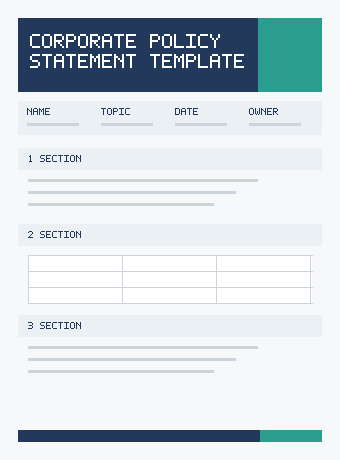
This Word template is designed for formal organization-wide governance. It includes policy owner, approving authority, effective date, review date, policy ID and version, a clear policy statement, purpose, scope, roles and responsibilities, exceptions and escalation, definitions and references, change history, and approval notes. The structure is suitable for businesses, nonprofits, associations, schools, institutions, and other organizations that maintain a controlled policy library.
2. Workplace & Department Policy Statement Template
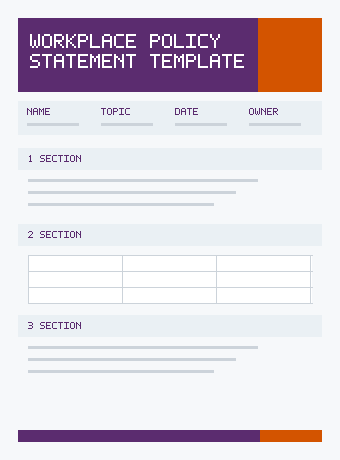
This second design is more operational. It helps a team turn a policy into rules that people can understand and use. The template includes a one-sentence policy, visual Know–Act–Record–Escalate flow, policy rationale, rules and decision points, responsibilities, an exception path, implementation checklist, communication plan, quick-reference notes, and approval record.
What Is a Policy Statement?
A policy statement expresses an approved organizational position or rule. It may require an action, prohibit an action, establish a standard, define a principle, allocate decision authority, or explain how the organization intends to handle a recurring issue. Policies can cover topics such as information handling, workplace conduct, purchasing, safety, access control, travel, expenses, customer service, records, conflicts of interest, use of equipment, sustainability, quality, or governance.
The most useful policy statements are written for decisions. A reader should be able to recognize when the policy applies and understand what the organization expects. Background information can provide context, but it should not bury the actual rule.
Policy Statement vs. Policy vs. Procedure
Organizations use these terms differently, but a practical distinction is that a policy establishes the rule or governing expectation, while a procedure explains the steps used to carry it out. The policy answers questions such as “what is required?” and “who is accountable?” A procedure is more likely to answer “which system do I open?” or “what sequence of approvals do I follow?”
A policy statement may be one important section inside a longer policy document. The corporate template on this page therefore gives the actual statement its own section and surrounds it with the control information needed to manage the document responsibly.
Policy Statements vs. Mission and Vision Statements
A policy statement should also be distinguished from broader strategic statements. A Mission Statement explains why an organization exists and whom it serves. A Vision Statement describes the future the organization hopes to help create. A policy statement is more operational and governing: it tells people what standard, rule, or principle applies to a particular subject.
What Should a Strong Policy Statement Include?
The exact sections depend on the topic and organization, but several elements make policies easier to use and maintain.
- Purpose: Why the policy exists and what organizational need, risk, or standard it addresses.
- Policy statement: The core rule, principle, commitment, or requirement in direct language.
- Scope: The people, units, systems, locations, activities, or circumstances covered.
- Responsibilities: Who must act, who makes decisions, who monitors, and who owns the document.
- Exceptions: Who can approve an exception and what evidence or record is required.
- References: Related procedures, forms, standards, contracts, laws, or internal documents.
- Approval and review: Who approved the policy, when it became effective, and when it should be reviewed.
- Version history: What changed and when, so users can identify the current controlled version.
Write the Core Rule Before Writing the Background
A common problem in policy writing is spending several paragraphs describing the issue without ever stating the policy clearly. Draft the core rule first. Ask: What should a person do, not do, obtain approval for, report, record, or consider when this situation occurs?
Once the rule is clear, write only the background needed to explain why it exists. If the policy is too complicated to express in a short core statement, it may contain several separate decision rules that should be organized individually.
Use Clear Decision Language
Words such as “must,” “may,” and “should” can signal different levels of expectation. Use them consistently. If an action is mandatory, vague language such as “employees are encouraged to consider” may create uncertainty. If an action is discretionary, writing it as an absolute command may create a different problem.
Definitions are useful when a term has a technical, regulatory, contractual, or organization-specific meaning. Do not fill a policy with definitions for ordinary words that readers already understand.
Define Scope Carefully
A policy can fail even when its central rule is sound if nobody knows who is covered. State whether the policy applies to employees, contractors, volunteers, directors, students, customers, vendors, specific departments, particular facilities, certain systems, or a combination of these groups.
Scope should also identify meaningful exclusions or jurisdictional differences where appropriate. If different local requirements apply, the organization may need location-specific supplements rather than one universal rule.
Assign Roles and Responsibilities
A policy that says “the organization will ensure” may be difficult to implement when no role is responsible for ensuring anything. The responsibility table in the corporate template helps distinguish the policy owner from managers, people covered by the policy, and assurance or compliance roles.
Responsibility should match authority. Do not assign a manager responsibility for approving something the manager has no authority or information to approve. When a decision is delegated, record the limit of that delegation.
Plan for Exceptions and Escalation
Some policies allow exceptions; others do not. If exceptions are possible, define the approving role, the information required, how the decision is recorded, whether the exception expires, and whether a higher-level review is needed for significant cases.
An escalation route is especially useful for policies involving risk, safety, privacy, finance, ethics, harassment, security, quality, or another issue where a routine supervisor may not be the final decision maker. The route should be appropriate to the subject and applicable requirements.
How to Use the Corporate Policy Template
Complete the policy-control section first. Assign a policy owner, approving authority, effective date, review date, ID, and version. These fields turn the document into something that can be managed rather than a file that circulates indefinitely after becoming obsolete.
Then write the purpose and core statement. Define scope before assigning responsibilities, because accountability depends on knowing who and what are covered. Add only the definitions and references necessary to interpret or implement the rule. Finally, document the review cycle and change history so readers can confirm they are using the current version.
How to Use the Workplace Policy Template
The workplace version starts with a one-sentence rule and then converts it into practical decision points. Use the “Situation / Trigger” column to describe when a rule becomes relevant. Use “Required Action” for what the employee or team should do, and “Decision / Approval” for the person or role that authorizes the next step.
The Know–Act–Record–Escalate structure is a useful implementation test. People need to know the rule, act consistently, create the records required by the organization, and understand where to go when the situation falls outside the routine path.
Implementation Is Part of Good Policy Design
Publishing a policy is not the same as implementing it. Before the effective date, check whether related procedures, forms, systems, permissions, templates, training, communications, and reporting mechanisms are ready. If a policy requires employees to submit a new approval but the approval system does not exist, the failure is partly a design problem.
Different audiences may need different communication. A manager may need training on approvals and exceptions, while employees may need a short explanation of the rule and a link to the procedure. The communication table in the workplace template helps separate those needs.
How Often Should Policies Be Reviewed?
There is no universal review period that suits every policy. The appropriate cycle depends on legal or regulatory requirements, the level of risk, how quickly the underlying activity changes, contractual obligations, incidents, audit findings, technology, and organizational structure. A policy may also need an unscheduled review after a significant change even if its routine review date is months away.
A review does not always require a rewrite. The reviewer may confirm that the policy remains appropriate, record that decision, and retain the existing version until the next review point.
Common Policy-Writing Mistakes
- Writing background information without stating the actual policy.
- Using vague words when the organization needs a clear requirement or decision rule.
- Failing to define who or what the policy covers.
- Assigning responsibilities to roles that lack the necessary authority.
- Mixing detailed procedures into the policy until it becomes difficult to maintain.
- Creating an exception process with no approval limits or records.
- Publishing a policy before the systems, forms, or training needed to follow it are ready.
- Ignoring related contracts, legal requirements, collective agreements, or sector standards.
- Leaving old versions available without a clear current version.
- Copying another organization’s policy without adapting it to your own operations and risks.
Final Review Checklist
- The policy has a clearly identified owner and approving authority.
- The core rule or commitment can be located quickly.
- The purpose explains a real organizational need rather than repeating the rule.
- The scope identifies the people, activities, systems, or locations covered.
- Mandatory and discretionary language is used consistently.
- Roles have both responsibility and appropriate decision authority.
- Exception and escalation routes are clear where relevant.
- Related procedures, forms, standards, and references are identified.
- The effective date, review date, version, and change history are controlled.
- The final policy has been checked against applicable organizational and external requirements.
Frequently Asked Questions
How long should a policy statement be?
It should be long enough to state the rule, scope, accountability, and necessary conditions clearly, but no longer than the subject requires. A short policy may fit on one or two pages, while a complex governance policy may need additional sections or supporting procedures.
What is the difference between a policy and a procedure?
A policy generally establishes what is required or permitted and who is accountable. A procedure explains the operational steps used to carry out the policy. Organizations may structure these documents differently, but separating stable rules from changeable steps often makes maintenance easier.
Who should approve a policy?
Approval authority depends on the organization, subject, governing documents, delegated authority, and applicable requirements. Some policies may be approved by management, while others require board, committee, HR, compliance, legal, safety, or another formal approval route.
How often should a workplace policy be reviewed?
Use a risk- and requirement-based review cycle. Also review a policy when relevant law, technology, organizational structure, incidents, contracts, audit findings, or operating practices change materially.
Can these templates be used for HR, safety, privacy, or legal policies?
They can provide a document structure, but regulated or high-impact subjects often require organization- and jurisdiction-specific content. Use the template as a starting framework and obtain appropriate professional review where the topic requires it.
Can I edit the templates in Microsoft Word?
Yes. Both files are editable DOCX templates. You can replace the prompts, change colors, add a logo, expand tables, insert organization-specific sections, and remove items that do not apply.