
A vision statement describes the future an organization, team, nonprofit, or community wants to help create. Unlike a mission statement, which usually explains what the organization does now and whom it serves, a vision statement looks ahead. It gives leaders and stakeholders a shared picture of the desired future so that strategy, priorities, investments, and everyday decisions can be judged against a common direction.
The two free templates below are deliberately different. The first is a business vision statement template built for strategic planning and leadership workshops. It helps a company define future position, stakeholder experience, strategic themes, alternative drafts, and a final approved vision. The second is an impact vision canvas for nonprofits, teams, community organizations, and mission-driven groups. It starts with the future condition people should experience and keeps the organization itself from becoming the center of the statement.
Download the Vision Statement Templates
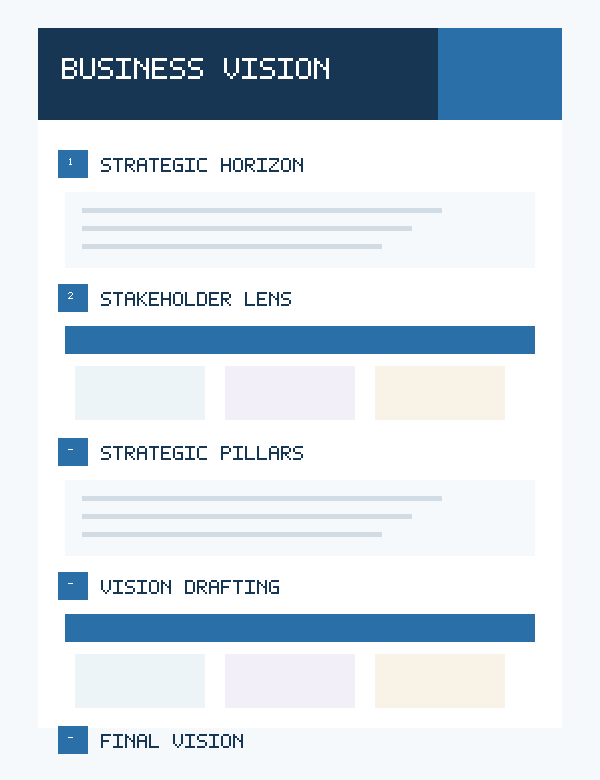
1. Business Vision Statement Template
This professionally designed DOCX template is intended for companies, founders, leadership teams, departments, and strategy workshops. It includes a visual “Now / Future / Why” framework, stakeholder table, strategic-theme section, drafting alternatives, a statement-quality test, and a final approval area.
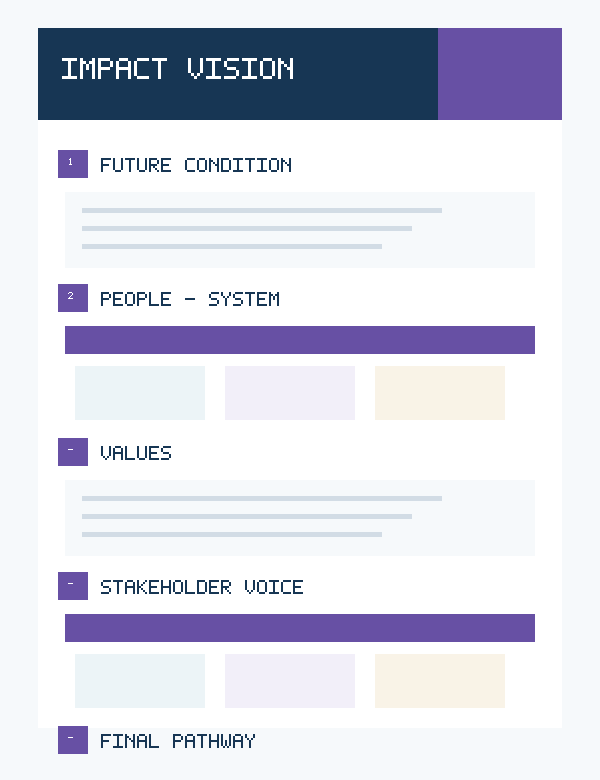
2. Nonprofit / Team Impact Vision Statement Template
The second template uses a different approach. It is designed for nonprofits, teams, associations, public-interest initiatives, and community groups that want to describe the change they hope people or systems will experience. It includes future-condition prompts, stakeholder impact, values, enabling conditions, wording guidance, three vision options, and a final selection area.
What Is a Vision Statement?
A vision statement is a concise description of a desired future state. It can express where an organization wants to be, what kind of experience it wants customers or communities to have, what impact it wants to create, or what future condition it wants to help make possible.
The statement is not a detailed strategy. It does not need to list every product, program, market, project, or objective. Its role is to give strategic direction. A good vision can help leaders decide whether a new opportunity moves the organization toward the future it says it wants.
Vision Statement vs. Mission Statement
The terms are often confused. A Mission Statement usually explains the organization’s present purpose: what it does, for whom, and often how. A vision statement describes the future the organization wants to reach or help create.
For example, a mission may say that an organization provides affordable learning resources to underserved students. A vision might describe a future where every student in its region can access the support needed to complete school successfully. The mission is about current purpose; the vision is about the desired future.
Why a Vision Statement Matters
A vision statement is useful only when people can connect it to decisions. It can help align leaders, employees, partners, and stakeholders around a common direction. It can also make strategy discussions more disciplined because proposals can be tested against an agreed future rather than against personal preference.
A strong vision can support several functions:
- Strategic choice: It helps distinguish opportunities that move the organization forward from attractive distractions.
- Leadership alignment: It gives decision-makers a shared definition of the future they are trying to build.
- Communication: It provides employees, customers, donors, or partners with a simple explanation of long-term direction.
- Motivation: It can connect daily work to a larger outcome when the statement is credible and meaningful.
- Consistency: It provides a stable reference point while individual plans, projects, and tactics change.
How to Use the Business Vision Statement Template
Start with the organization and planning horizon. A vision should usually be far enough in the future to encourage strategic thinking, but not so distant that the statement becomes pure fantasy. The appropriate horizon depends on the industry, organization size, technology cycle, regulation, capital requirements, and other factors.
The “Now / Future / Why” section helps prevent two common mistakes. First, it forces the team to acknowledge the current reality rather than drafting an aspirational slogan disconnected from the organization’s position. Second, it asks why the future matters, which helps remove statements that sound impressive but have little strategic meaning.
Describe the Future Position
In the first section, describe what the organization should look like in the future. Depending on the business, this might involve reach, reputation, customer experience, specialization, quality, resilience, innovation, scale, or a distinctive market role.
Avoid writing only in financial terms. Revenue, profitability, or market share may matter strategically, but a vision usually becomes more useful when it also describes what the organization will be known for and what customers or stakeholders will experience.
Include Stakeholders Without Making the Statement Too Long
The stakeholder table in the template is a planning tool rather than text that must appear in the final vision. Use it to ask what the future should mean for customers, employees, partners, and communities. Once those ideas are clear, the final statement can express the most important outcome without listing every group.
This step is especially useful because leadership teams sometimes draft a vision from the organization’s internal perspective only. Asking how others experience the future can make the statement more concrete.
Use Strategic Themes to Find the Core Idea
Many organizations identify several long-term themes such as innovation, growth, customer trust, sustainability, people development, operational excellence, or accessibility. The template provides a place to record themes and rate their importance.
The goal is not to squeeze all themes into one sentence. Instead, use them to identify the one or two ideas that make the desired future distinctive. If the statement becomes a list of six priorities separated by commas, it may be functioning more like a strategic plan than a vision.
How to Use the Nonprofit / Team Impact Vision Template
The nonprofit and team version begins with a different question: What change do we want people, communities, or systems to experience? This is useful for mission-driven organizations because it prevents the vision from becoming an organizational growth target such as “to become the largest nonprofit in the region.”
Growth may support the mission, but the desired future should usually be expressed in terms of the people or system the organization exists to serve. The stakeholder section asks how life, access, opportunity, safety, connection, trust, health, learning, or another relevant condition should be different.
Values and Enabling Conditions
The impact template includes values because two organizations may pursue a similar outcome in very different ways. Equity, dignity, trust, accessibility, resilience, and similar principles may shape what the desired future actually means.
The enabling-conditions section is equally important. A vision may depend on partnerships, capability, policy change, funding, technology, trust, workforce skills, or other conditions. These do not necessarily belong in the final sentence, but acknowledging them makes later strategic planning more realistic.
A Practical Vision Statement Formula
There is no universal formula, but one useful drafting structure is:
A future where [people / customers / community] experience [desired condition], so that [meaningful long-term impact].
For a business, another approach is:
To be [distinctive future position] for [customer / market], known for [core value or experience].
Use formulas only to start discussion. The final wording should sound natural for the organization and should not feel as though blanks were mechanically filled.
How to Test a Draft Vision Statement
The business template includes five practical tests. A useful vision should be:
- Directional: It should help guide choices.
- Distinctive: It should not be so generic that any competitor or organization could use it.
- Memorable: People should be able to explain the core idea without reading a paragraph.
- Credible: It can be ambitious without becoming meaningless fantasy.
- Human: It should make clear why the future matters to customers, employees, communities, or other stakeholders.
Common Vision Statement Mistakes
- Writing a mission statement and calling it a vision.
- Using vague words such as “leading,” “world-class,” or “best” without explaining what makes the future different.
- Turning the statement into a long list of strategic priorities.
- Focusing only on company size, revenue, or market dominance.
- Using terminology that employees interpret differently.
- Making claims that are impossible to verify or understand.
- Drafting the sentence before discussing the actual future state.
- Creating a statement that never affects strategy or resource allocation.
Vision Statement and Strategy
A vision should not replace strategy. The vision says where the organization wants to go; strategy explains the choices and priorities used to move in that direction. Once the vision is approved, leadership can translate it into strategic objectives, measures, investment priorities, initiatives, and project decisions.
When a specific initiative has a defined challenge, our Project Problem Statement Templates can help frame the issue at project level. This keeps the long-term vision separate from the immediate problem a particular project is solving.
Final Review Checklist
- The statement clearly describes a future rather than current activities.
- The core idea can be explained without a long paragraph.
- The wording is distinctive enough to guide choices.
- Stakeholders can understand what the future means for them.
- Key terms have a shared meaning among leaders and employees.
- The statement is ambitious but not empty or unbelievable.
- Mission, values, strategy, and vision are treated as related but different tools.
- The organization has a plan to use the vision in strategic decisions.
Frequently Asked Questions
How long should a vision statement be?
There is no fixed length, but shorter statements are usually easier to remember and use. The planning behind the vision may be extensive even when the final wording is one or two sentences.
How often should a vision statement be changed?
It should be stable enough to guide long-term direction, but it can be reviewed when the organization’s environment, mission, ownership, market, or long-term assumptions change materially.
Can a small business use a vision statement?
Yes. A small business can benefit from defining what it wants to become, especially when making decisions about growth, customers, hiring, investment, and positioning.
Should employees help create the vision?
Leadership usually has responsibility for strategic direction, but employee and stakeholder input can improve clarity and reveal how the proposed future is understood by the people expected to support it.
Can a nonprofit vision mention the organization itself?
Yes, but the strongest nonprofit visions often emphasize the future condition for the community or people served rather than organizational size or status.
Can I edit these templates in Microsoft Word?
Yes. Both files are editable DOCX templates. You can change colors, wording, tables, prompts, and section labels to match your organization.