
A useful method statement does more than describe a job. It turns the findings of a risk assessment into a clear sequence that the people doing and supervising the work can understand, check and follow. These two free method statement templates are designed for that practical purpose.
Download either editable Microsoft Word template below: a construction-focused format for project work and a facilities-maintenance format for occupied buildings, planned shutdowns and service restoration. Both are blank working documents—not pre-approved safety plans—so they must be adapted to the actual task, site, workforce and rules that apply.
What is a method statement?
A method statement explains how a particular activity will be carried out in a logical, controlled sequence. It normally identifies the scope, people responsible, required competence, plant and materials, permits or isolations, risk controls, work steps, emergency arrangements and sign-off process.
The UK Health and Safety Executive describes method statements as a practical way to plan, manage and monitor construction work and to communicate the safe system of work. It also stresses that a statement should draw on the risk assessment and be revised when circumstances change materially. See the HSE guidance on construction administration and method statements.
Method statement, risk assessment and statement of work
| Document | Main question | Typical content |
|---|---|---|
| Risk assessment | What could cause harm, and how will risk be controlled? | Hazards, people affected, existing controls, further action and review. |
| Method statement | How will this specific job be completed using those controls? | Resources, responsibilities, sequence, checkpoints, emergency action and briefing. |
| Statement of work | What is being delivered under the project or contract? | Scope, deliverables, timeline, acceptance criteria and commercial responsibilities. |
Risk assessments and method statements are often issued together and may be called RAMS. The method statement should not copy a list of hazards and stop there; it should show where each control belongs in the working sequence. For project deliverables rather than the safe method, use our statement of work templates or a project scope statement template.
1. Construction Method Statement Template
This structured template suits construction, installation and higher-coordination project work. Its dark navy and safety-orange design separates document control from the working method and makes the numbered sequence easy to brief on site.
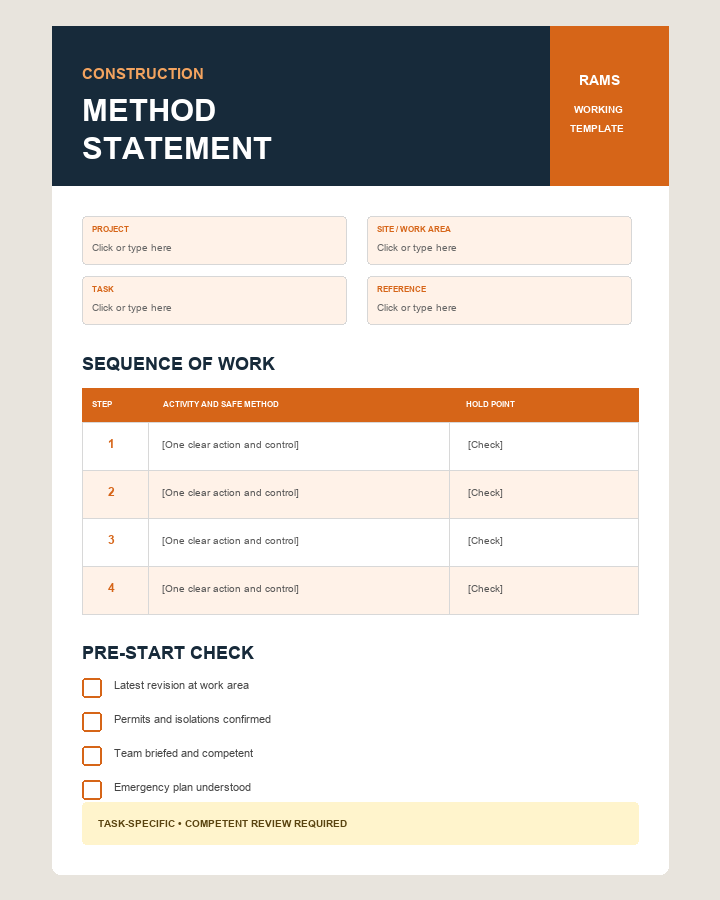
- Project, site, task and revision-control fields
- Responsibilities, supervision and competence records
- Plant, tools, materials, PPE and prerequisite checks
- Permits, isolations, interfaces and work-area controls
- Risk-control summary linked to the task assessment
- Eight-step work sequence with controls and hold points
- Quality, environmental, emergency and handover arrangements
- Briefing signatures and a final pre-start checklist
2. Facilities Maintenance Method Statement Template
This version uses a cleaner teal work-order format for repairs, planned maintenance and minor works in occupied facilities. Instead of copying the construction layout, it organizes the method around access, shutdown, isolation, go/no-go checkpoints, restoration and formal handover.
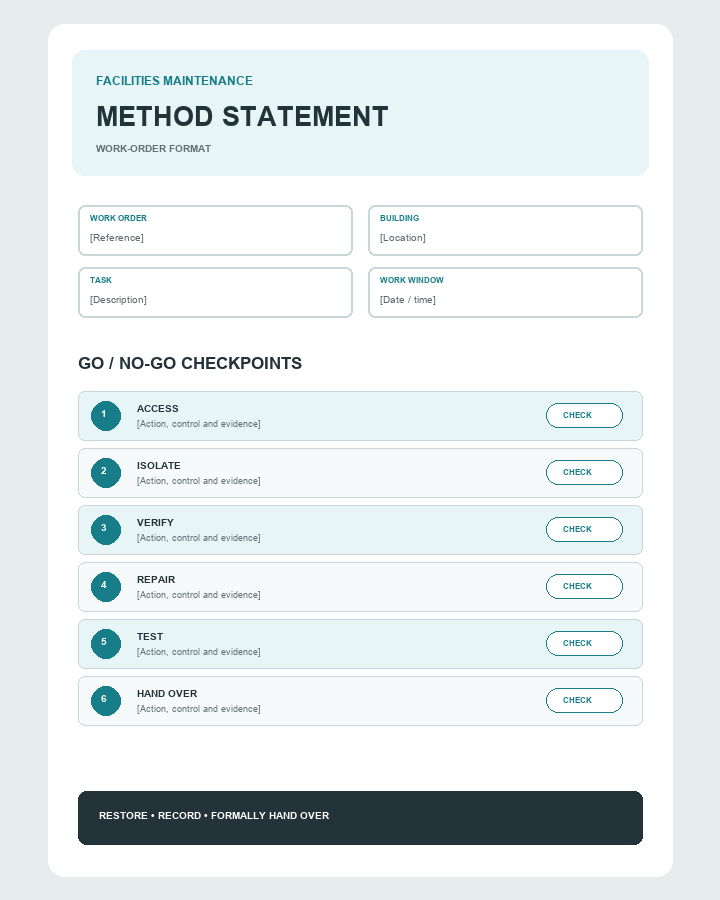
- Work-order, building, exact location and maintenance-window fields
- Service impact and occupant-notification planning
- Access authorization, isolation and area-control records
- People, tools, test equipment, materials and access equipment
- Go/no-go checkpoints before each critical stage
- Eight visually separated steps from preparation to handover
- Contingencies for unsafe conditions, alarms, damage and incomplete work
- Restoration, recordkeeping and acceptance fields
How to complete a method statement
1. Define one task and its boundaries
Name the activity precisely. Include the location, start and finish points, exclusions, nearby operations and any interface with occupants, the public or other contractors. A generic title such as “building work” is not enough to guide the team.
2. Start with the current risk assessment
Use the task-specific assessment to identify the controls that must appear in the method. Where possible, remove the hazard or use a safer method before relying on administrative controls or personal protective equipment. Cross-reference the exact assessment, permit, drawing and procedure revisions used.
3. Identify people, authority and competence
Record who coordinates the work, who supervises it, who carries out specialist actions and who can issue permits or approve changes. State the required training, authorization or evidence of competence. Everyone should understand who has stop-work authority if conditions no longer match the plan.
4. Confirm prerequisites before the sequence begins
List the plant, tools, materials, inspection records, access arrangements, service information, isolations and protective equipment needed. Safe equipment should be identified and available before work starts—a point also emphasized in the HSE guidance on assessing work at height.
5. Write the method in observable steps
Use one action per step and put controls where they are needed. “Complete the work safely” is not an instruction. A better entry states what is done, by whom, using which equipment, under which control, and what must be checked before the next step begins. Add simple sketches or marked-up plans where words alone could be misunderstood.
6. Add hold points and change control
A hold point stops the sequence until a named inspection, test, permit or approval is complete. The method should also explain what happens when equipment, weather, access, scope or site conditions change: pause the task, keep the area safe, reassess, obtain approval, revise the document and re-brief the people affected.
7. Plan emergencies, restoration and handover
Emergency arrangements must match the real site and task. Include the alarm route, first-aid or rescue arrangements, spill or exposure response, emergency access and contact process. End the method with how the area, service or structure will be left safe, tested, cleaned, secured and handed over.
Common mistakes to avoid
- Reusing a generic method unchanged: similar work may still involve different access, services, people, weather, interfaces or emergency arrangements.
- Copying hazards without a sequence: workers need to know when and how each control is applied.
- Using vague language: phrases such as “take care” or “use suitable equipment” do not define an actionable method.
- Ignoring non-routine stages: delivery, setup, isolation, testing, cleaning, waste removal and reinstatement can carry material risk.
- Missing revision control: the team should be able to identify the current issue and what changed.
- Treating a signature as proof of understanding: a meaningful briefing allows questions and checks whether the plan matches the actual work.
Method statement review checklist
- Does the title describe one specific task and location?
- Are the scope, exclusions and interfaces clear?
- Do the risk assessment and method statement agree?
- Are current drawings, permits and procedures referenced?
- Are responsibilities and required competence assigned?
- Is the sequence logical, complete and easy to brief?
- Are controls and hold points placed at the correct steps?
- Can workers tell what to do if the method needs to change?
- Are emergency, environmental and handover arrangements usable?
- Has a competent person reviewed the finished document?
Frequently asked questions
Is a method statement the same as RAMS?
No. RAMS is common industry shorthand for risk assessments and method statements supplied as a coordinated set. The risk assessment explains hazards and controls; the method statement turns relevant controls into a workable sequence.
Is a method statement legally required?
That depends on the jurisdiction, work type, contract and client rules. In the UK, HSE notes that method statements are not generally required by law for every construction activity, although written arrangements are required for certain work and method statements are widely used as an effective management tool. Check the current requirements that apply to your work.
Who should prepare and approve it?
A person with sufficient knowledge of the task, hazards, equipment and work environment should prepare it with input from supervisors and workers. Approval should follow the organization’s responsibility and permit arrangements. High-risk or specialist work may require additional technical review.
When should it be reviewed?
Review it before work starts, after a material change, when the method proves impractical, after an incident or near miss, when new information becomes available, and at any scheduled review point. Do not let an old signature prevent a necessary reassessment.
Important: These templates are general planning aids. They do not replace a site- and task-specific risk assessment, permits, manufacturer instructions, professional judgment, competent review or the laws and standards that apply in your jurisdiction.
You must be logged in to post a comment.