
An impact statement explains what changed, who experienced the change, why it matters, and what evidence supports the conclusion. It can be used by nonprofits, community programs, researchers, universities, grant recipients, public agencies, and project teams to turn activities and results into a concise, credible account of impact.
The two free Word templates below are built for different reporting situations. The first is a structured program impact statement template for nonprofits, community initiatives, funded projects, and internal evaluation. The second is a research impact statement template that traces a contribution from research through engagement, use or adoption, and a resulting academic, economic, social, health, cultural, policy, or environmental benefit.
Both downloads are editable DOCX files. They use different layouts, prompts, color themes, evidence structures, and review checklists so you can choose the format that matches your audience rather than forcing one document to serve every purpose.
Download the Impact Statement Templates
1. Program Impact Statement Template
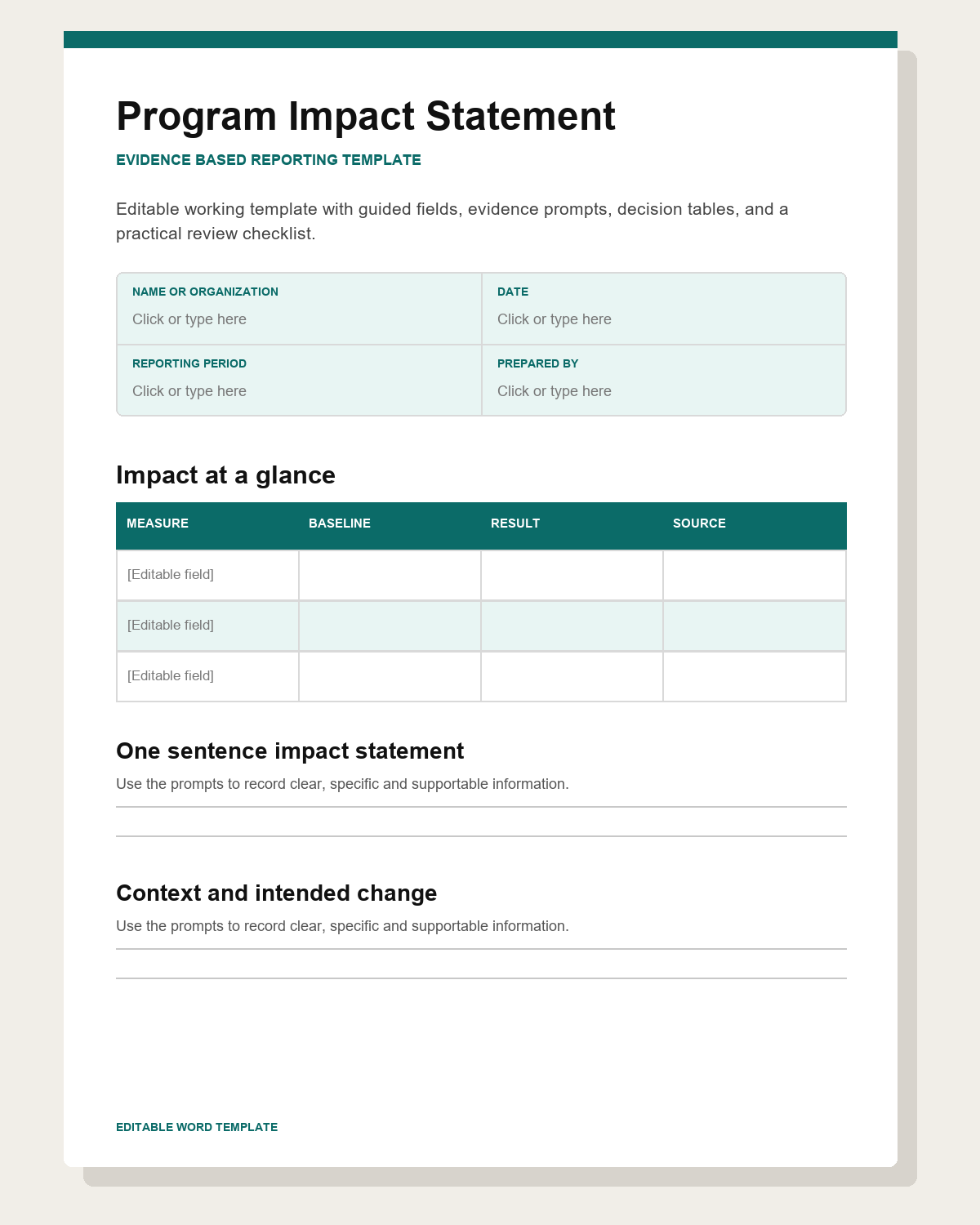
This teal report-style template is designed for a program, nonprofit, charity, community initiative, funded project, or service. It includes an impact-at-a-glance table, baseline and current results, a one-sentence impact summary, context and need, activities, outcomes, evidence quality, lived-experience examples, limitations, learning, next steps, and a final evidence checklist.
2. Research Impact Statement Template
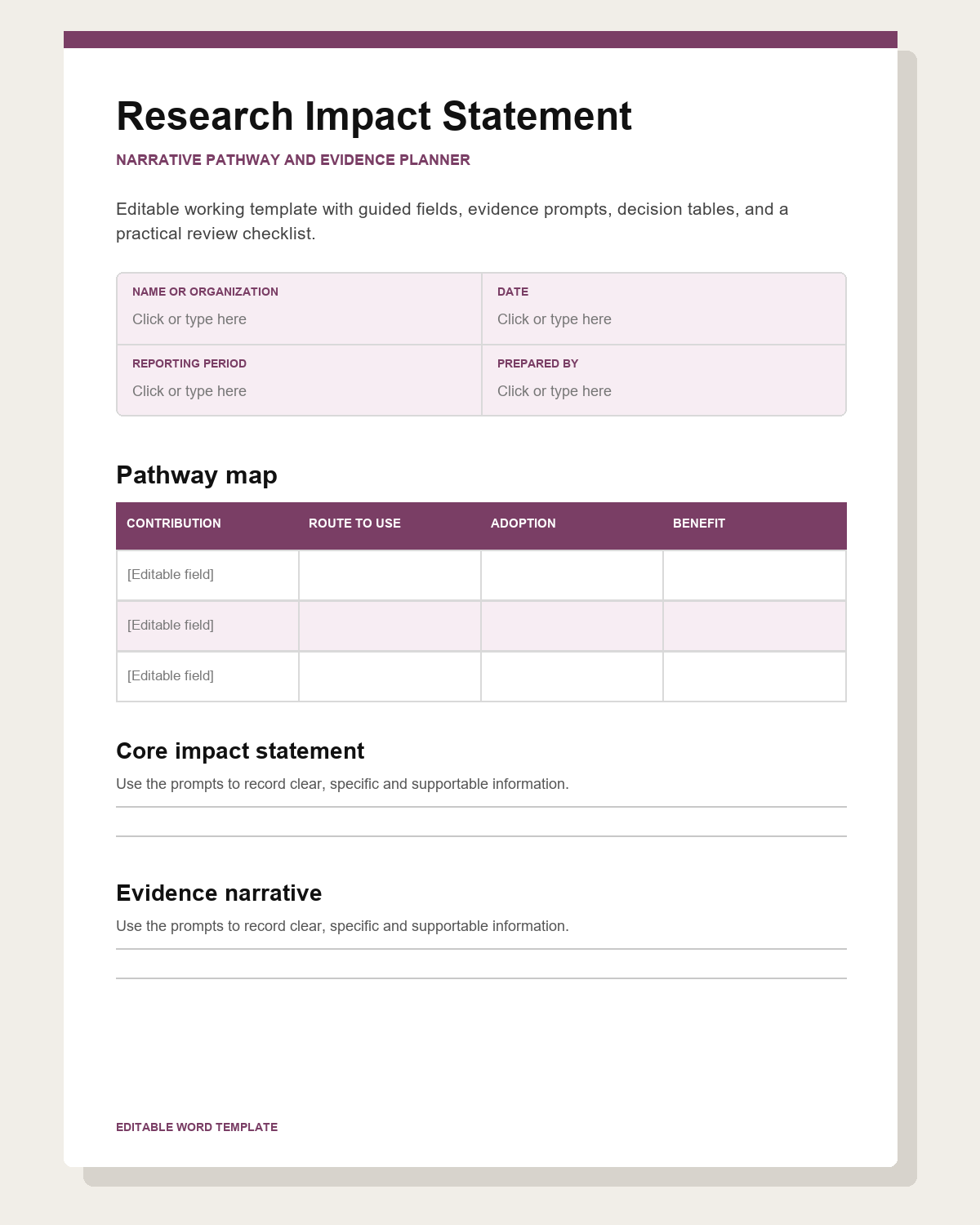
The plum research version uses a narrative pathway rather than a general program report. It helps connect a finding, method, dataset, tool, or other contribution to the people who used it, the route through which it was adopted, the change that followed, and the evidence that can verify the claim. It also includes sections for stakeholder verification, contribution, uncertainty, ethics, and future work.
What Is an Impact Statement?
An impact statement is a focused explanation of a meaningful change and the evidence for it. The word impact is used differently across organizations, but a useful statement normally goes beyond listing what was delivered. It shows the connection between an activity or contribution and an outcome for people, organizations, systems, policy, practice, knowledge, the economy, culture, health, or the environment.
For research, the ESRC describes impact as a demonstrable contribution that excellent research makes to society and the economy. Its guidance recognizes instrumental impact, such as changes in policy or practice; conceptual impact, such as reframing an issue; and capacity building. Requirements still vary by funder and institution, so always read the current instructions before using a general template.
Impact Statement vs. Output Report
An output is something produced or delivered: workshops held, people served, reports issued, tools built, datasets released, or partnerships formed. An outcome is a change that occurs after or because of those activities, such as improved knowledge, safer practice, greater access, reduced processing time, a changed policy, or adoption of a new method.
An impact statement should include outputs when they help explain scale or delivery, but it should not stop there. “We trained 200 participants” is an output. “Six months after training, 71% of surveyed participants reported using the procedure in their work” is an outcome claim that can be examined against a defined source, denominator, response rate, and reporting period.
What to Include in a Strong Impact Statement
- Context: the need, baseline condition, affected population, or problem addressed.
- Contribution: the activity, service, research finding, method, resource, or intervention connected to the change.
- Users or beneficiaries: the people, organizations, communities, sectors, or systems that used or experienced the work.
- Change: what became different in behavior, access, capability, performance, policy, practice, knowledge, health, wellbeing, culture, systems, or the environment.
- Evidence: records, measurements, surveys, interviews, independent reports, citations, usage data, testimony, or other sources that support the claim.
- Scale and significance: how broadly the change occurred and why it matters.
- Contribution and uncertainty: what role the work played, what other factors mattered, and what the evidence cannot establish.
- Next step: the decision, improvement, evaluation, or action that follows.
How to Write the One-Sentence Impact Summary
A useful summary usually answers four questions: who changed, what changed, during what period, and what contribution or activity is reasonably connected to the result. Add one concrete measure when it improves clarity.
A practical structure is: “During [period], [group] experienced [specific change], supported by [evidence], following [program, service, research use, or activity].” Treat this as a drafting structure, not as mandatory wording. If the evidence only shows association or contribution, avoid causal phrases such as “caused,” “proved,” or “resulted directly in.”
Choosing Evidence for an Impact Statement
Use evidence that fits the claim. Attendance records can establish reach, but they do not prove learning. A satisfaction survey can describe participants’ perceptions, but it may not demonstrate a lasting change in practice. Administrative records can show service use, but interpretation may require a baseline or comparator. Interviews can explain how and why change happened, but a small convenience sample should not be presented as representative of everyone.
Where possible, record the source, date, population, denominator, collection method, and known limitations. Triangulation can strengthen a statement: for example, usage data, an independent policy document, and stakeholder testimony may support different parts of the same pathway.
How to Use the Program Impact Statement Template
- Define the reporting period and audience before drafting.
- Choose a small number of outcome measures that reflect the program’s actual purpose.
- Record baseline and current values using the same definitions.
- Describe activities briefly, then give more space to outcomes and evidence.
- Include a lived-experience example only with appropriate consent and privacy protection.
- Separate contribution from attribution; acknowledge other programs, events, and conditions.
- Turn learning into a named decision, owner, and due date.
If the work began with a clearly defined need, our Statement of Need Templates can help document that earlier stage. For a project-specific challenge, the Project Problem Statement Templates provide a different planning format.
How to Use the Research Impact Statement Template
Begin with the research contribution, but do not treat the publication itself as the final impact. Explain how the finding, method, dataset, software, framework, or other contribution reached users. The route might include collaboration, professional guidance, training, licensing, policy engagement, standards work, clinical adoption, public programming, or a new service.
Then identify use or adoption. Who changed a decision, process, product, policy, method, service, or understanding? Finally, describe the resulting benefit and the evidence that supports it. UKRI guidance emphasizes engagement with research users and treating impact as part of the research process rather than as an afterthought.
Reach, Significance, and Contribution
Reach concerns extent: the number or range of people, organizations, places, systems, or sectors affected. Significance concerns importance: the depth, value, durability, or consequence of the change. A small but critical safety change may be highly significant even when its reach is limited. A widely downloaded resource may have broad reach but uncertain significance if use is not known.
Contribution explains the role played by the program or research. Complex outcomes rarely have one cause. A credible statement can be strong without claiming sole attribution. It is often more accurate to describe a contribution alongside other actors, policies, funding, market conditions, or community efforts.
Common Impact Statement Mistakes
- Using activity totals as the only evidence of impact.
- Making causal claims that the evaluation design cannot support.
- Reporting a percentage without the underlying number or denominator.
- Selecting only positive evidence and hiding contrary findings.
- Using one testimonial as proof of a result for everyone.
- Confusing media attention, downloads, or citations with demonstrated change.
- Leaving the reporting period, population, or source undefined.
- Overloading the statement with background while giving little space to the change.
- Including personal or sensitive information without consent or a clear need.
- Ignoring the specific format or definitions required by the funder or institution.
Final Review Checklist
- The main change is clear in the opening section.
- Outputs, outcomes, and impacts are not used interchangeably.
- Every important number has a source, date, and population.
- The statement distinguishes evidence from interpretation.
- Reach and significance are described accurately.
- Contribution is not overstated as sole causation.
- Limitations, missing data, and uncertainty are disclosed.
- Stakeholder quotations and personal data have appropriate permission.
- The final document follows the recipient’s current instructions.
Frequently Asked Questions
How long should an impact statement be?
Follow the receiving organization’s limit. A short internal summary may fit on one page, while a funder report or research assessment may require several sections and supporting evidence. Write to the decision the reader needs to make rather than filling space.
Can I use percentages without raw numbers?
It is usually clearer to provide both, such as “34 of 48 respondents (71%).” Also state the relevant population and response rate when those details affect interpretation.
Is a testimonial enough evidence?
A testimonial can illustrate experience or explain how change occurred, but it rarely establishes scale or representativeness on its own. Pair it with other suitable evidence when making a broader claim.
What is the difference between a research output and research impact?
An output is produced by the research, such as an article, dataset, tool, or method. Impact is a demonstrable contribution or change associated with the use of research in academia, society, the economy, policy, practice, culture, health, or the environment.
Can these templates be edited in Microsoft Word?
Yes. Both downloads are editable DOCX files. Replace the prompts, expand or remove tables, apply your organization’s branding, and adapt the headings to the reporting requirements you must follow.