
Every January, churches, charities and community groups send thousands of donors a summary of their giving. Done well, a donation statement is more than a tax document. It’s a thank-you note, a reminder of the difference the donor made and a chance to strengthen the relationship for the year ahead. A reliable donation statement template keeps the details accurate and the wording consistent, and makes it easy to produce statements for every donor on time.
This guide covers what a donation statement is and what it usually needs to include. It explains how deductible amounts work when donors receive something in return and how to keep a donation log that feeds your statements. It also covers non-cash gifts. Five free templates follow, with advice on filling them in.
What Is a Donation Statement?
A donation statement (also called a giving statement, contribution statement or donor acknowledgement) is a written record from a charitable organisation listing the gifts a donor made over a period, usually a calendar year. Donors keep it as evidence for tax deductions or credits where these are available, and as a personal record of their giving.
Organisations typically issue statements:
- Annually, by the end of January for the previous calendar year
- Quarterly, for regular givers and pledges
- Per gift, as an immediate receipt for larger or one-off donations
The details required vary by country. In the US, IRS Publication 1771 sets out what a written acknowledgement must contain for gifts of $250 or more. In other countries, schemes such as UK Gift Aid declarations or Canadian official donation receipts have their own rules. The templates follow widely used good practice, but always check the specific requirements for your organisation and country.
What to Include in a Donation Statement
- Organisation name, address and registration or tax ID number
- Donor name and address
- Statement date and the period covered
- Each gift: date, amount, method (cheque, cash, card, online) and the fund or campaign it went to
- Total contributions for the period
- A statement on whether any goods or services were provided in return and, if so, a good-faith estimate of their value
- For religious organisations, where applicable, the wording that only intangible religious benefits were provided
- For non-cash gifts, a description of the items, but not a valuation
- A thank-you message and a signature from an authorised person
Download 5 Free Donation Statement Templates
Each template suits a different kind of giving: regular church offerings, event-based fundraising, many donors across many funds, pledges and non-cash gifts. The Excel templates total gifts per donor and per fund automatically.
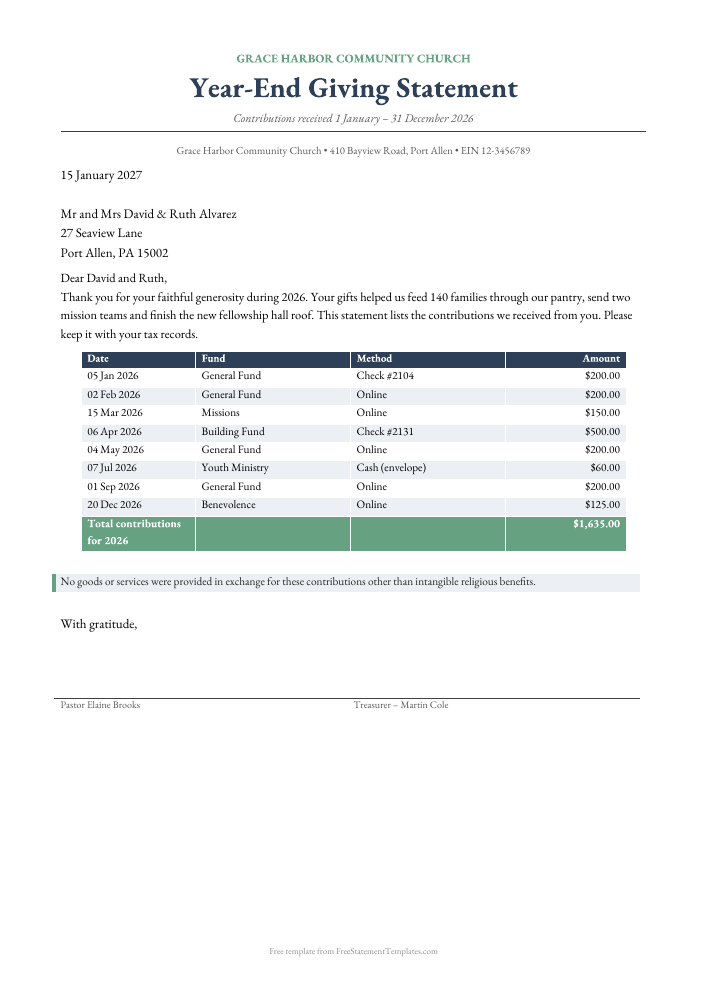
1. Year-End Giving Statement (Church)
A warm, letter-style annual statement for churches. It lists each gift by date, fund and method, gives the year total and includes the standard “intangible religious benefits” wording.
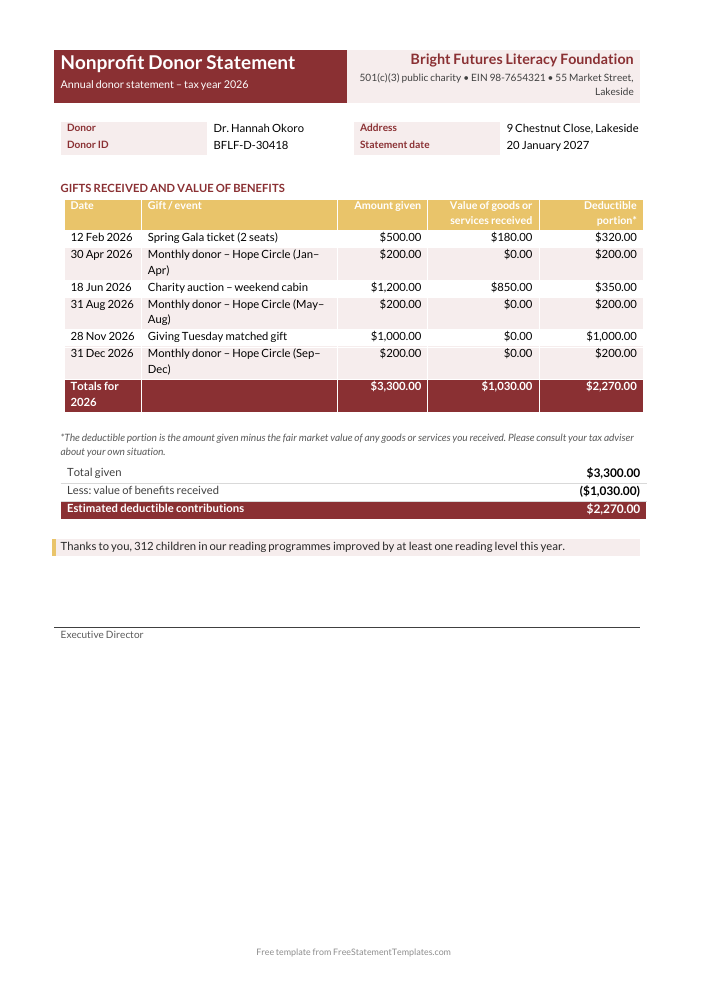
2. Nonprofit Donor Statement with Deductible Amounts
For charities whose donors attend galas, auctions or ticketed events. It shows the amount given, the value of benefits received and the deductible portion for each gift.
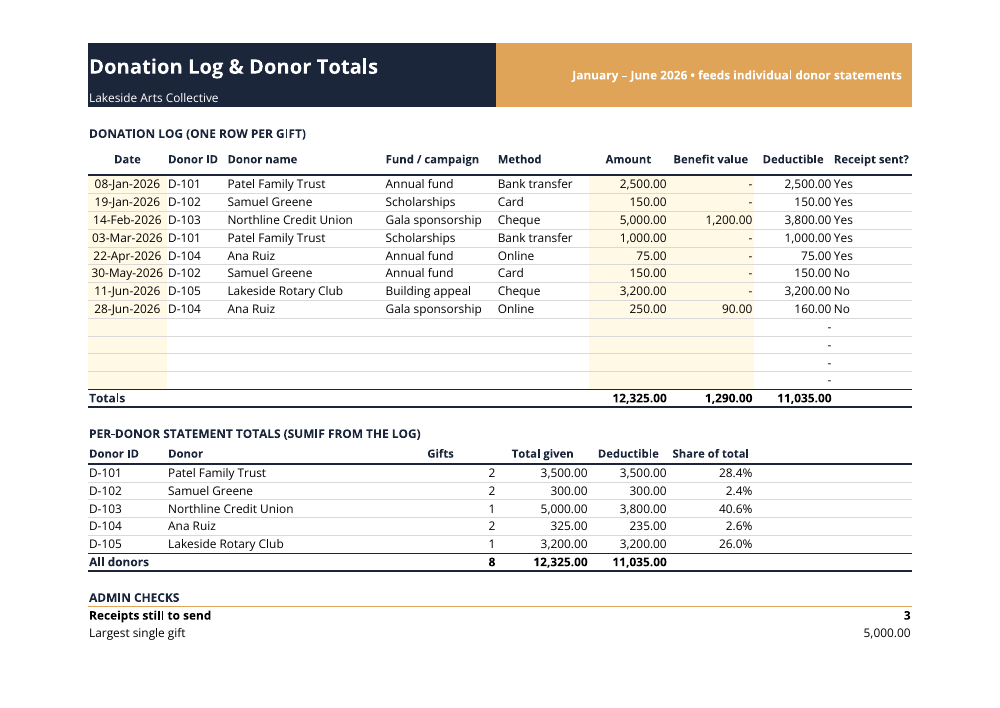
3. Donation Log & Donor Statement Summary
Record every gift in one log. SUMIF and COUNTIF formulas then total each donor’s gifts, ready to copy into individual statements, and count the receipts still to send.
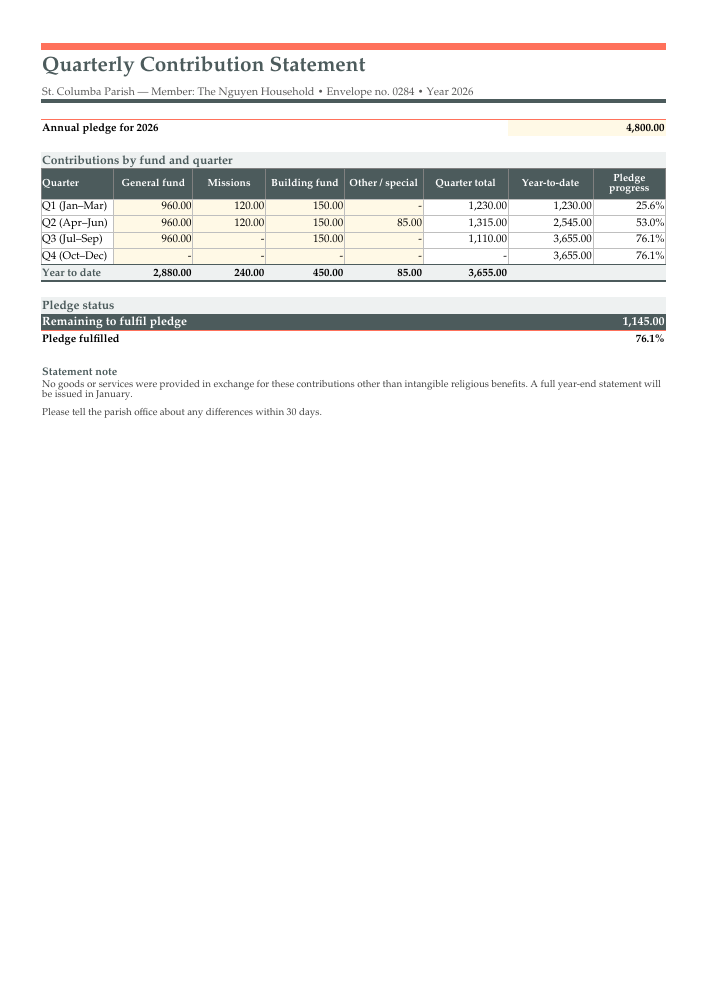
4. Quarterly Contribution Statement
A quarterly statement by fund, with year-to-date totals and progress towards the member’s annual pledge.
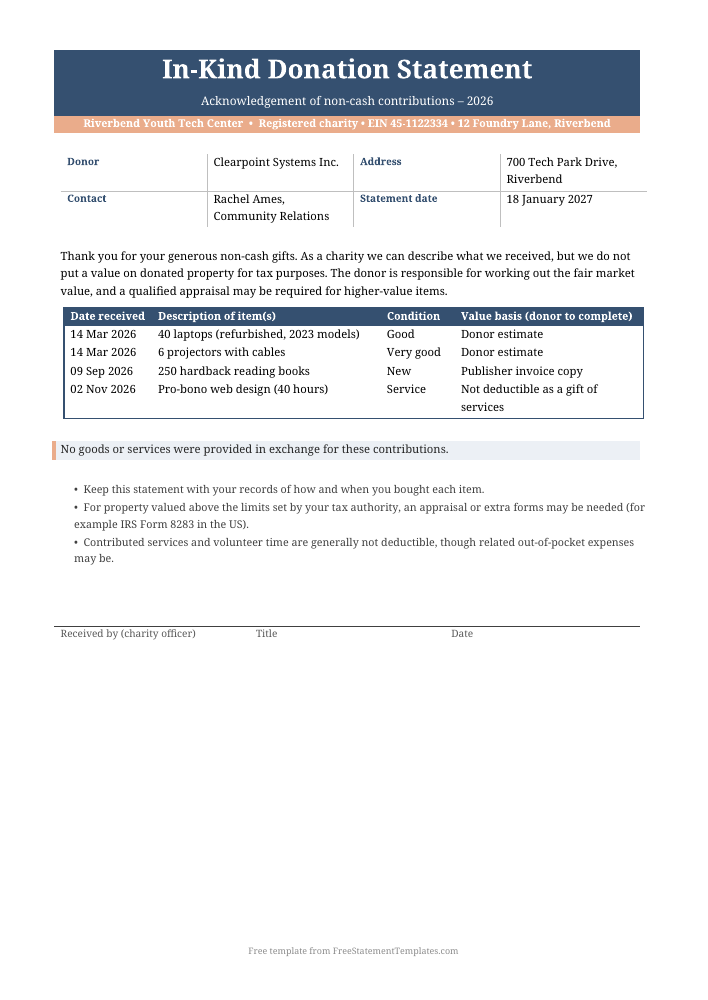
5. In-Kind Donation Statement
An acknowledgement for donated goods and services. It describes the items without valuing them and gives the donor guidance on valuation and appraisal.
How to Prepare Year-End Giving Statements
- Close the giving year. Make sure every gift received by 31 December is recorded, including online gifts that settle in early January but were made in December.
- Reconcile the donation log to the bank. Total gifts in your log should match deposits in your bank statement, after allowing for payment processor fees and timing.
- Check donor details. Update addresses and merge duplicate donor records so no one gets two statements or a partial one.
- Generate each statement. List every gift for the donor with its date, fund and method, and total the year.
- Add the goods-and-services wording. Use the standard sentence when nothing was given in return. Where donors received benefits, such as a gala dinner, show the value and the deductible portion.
- Write a short, specific thank-you. Mention a concrete result the donor’s giving supported.
- Sign and send by the end of January, by post or email, and keep a copy.
Gifts With Benefits: Working Out the Deductible Portion
When a donor receives something in return, such as an event ticket, a meal, merchandise or an auction item, only the amount above the fair market value of that benefit is generally treated as a charitable gift. Say a donor pays $500 for two gala seats and the dinner and entertainment are worth $180. The deductible portion is then $320. The nonprofit donor statement template has columns for the amount given, the value of goods or services received and the deductible portion, with totals for the year. The organisation estimates the value of benefits in good faith. It is up to donors and their tax advisers to decide what they actually claim.
Keeping a Donation Log
Statements are only as accurate as the records behind them. The donation log template has one row per gift with the date, donor ID, name, fund or campaign, method, amount, benefit value and whether a receipt has been sent. A second table uses COUNTIF and SUMIF formulas to total each donor’s gifts and deductible amounts automatically. You can copy those totals straight into individual statements. An admin check counts receipts still to send and shows the largest single gift, which can be a useful prompt for a personal thank-you call.
Quarterly and Pledge Statements
Many churches and membership organisations send statements every quarter so givers can track progress towards an annual pledge. The quarterly template shows contributions by fund for each quarter, a running year-to-date total and pledge progress as a percentage. It also shows how much remains to fulfil the pledge. A short reminder like this often encourages regular giving without any hard sell.
In-Kind (Non-Cash) Donations
Donated goods such as equipment, books, food, vehicles or property need a slightly different statement. Generally the charity describes what it received and its condition but does not put a value on it. Valuation is the donor’s responsibility, and higher-value items may need a qualified appraisal and extra tax forms. Donated services, such as volunteer time or pro-bono work, are usually not deductible as gifts, although related out-of-pocket expenses sometimes are. The in-kind template reflects these points and leaves the value basis for the donor to complete.
Common Mistakes in Donation Statements
- Leaving out the goods-and-services sentence. For gifts that require a written acknowledgement, the missing wording can mean the donor can’t support the deduction.
- Counting the full event ticket as a gift. Deduct the fair market value of meals, entertainment or auction items to show the deductible portion.
- Putting values on donated goods. Describe in-kind gifts, but leave the valuation to the donor.
- Using the wrong year. A cheque dated 31 December and posted that day generally counts for that year, even if it’s banked in January. Check the rules that apply to you.
- Combining spouses or households inconsistently. Decide whether statements go to individuals or households, then apply the same rule every year.
- Including sensitive identifiers. Donation statements don’t need social security or national ID numbers, so leave them off.
Fixing these points before statements go out avoids awkward corrections in February, when donors are already preparing their returns. Our statement of account templates can also help if you need to track pledges owed rather than gifts received.
Best Practices for Donation Statements
- Be accurate before anything else. One wrong total damages trust more than a plain design ever could.
- Be timely. Donors preparing tax returns will be waiting for your statement.
- Be personal. Use first names and mention the impact their giving had.
- Protect donor data. Statements contain personal and financial information, so email them securely and never send them to shared addresses without consent.
- Keep copies of every statement issued, together with your reconciled donation log.
For mission-driven organisations, a well-written mission statement and an impact statement can sit alongside your giving statement and show donors the bigger picture. Browse more templates in our Business Statements category.
Frequently Asked Questions
What is the difference between a donation receipt and a donation statement?
A donation receipt usually acknowledges a single gift, often issued straight away. A donation statement summarises all of a donor’s gifts over a period, typically a year. Many organisations issue receipts for one-off gifts and an annual statement for regular donors.
When should donation statements be sent?
Year-end statements are typically sent by 31 January for the previous calendar year, so donors have them in time for their tax returns. In the US, donors need a written acknowledgement for gifts of $250 or more by the time they file, and sending by the end of January is standard practice.
What does “no goods or services were provided” mean?
It confirms that the donor received nothing of value in exchange for the gift, so the full amount may be treated as a charitable contribution. If the donor did receive something, such as a dinner or event ticket, the statement should describe it and give a good-faith estimate of its value instead.
Should a donation statement include the value of donated items?
Usually not. The charity should describe non-cash items and their condition, and the donor determines the value, with an appraisal where the rules require one. Putting your own valuation on donated goods can cause problems for both the donor and the organisation.
Can I send donation statements by email?
Yes. Electronic acknowledgements are widely accepted, including by the IRS in the US. Send them as a PDF from a secure system and make sure the donor has agreed to receive them by email.
Do small organisations need a donation log?
Yes. Even a small church or club should record every gift as it arrives. A simple log, like the Excel template here, makes year-end statements quick to prepare, supports your financial reports and helps if your records are ever reviewed.
Final Thoughts
A donation statement is often the most important message a donor gets from you all year. Keep a clean donation log, reconcile it to the bank, apply the right wording for gifts with or without benefits, and send personal, accurate statements on time. Done well, it confirms the gift and encourages the next one.