
A capability statement is a short business-credentials document designed for people who need to understand a company quickly. Rather than reading a long brochure, a buyer can scan the company’s core services, relevant experience, differentiators, identifiers or certifications, and contact details on one focused page.
The two free capability statement templates below are intentionally different. The first is structured for government contractors and subcontractors that need space for items such as UEI, CAGE, NAICS and past performance. The second is a cleaner commercial-business version for consultants, service companies, vendors and small businesses that want to present capabilities without government-specific fields.
Download the Free Capability Statement Templates
Start with the version that matches the audience you are approaching. Both files are editable in Microsoft Word and other programs that support RTF files. Replace the bracketed prompts with verified company information, then save a PDF copy before sending the final document.
1. Government Contractor Capability Statement Template
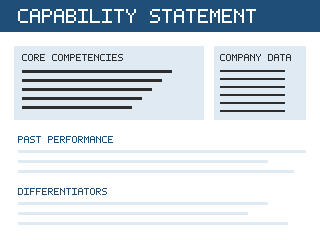
This version is organized around the information procurement teams and prime contractors commonly look for when screening potential vendors: core competencies, past performance, differentiators, company data, certifications and a direct contact block. The layout is deliberately concise so you can tailor the page to a specific agency, opportunity or teaming conversation.
2. Business Capability Statement Template
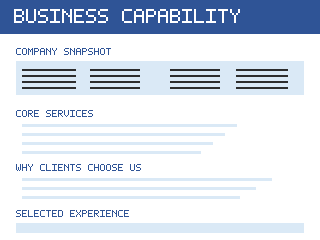
The commercial version removes the federal-data emphasis and gives more room to explain services, markets served, selected experience and the reasons clients choose the business. It works well as a concise introduction for consultants, maintenance providers, professional-service firms, suppliers, technology companies and other organizations that need a polished one-page company summary.
What Makes a Capability Statement Useful?
A capability statement is not simply an “About Us” page placed into Word. Its value comes from selection. The document should help a reader decide whether your company appears relevant enough for a follow-up conversation, request for information, vendor review or subcontracting discussion.
That means the strongest version is rarely the one containing the most text. A useful statement removes general claims and keeps information that supports the buyer’s current need. If a facilities manager is sourcing preventive-maintenance support, for example, experience in an unrelated service line may be less valuable than response coverage, technician qualifications, relevant contracts and measurable service results.
What to Include in a Government Capability Statement
The exact content should reflect the opportunity and the company, but a practical government contractor capability statement usually needs several clearly separated blocks.
- Core competencies: List the services or products you can actually deliver. Specific wording such as “cloud migration for Microsoft 365 environments” is more useful than a broad label such as “IT solutions.”
- Past performance: Select projects that resemble the target work in scope, complexity, customer type, geography or delivery conditions. Add dates and measurable outcomes when they can be verified.
- Differentiators: Explain why your company is a particularly relevant option. Capacity, specialized equipment, response time, certifications, technical expertise and proven processes can be differentiators when they are real and meaningful.
- Company data: Add identifiers such as UEI, CAGE, NAICS or PSC only when they apply to your business and are current. Do not fill the page with codes that do not help the intended reader.
- Certifications and status: List current designations, licenses or quality credentials accurately. Avoid implying that a certification is held when it is pending, expired or not applicable.
- Contact information: Give the buyer one obvious person to contact, with a direct phone number, email address and website.
A Different Approach for Commercial Clients
A general business capability statement can be less code-driven and more outcome-driven. A commercial buyer may care more about service coverage, industry experience, turnaround time, implementation capacity, quality controls and examples of similar work than government registration details.
For that reason, the second template begins with a company snapshot and a short “what we do” section before moving into core services, differentiators and selected experience. This creates a document that can be attached to an introductory email, vendor-registration package or early-stage sales conversation without feeling like a federal contracting form.
Capability Statement Example: Replace Claims with Evidence
Generic wording consumes space without giving the reader much to evaluate. Compare these two approaches:
Too vague: “We provide high-quality professional services and always put the customer first.”
More useful: “Our eight-person field team provides scheduled and emergency HVAC maintenance across three counties, with 24-hour callout coverage and documented preventive-maintenance checklists for each site.”
The second version is stronger because it gives the reader information that can be matched to a requirement. Apply the same test to each section: could a buyer use this sentence to understand capability, relevance or evidence? If not, revise it or remove it.
How to Tailor the Template Before Sending It
- Identify the reader. A contracting officer, prime contractor, corporate procurement team and potential commercial client may each need a slightly different version.
- Match the language to the opportunity. Use the terminology that appears in the buyer’s requirement where it accurately describes your own services.
- Choose relevant proof. Feature two or three past-performance examples that most closely resemble the work you want, rather than listing every customer you have served.
- Check every identifier and claim. Confirm contact details, registrations, certifications, dates, contract descriptions and numbers before distribution.
- Export a clean PDF. Keep the editable master file, but send a PDF when you want the layout to remain stable across devices.
Common Problems That Weaken a Capability Statement
- Trying to describe every service the company has ever offered.
- Using marketing adjectives where facts or outcomes would be more persuasive.
- Copying the same capability statement for every agency, buyer or opportunity.
- Listing past performance that has little connection to the target work.
- Using outdated CAGE, UEI, NAICS, certification or contact information.
- Making the page visually dense with tiny text, long paragraphs or unnecessary graphics.
- Claiming certifications, capacity or experience that cannot be supported.
Capability Statement vs. Company Profile vs. Proposal
| Document | Main Purpose | Typical Level of Detail |
|---|---|---|
| Capability Statement | Show what the company can do and why it is relevant | Concise, often one or two pages |
| Company Profile | Introduce the organization more broadly | Can include history, team, markets, values and services |
| Proposal | Respond to a defined need with a specific approach, scope and commercial offer | Usually much more detailed and opportunity-specific |
If the conversation moves from capability screening to a defined project, you may also need a Statement of Work template. For broader organization messaging, see the site’s Business Statement templates.
Frequently Asked Questions
How long should a capability statement be?
Keep it as short as the audience allows while preserving useful evidence. Many capability statements work best as one focused page; a second page may be justified when relevant experience or technical information cannot be presented clearly on one.
Do I need a UEI or CAGE code on every capability statement?
No. Include government identifiers when they apply to your company and matter to the intended reader. A commercial capability statement may not need them at all.
Can I edit these templates in Microsoft Word?
Yes. Both downloads use RTF, an editable Word-compatible format. You can change the wording, fonts, spacing, logo and sections, then save the finished document as DOCX or PDF if preferred.
Should every client receive the same capability statement?
Usually not. Keep a strong master version, then adjust competencies, examples and emphasis so the document reflects the target client or opportunity without changing verified facts.
Can a consultant or freelancer use a capability statement?
Yes. A solo consultant can use the same structure by focusing on specialist services, qualifications, representative engagements, results and direct contact information.